

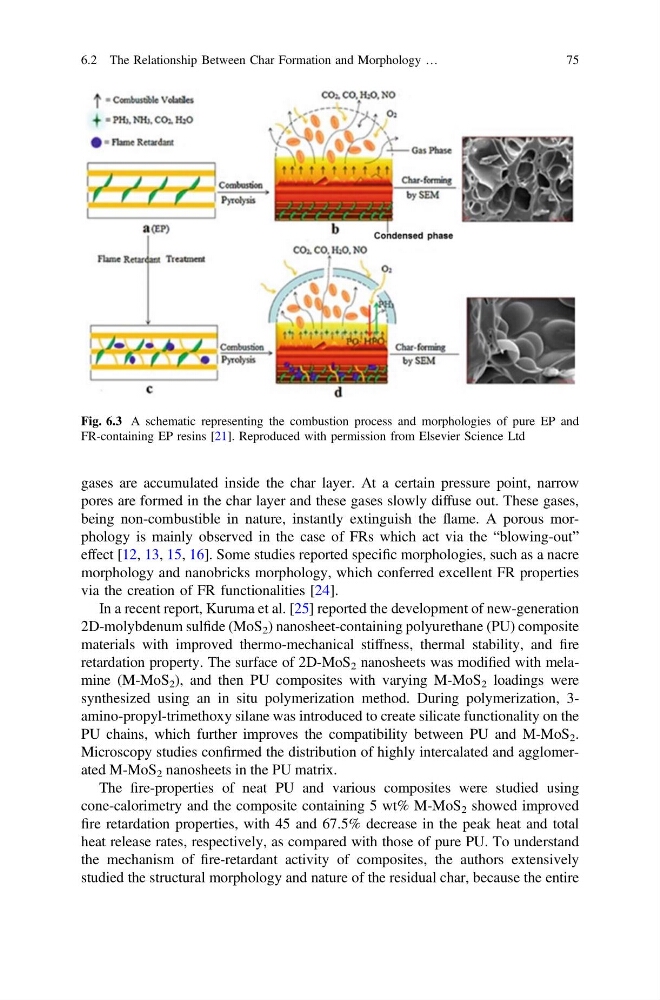
gases are accumulated inside the char layer. At a certain pressure point, narrow
pores are formed in the char layer and these gases slowly diffuse out. These gases,
being non-combustible in nature, instantly extinguish the flame. A porous morphology is mainly observed in the case of FRs which act via the “blowing-out”
effect [12, 13, 15, 16]. Some studies reported specific morphologies, such as a nacre
morphology and nanobricks morphology, which conferred excellent FR properties
via the creation of FR functionalities [24].
In a recent report, Kuruma et al. [25] reported the development of new-generation
2D-molybdenum sulfide (MoS 2 ) nanosheet-containing polyurethane (PU) composite
materials with improved thermo-mechanical stiffness, thermal stability, and fire
retardation property. The surface of 2D-MoS 2 nanosheets was modified with melamine (M-MoS 2 ), and then PU composites with varying M-MoS 2 loadings were
synthesized using an in situ polymerization method. During polymerization, 3amino-propyl-trimethoxy silane was introduced to create silicate functionality on the
PU chains, which further improves the compatibility between PU and M-MoS 2 .
Microscopy studies confirmed the distribution of highly intercalated and agglomerated M-MoS 2 nanosheets in the PU matrix.
The fire-properties of neat PU and various composites were studied using
cone-calorimetry and the composite containing 5 wt% M-MoS 2 showed improved
fire retardation properties, with 45 and 67.5% decrease in the peak heat and total
heat release rates, respectively, as compared with those of pure PU. To understand
the mechanism of fire-retardant activity of composites, the authors extensively
studied the structural morphology and nature of the residual char, because the entire
Fig. 6.3 A schematic representing the combustion process and morphologies of pure EP and
FR-containing EP resins [21]. Reproduced with permission from Elsevier Science Ltd
6.2 The Relationship Between Char Formation and Morphology …
75
pores are formed in the char layer and these gases slowly diffuse out. These gases,
being non-combustible in nature, instantly extinguish the flame. A porous morphology is mainly observed in the case of FRs which act via the “blowing-out”
effect [12, 13, 15, 16]. Some studies reported specific morphologies, such as a nacre
morphology and nanobricks morphology, which conferred excellent FR properties
via the creation of FR functionalities [24].
In a recent report, Kuruma et al. [25] reported the development of new-generation
2D-molybdenum sulfide (MoS 2 ) nanosheet-containing polyurethane (PU) composite
materials with improved thermo-mechanical stiffness, thermal stability, and fire
retardation property. The surface of 2D-MoS 2 nanosheets was modified with melamine (M-MoS 2 ), and then PU composites with varying M-MoS 2 loadings were
synthesized using an in situ polymerization method. During polymerization, 3amino-propyl-trimethoxy silane was introduced to create silicate functionality on the
PU chains, which further improves the compatibility between PU and M-MoS 2 .
Microscopy studies confirmed the distribution of highly intercalated and agglomerated M-MoS 2 nanosheets in the PU matrix.
The fire-properties of neat PU and various composites were studied using
cone-calorimetry and the composite containing 5 wt% M-MoS 2 showed improved
fire retardation properties, with 45 and 67.5% decrease in the peak heat and total
heat release rates, respectively, as compared with those of pure PU. To understand
the mechanism of fire-retardant activity of composites, the authors extensively
studied the structural morphology and nature of the residual char, because the entire
Fig. 6.3 A schematic representing the combustion process and morphologies of pure EP and
FR-containing EP resins [21]. Reproduced with permission from Elsevier Science Ltd
6.2 The Relationship Between Char Formation and Morphology …
75