

94
at ∅
′
→ e
iα(x)
∅. Therefore, the induced cool-state photons will be converted into
heat-state photons. This procedure could be described using a functional divergent
considering a distinctive reformation law of the scalar field, described in [14, 17]:
∂ →
= ∂ =
[
]
=
+ ∂
′
µ
µ
µ
µ
µ
µ
µ
µ
α
D
i eA
A
A e
A
covariant derivatives
derivati
1
v ves
,
(5.26)
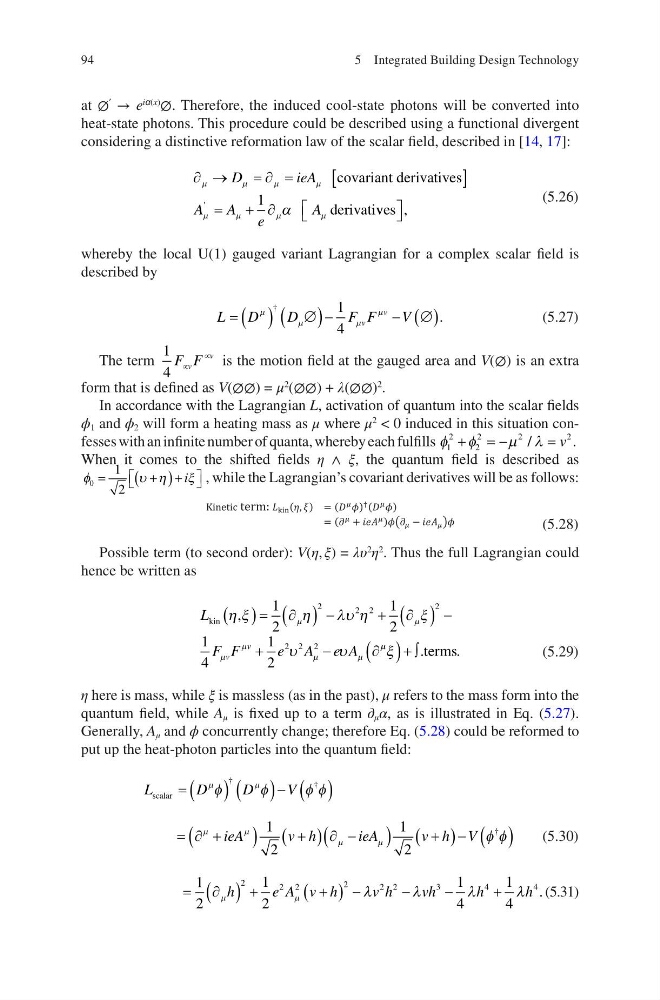
whereby the local U(1) gauged variant Lagrangian for a complex scalar field is
described by
L
D
D
F F
V
v
v
= ( ) ∅
( ) −
− ∅
( )
µ
µ
µ
µ
†
.
1
4
(5.27)
The term
1
4
F F
v
v
∝
∝ is the motion field at the gauged area and V(∅) is an extra
form that is defined as V(∅∅) = μ
2
(∅∅) + λ(∅∅)
2
.
In accordance with the Lagrangian L, activation of quantum into the scalar fields
ϕ 1 and ϕ 2 will form a heating mass as μ where μ
2
< 0 induced in this situation confesses with an infinite number of quanta, whereby each fulfills φ φ
µ λ
1
2
2
2
2
2
+ = −
=
/
.
v
When it comes to the shifted fields η ∧ ξ, the quantum field is described as
φ
υ η
ξ
0
1
2
=
+
(
)+
i , while the Lagrangian’s covariant derivatives will be as follows:
(5.28)
Possible term (to second order): V(η, ξ) = λυ
2
η
2
. Thus the full Lagrangian could
hence be written as
L
F F
e A e A
v
v
kin
,
η ξ
η
λυ η
ξ
υ
υ
µ
µ
µ
µ
µ
µ
( )= ∂
( ) −
+ ∂
( ) −
+
−
∂
1
2
1
2
1
4
1
2
2
2 2
2
2 2 2
µ µ
ξ
( ) + ∫. .
terms
(5.29)
η here is mass, while ξ is massless (as in the past), μ refers to the mass form into the
quantum field, while A μ is fixed up to a term ∂ μ α, as is illustrated in Eq. (5.27).
Generally, A μ and ϕ concurrently change; therefore Eq. (5.28) could be reformed to
put up the heat-photon particles into the quantum field:
L
D
D
V
scalar = ( ) ( ) − ( )
µ
µ
φ
φ
φ φ
†
†
= ∂ +
(
)
+
( ) ∂ −
(
)
+
( )− ( )
µ
µ
µ
µ
φ φ
ieA
v h
ieA
v h V
1
2
1
2
†
(5.30)
= ∂
( ) +
+
( ) −
−
−
+
1
2
1
2
1
4
1
4
2
2 2
2
2 2
3
4
4
µ
µ
λ
λ
λ
λ
h
e A v h
v h
vh
h
h . (5.31)
5 Integrated Building Design Technology
at ∅
′
→ e
iα(x)
∅. Therefore, the induced cool-state photons will be converted into
heat-state photons. This procedure could be described using a functional divergent
considering a distinctive reformation law of the scalar field, described in [14, 17]:
∂ →
= ∂ =
[
]
=
+ ∂
′
µ
µ
µ
µ
µ
µ
µ
µ
α
D
i eA
A
A e
A
covariant derivatives
derivati
1
v ves
,
(5.26)
whereby the local U(1) gauged variant Lagrangian for a complex scalar field is
described by
L
D
D
F F
V
v
v
= ( ) ∅
( ) −
− ∅
( )
µ
µ
µ
µ
†
.
1
4
(5.27)
The term
1
4
F F
v
v
∝
∝ is the motion field at the gauged area and V(∅) is an extra
form that is defined as V(∅∅) = μ
2
(∅∅) + λ(∅∅)
2
.
In accordance with the Lagrangian L, activation of quantum into the scalar fields
ϕ 1 and ϕ 2 will form a heating mass as μ where μ
2
< 0 induced in this situation confesses with an infinite number of quanta, whereby each fulfills φ φ
µ λ
1
2
2
2
2
2
+ = −
=
/
.
v
When it comes to the shifted fields η ∧ ξ, the quantum field is described as
φ
υ η
ξ
0
1
2
=
+
(
)+
i , while the Lagrangian’s covariant derivatives will be as follows:
(5.28)
Possible term (to second order): V(η, ξ) = λυ
2
η
2
. Thus the full Lagrangian could
hence be written as
L
F F
e A e A
v
v
kin
,
η ξ
η
λυ η
ξ
υ
υ
µ
µ
µ
µ
µ
µ
( )= ∂
( ) −
+ ∂
( ) −
+
−
∂
1
2
1
2
1
4
1
2
2
2 2
2
2 2 2
µ µ
ξ
( ) + ∫. .
terms
(5.29)
η here is mass, while ξ is massless (as in the past), μ refers to the mass form into the
quantum field, while A μ is fixed up to a term ∂ μ α, as is illustrated in Eq. (5.27).
Generally, A μ and ϕ concurrently change; therefore Eq. (5.28) could be reformed to
put up the heat-photon particles into the quantum field:
L
D
D
V
scalar = ( ) ( ) − ( )
µ
µ
φ
φ
φ φ
†
†
= ∂ +
(
)
+
( ) ∂ −
(
)
+
( )− ( )
µ
µ
µ
µ
φ φ
ieA
v h
ieA
v h V
1
2
1
2
†
(5.30)
= ∂
( ) +
+
( ) −
−
−
+
1
2
1
2
1
4
1
4
2
2 2
2
2 2
3
4
4
µ
µ
λ
λ
λ
λ
h
e A v h
v h
vh
h
h . (5.31)
5 Integrated Building Design Technology