

93
To be specific, I first of all took into consideration the PB as the Fock cooling
determination n 0 , i. e. , ρ(t 0 ) = |n 0 ⟩⟨n 0 |, which is theoretically acquired via quantum
field [2, 24, 36], and at that point, through solving Eq. (5.1), taking into account the
cool photonic induction state at time t:
ρ t
P
t n n
n
n
n
( ) =
( )
=
∞
( )
∑
0
0 0
0
(5.24)
P
t
v t t
v t t
t
x
n
n
n
n
n
k
n
0
0
0
1
1
1
0
( )
+
=
( ) =
( )
+ ( )
− ( )
,
,
,
Ω
min
n n
k
n
k
n
k v t t
t
t
{ }
∑
( )
( )
− ( )
0
1
1
,
Ω
Ω
, (5.25)
whereby
Ω t
u t t
v t t
( ) =
( )
+ ( )
,
,
0
2
1
. This outcome recommends a prompt into dynamic
states P
t
n
n
n 0
0
( )
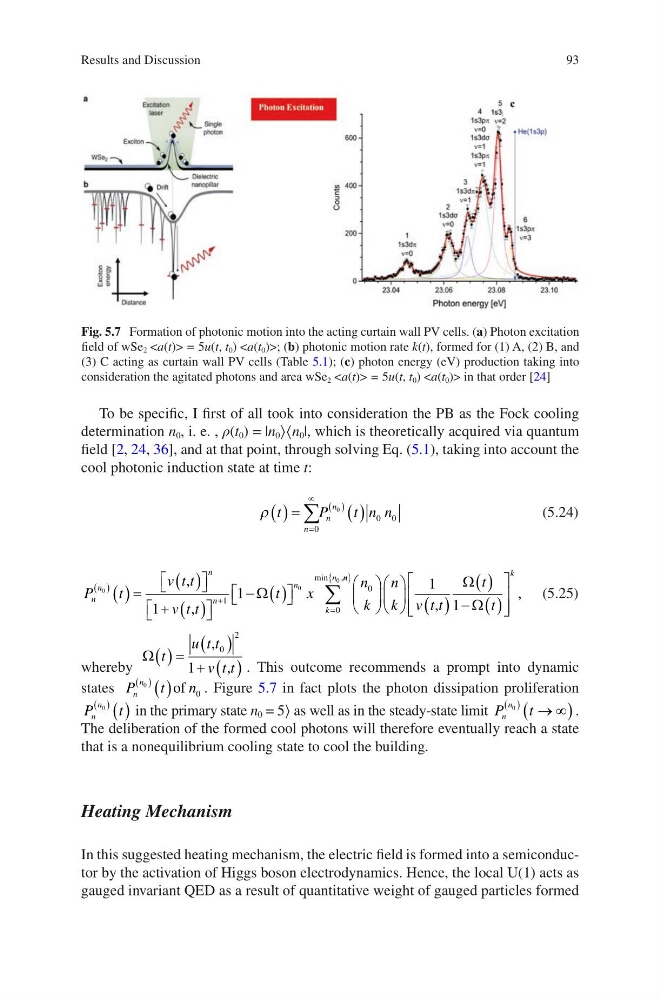
( )of . Figure 5.7 in fact plots the photon dissipation proliferation
P
t
n
n 0
( )
( ) in the primary state n 0 = 5⟩ as well as in the steady-state limit P t
n
n 0
( )
→ ∞
(
).
The deliberation of the formed cool photons will therefore eventually reach a state
that is a nonequilibrium cooling state to cool the building.
Heating Mechanism
In this suggested heating mechanism, the electric field is formed into a semiconductor by the activation of Higgs boson electrodynamics. Hence, the local U(1) acts as
gauged invariant QED as a result of quantitative weight of gauged particles formed
Fig. 5.7 Formation of photonic motion into the acting curtain wall PV cells. (a) Photon excitation
field of wSe 2 = 5u(t, t 0 ) ; (b) photonic motion rate k(t), formed for (1) A, (2) B, and
(3) C acting as curtain wall PV cells (Table 5.1); (c) photon energy (eV) production taking into
consideration the agitated photons and area wSe 2 = 5u(t, t 0 ) in that order [24]
Results and Discussion
To be specific, I first of all took into consideration the PB as the Fock cooling
determination n 0 , i. e. , ρ(t 0 ) = |n 0 ⟩⟨n 0 |, which is theoretically acquired via quantum
field [2, 24, 36], and at that point, through solving Eq. (5.1), taking into account the
cool photonic induction state at time t:
ρ t
P
t n n
n
n
n
( ) =
( )
=
∞
( )
∑
0
0 0
0
(5.24)
P
t
v t t
v t t
t
x
n
n
n
n
n
k
n
0
0
0
1
1
1
0
( )
+
=
( ) =
( )
+ ( )
− ( )
,
,
,
Ω
min
n n
k
n
k
n
k v t t
t
t
{ }
∑
( )
( )
− ( )
0
1
1
,
Ω
Ω
, (5.25)
whereby
Ω t
u t t
v t t
( ) =
( )
+ ( )
,
,
0
2
1
. This outcome recommends a prompt into dynamic
states P
t
n
n
n 0
0
( )
( )of . Figure 5.7 in fact plots the photon dissipation proliferation
P
t
n
n 0
( )
( ) in the primary state n 0 = 5⟩ as well as in the steady-state limit P t
n
n 0
( )
→ ∞
(
).
The deliberation of the formed cool photons will therefore eventually reach a state
that is a nonequilibrium cooling state to cool the building.
Heating Mechanism
In this suggested heating mechanism, the electric field is formed into a semiconductor by the activation of Higgs boson electrodynamics. Hence, the local U(1) acts as
gauged invariant QED as a result of quantitative weight of gauged particles formed
Fig. 5.7 Formation of photonic motion into the acting curtain wall PV cells. (a) Photon excitation
field of wSe 2
(3) C acting as curtain wall PV cells (Table 5.1); (c) photon energy (eV) production taking into
consideration the agitated photons and area wSe 2
Results and Discussion