

92
The frequency ω b in Eq. (5.2) here stands for the cool photon frequency module
in the PBG (0 < ω b < ω e ), computed under the pole condition ω b − ω c − ∆(ω b ) = 0,
in which ∆ ( )= ∫
( )
−
′
′
′
ω
ω
ω
ω ω
P d
J
is a very important principal value.
In Fig. 5.7a, the cool photon motion of the formation magnitude |u(t, t 0 )| is computed in A, B, and C photonic structures for several structure δ and incorporated into
the PB area from the PBG area [38, 39]. The rates of cool photon motion κ(t) are
generated in Fig. 5.7b. The outcomes point out that the moment ω c is transferred
into the PB area from the PBG area; the rate of generating dynamic photons becomes
very high. Since the range of u(t, t 0 ) is 1 ≥ |u(t, t 0 )| ≥ 0, I have defined the crossover
area to fulfill 0.9 ≿ |u(t → ∞, t 0 )| ≥ 0. This represents −0.025ω e ≲ δ ≲ 0.025ω e , at a
cool photonic motion rate κ(t) at the PBG (δ ← 0.025ω e ) and close to the PBE
(−0.025ω e ≲ δ ≲ 0.025ω e ).
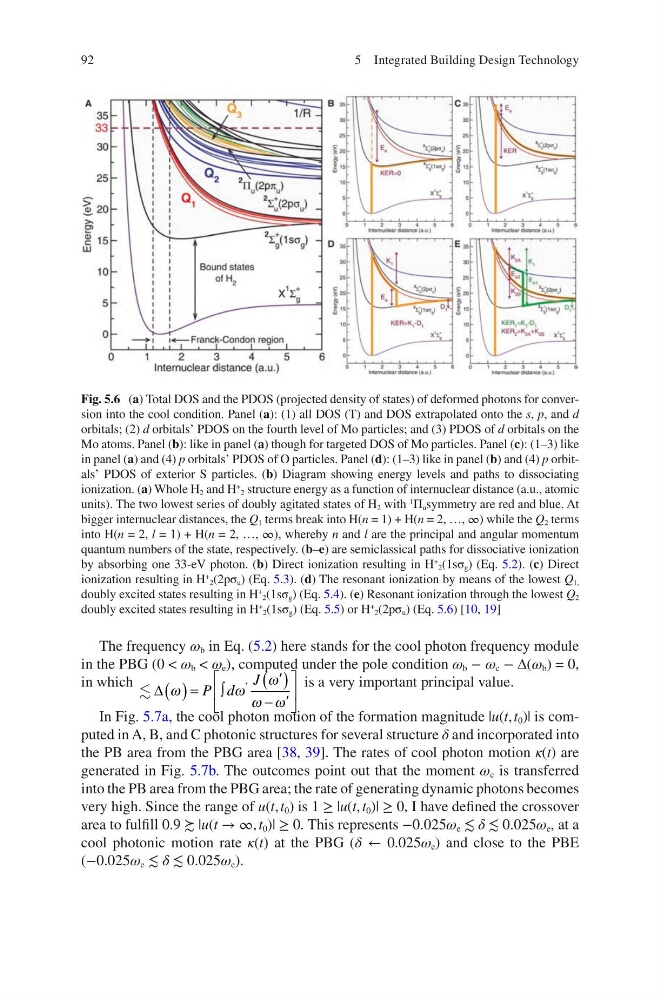
Fig. 5.6 (a) Total DOS and the PDOS (projected density of states) of deformed photons for conversion into the cool condition. Panel (a): (1) all DOS (T) and DOS extrapolated onto the s, p, and d
orbitals; (2) d orbitals’ PDOS on the fourth level of Mo particles; and (3) PDOS of d orbitals on the
Mo atoms. Panel (b): like in panel (a) though for targeted DOS of Mo particles. Panel (c): (1–3) like
in panel (a) and (4) p orbitals’ PDOS of O particles. Panel (d): (1–3) like in panel (b) and (4) p orbitals’ PDOS of exterior S particles. (b) Diagram showing energy levels and paths to dissociating
ionization. (a) Whole H 2 and H
+
2 structure energy as a function of internuclear distance (a.u., atomic
units). The two lowest series of doubly agitated states of H 2 with
1
Π u symmetry are red and blue. At
bigger internuclear distances, the Q 1 terms break into H(n = 1) + H(n = 2, …, ∞) while the Q 2 terms
into H(n = 2, l = 1) + H(n = 2, …, ∞), whereby n and l are the principal and angular momentum
quantum numbers of the state, respectively. (b–e) are semiclassical paths for dissociative ionization
by absorbing one 33-eV photon. (b) Direct ionization resulting in H
+
2 (1sσ g ) (Eq. 5.2). (c) Direct
ionization resulting in H
+
2 (2pσ u ) (Eq. 5.3). (d) The resonant ionization by means of the lowest Q 1,
doubly excited states resulting in H
+
2 (1sσ g ) (Eq. 5.4). (e) Resonant ionization through the lowest Q 2
doubly excited states resulting in H
+
2 (1sσ g ) (Eq. 5.5) or H
+
2 (2pσ u ) (Eq. 5.6) [10, 19]
5 Integrated Building Design Technology
The frequency ω b in Eq. (5.2) here stands for the cool photon frequency module
in the PBG (0 < ω b < ω e ), computed under the pole condition ω b − ω c − ∆(ω b ) = 0,
in which ∆ ( )= ∫
( )
−
′
′
′
ω
ω
ω
ω ω
P d
J
is a very important principal value.
In Fig. 5.7a, the cool photon motion of the formation magnitude |u(t, t 0 )| is computed in A, B, and C photonic structures for several structure δ and incorporated into
the PB area from the PBG area [38, 39]. The rates of cool photon motion κ(t) are
generated in Fig. 5.7b. The outcomes point out that the moment ω c is transferred
into the PB area from the PBG area; the rate of generating dynamic photons becomes
very high. Since the range of u(t, t 0 ) is 1 ≥ |u(t, t 0 )| ≥ 0, I have defined the crossover
area to fulfill 0.9 ≿ |u(t → ∞, t 0 )| ≥ 0. This represents −0.025ω e ≲ δ ≲ 0.025ω e , at a
cool photonic motion rate κ(t) at the PBG (δ ← 0.025ω e ) and close to the PBE
(−0.025ω e ≲ δ ≲ 0.025ω e ).
Fig. 5.6 (a) Total DOS and the PDOS (projected density of states) of deformed photons for conversion into the cool condition. Panel (a): (1) all DOS (T) and DOS extrapolated onto the s, p, and d
orbitals; (2) d orbitals’ PDOS on the fourth level of Mo particles; and (3) PDOS of d orbitals on the
Mo atoms. Panel (b): like in panel (a) though for targeted DOS of Mo particles. Panel (c): (1–3) like
in panel (a) and (4) p orbitals’ PDOS of O particles. Panel (d): (1–3) like in panel (b) and (4) p orbitals’ PDOS of exterior S particles. (b) Diagram showing energy levels and paths to dissociating
ionization. (a) Whole H 2 and H
+
2 structure energy as a function of internuclear distance (a.u., atomic
units). The two lowest series of doubly agitated states of H 2 with
1
Π u symmetry are red and blue. At
bigger internuclear distances, the Q 1 terms break into H(n = 1) + H(n = 2, …, ∞) while the Q 2 terms
into H(n = 2, l = 1) + H(n = 2, …, ∞), whereby n and l are the principal and angular momentum
quantum numbers of the state, respectively. (b–e) are semiclassical paths for dissociative ionization
by absorbing one 33-eV photon. (b) Direct ionization resulting in H
+
2 (1sσ g ) (Eq. 5.2). (c) Direct
ionization resulting in H
+
2 (2pσ u ) (Eq. 5.3). (d) The resonant ionization by means of the lowest Q 1,
doubly excited states resulting in H
+
2 (1sσ g ) (Eq. 5.4). (e) Resonant ionization through the lowest Q 2
doubly excited states resulting in H
+
2 (1sσ g ) (Eq. 5.5) or H
+
2 (2pσ u ) (Eq. 5.6) [10, 19]
5 Integrated Building Design Technology