

95
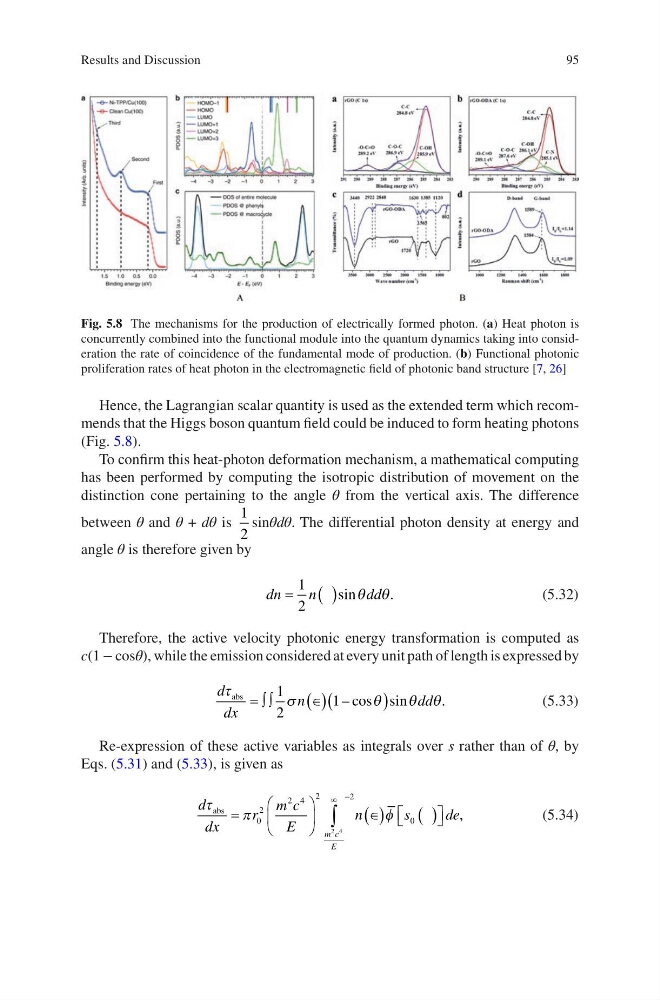
Hence, the Lagrangian scalar quantity is used as the extended term which recommends that the Higgs boson quantum field could be induced to form heating photons
(Fig. 5.8).
To confirm this heat-photon deformation mechanism, a mathematical computing
has been performed by computing the isotropic distribution of movement on the
distinction cone pertaining to the angle θ from the vertical axis. The difference
between θ and θ + dθ is
1
2
sinθdθ. The differential photon density at energy and
angle θ is therefore given by
dn
n
d d
=
( )
1
2
sin
.
θ θ
(5.32)
Therefore, the active velocity photonic energy transformation is computed as
c(1 − cosθ), while the emission considered at every unit path of length is expressed by
d
dx
n
d d
τ
σ
θ
θ θ
abs
= ∫ ∫
∈
( )(
)
1
2
1 – cos sin
.
(5.33)
Re-expression of these active variables as integrals over s rather than of θ, by
Eqs. (5.31) and (5.33), is given as
d
dx
r
m c
E
n
s
de
m c
E
τ
π
φ
abs
=
∈
( )
( )
∞ −
∫
0
2
2 4 2
2
0
2 4
,
(5.34)
Fig. 5.8 The mechanisms for the production of electrically formed photon. (a) Heat photon is
concurrently combined into the functional module into the quantum dynamics taking into consideration the rate of coincidence of the fundamental mode of production. (b) Functional photonic
proliferation rates of heat photon in the electromagnetic field of photonic band structure [7, 26]
Results and Discussion
Hence, the Lagrangian scalar quantity is used as the extended term which recommends that the Higgs boson quantum field could be induced to form heating photons
(Fig. 5.8).
To confirm this heat-photon deformation mechanism, a mathematical computing
has been performed by computing the isotropic distribution of movement on the
distinction cone pertaining to the angle θ from the vertical axis. The difference
between θ and θ + dθ is
1
2
sinθdθ. The differential photon density at energy and
angle θ is therefore given by
dn
n
d d
=
( )
1
2
sin
.
θ θ
(5.32)
Therefore, the active velocity photonic energy transformation is computed as
c(1 − cosθ), while the emission considered at every unit path of length is expressed by
d
dx
n
d d
τ
σ
θ
θ θ
abs
= ∫ ∫
∈
( )(
)
1
2
1 – cos sin
.
(5.33)
Re-expression of these active variables as integrals over s rather than of θ, by
Eqs. (5.31) and (5.33), is given as
d
dx
r
m c
E
n
s
de
m c
E
τ
π
φ
abs
=
∈
( )
( )
∞ −
∫
0
2
2 4 2
2
0
2 4
,
(5.34)
Fig. 5.8 The mechanisms for the production of electrically formed photon. (a) Heat photon is
concurrently combined into the functional module into the quantum dynamics taking into consideration the rate of coincidence of the fundamental mode of production. (b) Functional photonic
proliferation rates of heat photon in the electromagnetic field of photonic band structure [7, 26]
Results and Discussion