

86
whereby I sc is the photonic current for every unit area at 25 °C, K I represents the
corresponding photon panel coefficient, T cool stands for the cooling temperature of
the photon cell, and G exemplifies the solar energy for every unit area [23, 26–28].
Heating Mechanism
The Higgs boson electro-quantum dynamics have been exploited and the photonheating relationship’s parameters and have been accurately determined for the
deforming of the cooling photons into heating photons [29, 30]. To generate a surrounding Higgs boson electro-quantum field in the curtain wall, the albanian surrounding symmetries have therefore been replicated. Since the emission of solar light
splits the gauge field symmetry, the Goldstone scalar particles shall become the longitudinal module vector boson [24, 26]. In the corresponding gauge field of A x
µ
α
( )
in the albanian, the surrounding symmetry particle Τ
α
of every photon shall therefore
be shaken up spontaneously. The Higgs quantum field shall start operating in local
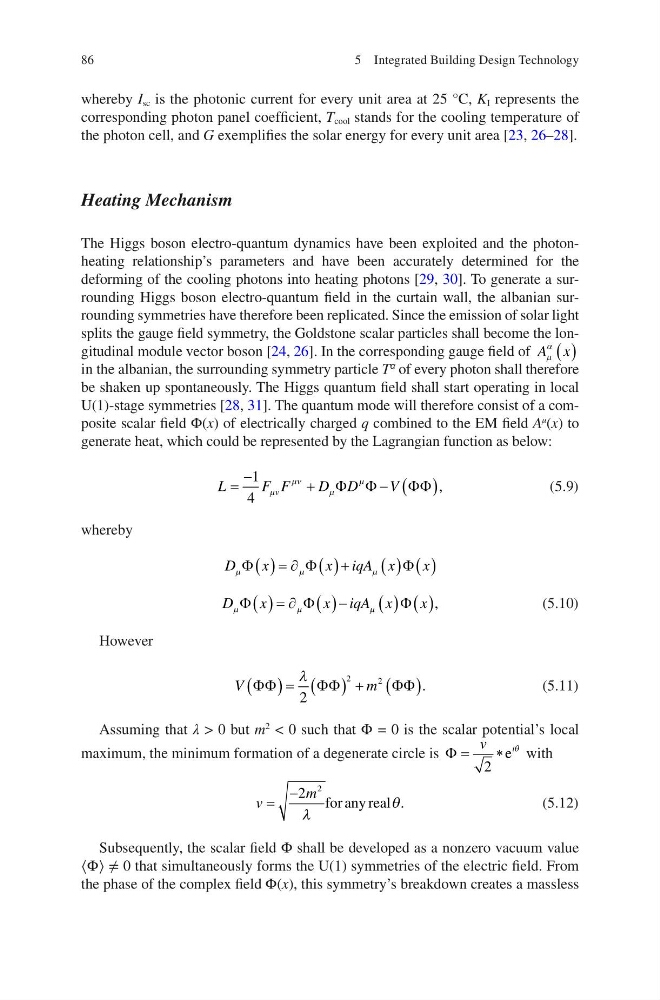
U(1)-stage symmetries [28, 31]. The quantum mode will therefore consist of a composite scalar field Φ(x) of electrically charged q combined to the EM field A
μ
(x) to
generate heat, which could be represented by the Lagrangian function as below:
L
F F
D D
V
v
=
−
+
− ( )
1
4
µ
µν
µ
µ
Φ Φ
ΦΦ ,
(5.9)
whereby
D
x
x iqA x
x
µ
µ
µ
Φ
Φ
Φ
( ) = ∂ ( )+
( ) ( )
D
x
x iqA x
x
µ
µ
µ
Φ
Φ
Φ
( ) = ∂ ( )−
( ) ( ),
(5.10)
However
V
m
ΦΦ
ΦΦ
ΦΦ
( )= ( ) + ( )
λ
2
2
2
.
(5.11)
Assuming that λ > 0 but m
2
< 0 such that Φ = 0 is the scalar potential’s local
maximum, the minimum formation of a degenerate circle is Φ =
∗
v
i
2
e
θ with
v
m
=
−2
2
λ
θ
for any real .
(5.12)
Subsequently, the scalar field Φ shall be developed as a nonzero vacuum value
⟨Φ⟩ ≠ 0 that simultaneously forms the U(1) symmetries of the electric field. From
the phase of the complex field Φ(x), this symmetry’s breakdown creates a massless
5 Integrated Building Design Technology
whereby I sc is the photonic current for every unit area at 25 °C, K I represents the
corresponding photon panel coefficient, T cool stands for the cooling temperature of
the photon cell, and G exemplifies the solar energy for every unit area [23, 26–28].
Heating Mechanism
The Higgs boson electro-quantum dynamics have been exploited and the photonheating relationship’s parameters and have been accurately determined for the
deforming of the cooling photons into heating photons [29, 30]. To generate a surrounding Higgs boson electro-quantum field in the curtain wall, the albanian surrounding symmetries have therefore been replicated. Since the emission of solar light
splits the gauge field symmetry, the Goldstone scalar particles shall become the longitudinal module vector boson [24, 26]. In the corresponding gauge field of A x
µ
α
( )
in the albanian, the surrounding symmetry particle Τ
α
of every photon shall therefore
be shaken up spontaneously. The Higgs quantum field shall start operating in local
U(1)-stage symmetries [28, 31]. The quantum mode will therefore consist of a composite scalar field Φ(x) of electrically charged q combined to the EM field A
μ
(x) to
generate heat, which could be represented by the Lagrangian function as below:
L
F F
D D
V
v
=
−
+
− ( )
1
4
µ
µν
µ
µ
Φ Φ
ΦΦ ,
(5.9)
whereby
D
x
x iqA x
x
µ
µ
µ
Φ
Φ
Φ
( ) = ∂ ( )+
( ) ( )
D
x
x iqA x
x
µ
µ
µ
Φ
Φ
Φ
( ) = ∂ ( )−
( ) ( ),
(5.10)
However
V
m
ΦΦ
ΦΦ
ΦΦ
( )= ( ) + ( )
λ
2
2
2
.
(5.11)
Assuming that λ > 0 but m
2
< 0 such that Φ = 0 is the scalar potential’s local
maximum, the minimum formation of a degenerate circle is Φ =
∗
v
i
2
e
θ with
v
m
=
−2
2
λ
θ
for any real .
(5.12)
Subsequently, the scalar field Φ shall be developed as a nonzero vacuum value
⟨Φ⟩ ≠ 0 that simultaneously forms the U(1) symmetries of the electric field. From
the phase of the complex field Φ(x), this symmetry’s breakdown creates a massless
5 Integrated Building Design Technology