

87
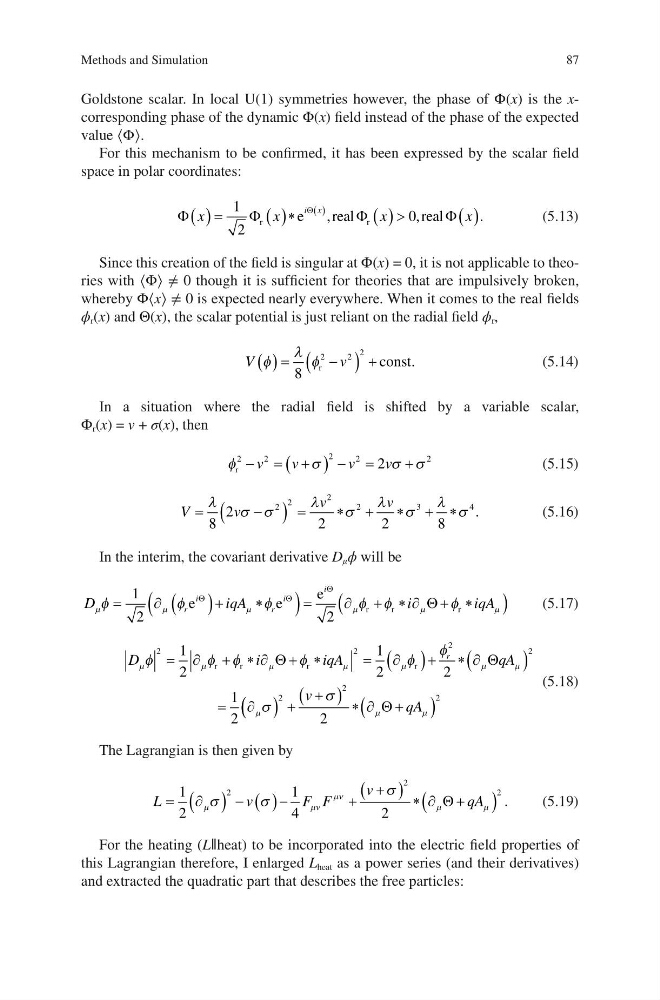
Goldstone scalar. In local U(1) symmetries however, the phase of Φ(x) is the xcorresponding phase of the dynamic Φ(x) field instead of the phase of the expected
value ⟨Φ⟩.
For this mechanism to be confirmed, it has been expressed by the scalar field
space in polar coordinates:
Φ
Φ
Φ
Φ
Θ
x
x
x
x
i x
( ) =
( )∗
( ) >
( )
( )
1
2
0
r
r
e
real
real
,
,
.
(5.13)
Since this creation of the field is singular at Φ(x) = 0, it is not applicable to theories with ⟨Φ⟩ ≠ 0 though it is sufficient for theories that are impulsively broken,
whereby Φ⟨x⟩ ≠ 0 is expected nearly everywhere. When it comes to the real fields
ϕ r (x) and Θ(x), the scalar potential is just reliant on the radial field ϕ r ,
V
v
φ
λ φ
( ) =
−
(
) +
8
2
2
2
r
const.
(5.14)
In a situation where the radial field is shifted by a variable scalar,
Φ r (x) = v + σ(x), then
φ
σ
σ σ
r
2
2
2
2
2
2
− = +
(
) − =
+
v
v
v
v
(5.15)
V
v
v
v
=
−
(
) = ∗ + ∗ + ∗
λ
σ σ
λ
σ
λ σ
λ σ
8
2
2
2
8
2
2
2
2
3
4 .
(5.16)
In the interim, the covariant derivative D μ ϕ will be
D
i qA
i
i qA
r
i
r
i
i
µ
µ
µ
µ
µ
µ
φ
φ
φ
φ φ
φ
=
∂ ( ) + ∗
(
) = ∂ + ∗ ∂ + ∗
(
)
1
2
2
e
e
e
r
r
r
Θ
Θ
Θ
Θ
(5.17)
D
i
iqA
q A
r
µ
µ
µ
µ
µ
µ
µ
µ
φ
φ φ
φ
φ
φ
σ
2
2
2
2
1
2
1
2
2
1
2
= ∂ + ∗ ∂ + ∗
= ∂
( ) + ∗ ∂
(
)
= ∂
r
r
r
r
Θ
Θ
( ( ) +
+
(
) ∗ ∂ +
(
)
2
2
2
2
v
qA
σ
µ
µ
Θ
(5.18)
The Lagrangian is then given by
L
v
F F
v
qA
= ∂
( ) − ( )−
+
+
(
) ∗ ∂ +
(
)
1
2
1
4
2
2
2
2
µ
µ ν
µν
µ
µ
σ
σ
σ
Θ
.
(5.19)
For the heating (L‖heat) to be incorporated into the electric field properties of
this Lagrangian therefore, I enlarged L heat as a power series (and their derivatives)
and extracted the quadratic part that describes the free particles:
Methods and Simulation
Goldstone scalar. In local U(1) symmetries however, the phase of Φ(x) is the xcorresponding phase of the dynamic Φ(x) field instead of the phase of the expected
value ⟨Φ⟩.
For this mechanism to be confirmed, it has been expressed by the scalar field
space in polar coordinates:
Φ
Φ
Φ
Φ
Θ
x
x
x
x
i x
( ) =
( )∗
( ) >
( )
( )
1
2
0
r
r
e
real
real
,
,
.
(5.13)
Since this creation of the field is singular at Φ(x) = 0, it is not applicable to theories with ⟨Φ⟩ ≠ 0 though it is sufficient for theories that are impulsively broken,
whereby Φ⟨x⟩ ≠ 0 is expected nearly everywhere. When it comes to the real fields
ϕ r (x) and Θ(x), the scalar potential is just reliant on the radial field ϕ r ,
V
v
φ
λ φ
( ) =
−
(
) +
8
2
2
2
r
const.
(5.14)
In a situation where the radial field is shifted by a variable scalar,
Φ r (x) = v + σ(x), then
φ
σ
σ σ
r
2
2
2
2
2
2
− = +
(
) − =
+
v
v
v
v
(5.15)
V
v
v
v
=
−
(
) = ∗ + ∗ + ∗
λ
σ σ
λ
σ
λ σ
λ σ
8
2
2
2
8
2
2
2
2
3
4 .
(5.16)
In the interim, the covariant derivative D μ ϕ will be
D
i qA
i
i qA
r
i
r
i
i
µ
µ
µ
µ
µ
µ
φ
φ
φ
φ φ
φ
=
∂ ( ) + ∗
(
) = ∂ + ∗ ∂ + ∗
(
)
1
2
2
e
e
e
r
r
r
Θ
Θ
Θ
Θ
(5.17)
D
i
iqA
q A
r
µ
µ
µ
µ
µ
µ
µ
µ
φ
φ φ
φ
φ
φ
σ
2
2
2
2
1
2
1
2
2
1
2
= ∂ + ∗ ∂ + ∗
= ∂
( ) + ∗ ∂
(
)
= ∂
r
r
r
r
Θ
Θ
( ( ) +
+
(
) ∗ ∂ +
(
)
2
2
2
2
v
qA
σ
µ
µ
Θ
(5.18)
The Lagrangian is then given by
L
v
F F
v
qA
= ∂
( ) − ( )−
+
+
(
) ∗ ∂ +
(
)
1
2
1
4
2
2
2
2
µ
µ ν
µν
µ
µ
σ
σ
σ
Θ
.
(5.19)
For the heating (L‖heat) to be incorporated into the electric field properties of
this Lagrangian therefore, I enlarged L heat as a power series (and their derivatives)
and extracted the quadratic part that describes the free particles:
Methods and Simulation