

450
commences directly when at 400 mV positive of a short circuit. Photocurrent density may be met with limiting values of 120 mA/cm 2 and at ~0.15 V. This will
remain constant as bias rises. As gas bubbles can grow to a size that makes them
capable of becoming miniature lenses that could pit the semiconductor electrode,
0.0 1 M of the surfactant Triton X-100 is selected for the solution to allow smaller
bubbles to form that would more rapidly vacate the sample surface. The photocurrent with lower saturation in the p-GaInP 2 (Pt)/TJ/GaAs electrode compared to the
p-GaInP 2 electrode is taken into consideration in demonstrating that the p/n GaA
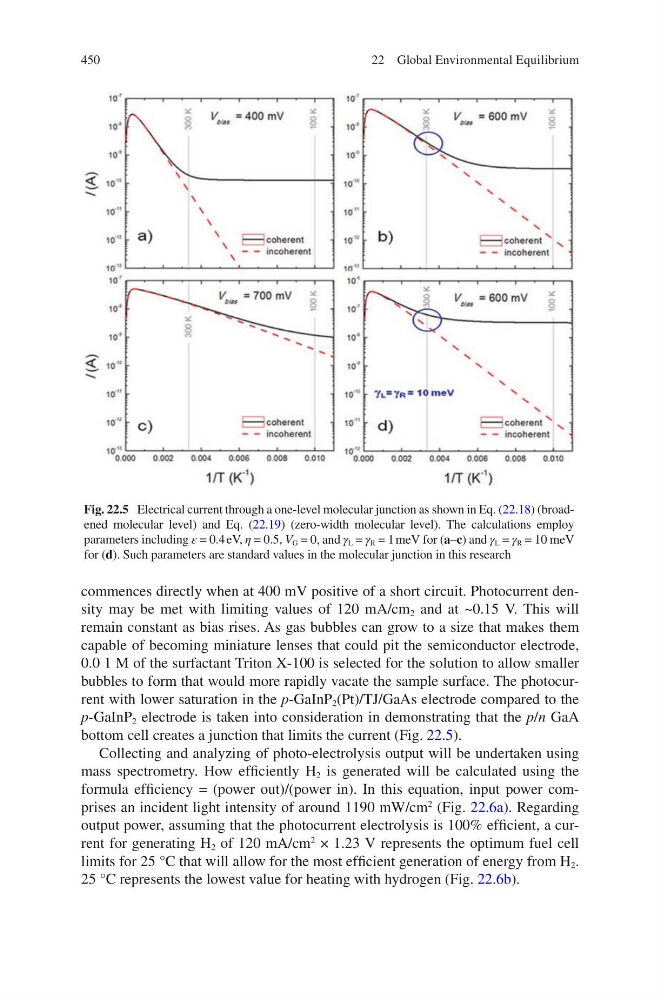
bottom cell creates a junction that limits the current (Fig. 22.5).
Collecting and analyzing of photo-electrolysis output will be undertaken using
mass spectrometry. How efficiently H 2 is generated will be calculated using the
formula efficiency = (power out)/(power in). In this equation, input power comprises an incident light intensity of around 1190 mW/cm
2
(Fig. 22.6a). Regarding
output power, assuming that the photocurrent electrolysis is 100% efficient, a current for generating H 2 of 120 mA/cm
2
× 1.23 V represents the optimum fuel cell
limits for 25 °C that will allow for the most efficient generation of energy from H 2 .
25 °C represents the lowest value for heating with hydrogen (Fig. 22.6b).
Fig. 22.5 Electrical current through a one-level molecular junction as shown in Eq. (22.18) (broadened molecular level) and Eq. (22.19) (zero-width molecular level). The calculations employ
parameters including ε = 0.4 eV, η = 0.5, V G = 0, and γ L = γ R = 1 meV for (a–c) and γ L = γ R = 10 meV
for (d). Such parameters are standard values in the molecular junction in this research
22 Global Environmental Equilibrium
commences directly when at 400 mV positive of a short circuit. Photocurrent density may be met with limiting values of 120 mA/cm 2 and at ~0.15 V. This will
remain constant as bias rises. As gas bubbles can grow to a size that makes them
capable of becoming miniature lenses that could pit the semiconductor electrode,
0.0 1 M of the surfactant Triton X-100 is selected for the solution to allow smaller
bubbles to form that would more rapidly vacate the sample surface. The photocurrent with lower saturation in the p-GaInP 2 (Pt)/TJ/GaAs electrode compared to the
p-GaInP 2 electrode is taken into consideration in demonstrating that the p/n GaA
bottom cell creates a junction that limits the current (Fig. 22.5).
Collecting and analyzing of photo-electrolysis output will be undertaken using
mass spectrometry. How efficiently H 2 is generated will be calculated using the
formula efficiency = (power out)/(power in). In this equation, input power comprises an incident light intensity of around 1190 mW/cm
2
(Fig. 22.6a). Regarding
output power, assuming that the photocurrent electrolysis is 100% efficient, a current for generating H 2 of 120 mA/cm
2
× 1.23 V represents the optimum fuel cell
limits for 25 °C that will allow for the most efficient generation of energy from H 2 .
25 °C represents the lowest value for heating with hydrogen (Fig. 22.6b).
Fig. 22.5 Electrical current through a one-level molecular junction as shown in Eq. (22.18) (broadened molecular level) and Eq. (22.19) (zero-width molecular level). The calculations employ
parameters including ε = 0.4 eV, η = 0.5, V G = 0, and γ L = γ R = 1 meV for (a–c) and γ L = γ R = 10 meV
for (d). Such parameters are standard values in the molecular junction in this research
22 Global Environmental Equilibrium