

449
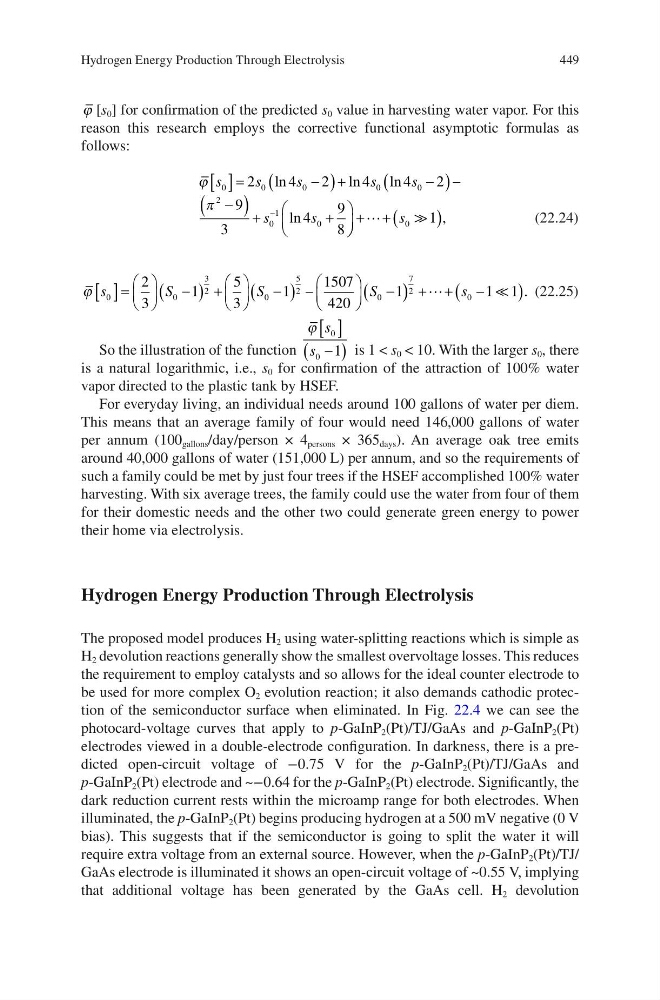
ϕ [s 0 ] for confirmation of the predicted s 0 value in harvesting water vapor. For this
reason this research employs the corrective functional asymptotic formulas as
follows:
ϕ
π
s
s
s
s
s
s
s
0
0
0
0
0
2
0
1
0
2
4
2
4
4
2
9
3
4
9
8
[ ]=
−
(
)+
−
(
)−
−
(
) +
+
−
ln
ln
ln
ln
+ +(
)
s 0 1 ,
(22.24)
ϕ s
S
S
S
0
0
3
2
0
5
2
0
2
3
1
5
3
1
1507
420
1
[ ]=
−
(
) +
−
(
)
−
(
–
) ) + +(
)
7
2
0
1 1
s –
. (22.25)
So the illustration of the function
ϕ s
s
0
0
1
[ ]
−
(
) is 1 < s 0 < 10. With the larger s 0 , there
is a natural logarithmic, i.e., s 0 for confirmation of the attraction of 100% water
vapor directed to the plastic tank by HSEF.
For everyday living, an individual needs around 100 gallons of water per diem.
This means that an average family of four would need 146,000 gallons of water
per annum (100 gallons /day/person × 4 persons × 365 days ). An average oak tree emits
around 40,000 gallons of water (151,000 L) per annum, and so the requirements of
such a family could be met by just four trees if the HSEF accomplished 100% water
harvesting. With six average trees, the family could use the water from four of them
for their domestic needs and the other two could generate green energy to power
their home via electrolysis.
Hydrogen Energy Production Through Electrolysis
The proposed model produces H 2 using water-splitting reactions which is simple as
H 2 devolution reactions generally show the smallest overvoltage losses. This reduces
the requirement to employ catalysts and so allows for the ideal counter electrode to
be used for more complex O 2 evolution reaction; it also demands cathodic protection of the semiconductor surface when eliminated. In Fig. 22.4 we can see the
photocard-voltage curves that apply to p-GaInP 2 (Pt)/TJ/GaAs and p-GaInP 2 (Pt)
electrodes viewed in a double-electrode configuration. In darkness, there is a predicted open-circuit voltage of −0.75 V for the p-GaInP 2 (Pt)/TJ/GaAs and
p-GaInP 2 (Pt) electrode and ~−0.64 for the p-GaInP 2 (Pt) electrode. Significantly, the
dark reduction current rests within the microamp range for both electrodes. When
illuminated, the p-GaInP 2 (Pt) begins producing hydrogen at a 500 mV negative (0 V
bias). This suggests that if the semiconductor is going to split the water it will
require extra voltage from an external source. However, when the p-GaInP 2 (Pt)/TJ/
GaAs electrode is illuminated it shows an open-circuit voltage of ~0.55 V, implying
that additional voltage has been generated by the GaAs cell. H 2 devolution
Hydrogen Energy Production Through Electrolysis
ϕ [s 0 ] for confirmation of the predicted s 0 value in harvesting water vapor. For this
reason this research employs the corrective functional asymptotic formulas as
follows:
ϕ
π
s
s
s
s
s
s
s
0
0
0
0
0
2
0
1
0
2
4
2
4
4
2
9
3
4
9
8
[ ]=
−
(
)+
−
(
)−
−
(
) +
+
−
ln
ln
ln
ln
+ +(
)
s 0 1 ,
(22.24)
ϕ s
S
S
S
0
0
3
2
0
5
2
0
2
3
1
5
3
1
1507
420
1
[ ]=
−
(
) +
−
(
)
−
(
–
) ) + +(
)
7
2
0
1 1
s –
. (22.25)
So the illustration of the function
ϕ s
s
0
0
1
[ ]
−
(
) is 1 < s 0 < 10. With the larger s 0 , there
is a natural logarithmic, i.e., s 0 for confirmation of the attraction of 100% water
vapor directed to the plastic tank by HSEF.
For everyday living, an individual needs around 100 gallons of water per diem.
This means that an average family of four would need 146,000 gallons of water
per annum (100 gallons /day/person × 4 persons × 365 days ). An average oak tree emits
around 40,000 gallons of water (151,000 L) per annum, and so the requirements of
such a family could be met by just four trees if the HSEF accomplished 100% water
harvesting. With six average trees, the family could use the water from four of them
for their domestic needs and the other two could generate green energy to power
their home via electrolysis.
Hydrogen Energy Production Through Electrolysis
The proposed model produces H 2 using water-splitting reactions which is simple as
H 2 devolution reactions generally show the smallest overvoltage losses. This reduces
the requirement to employ catalysts and so allows for the ideal counter electrode to
be used for more complex O 2 evolution reaction; it also demands cathodic protection of the semiconductor surface when eliminated. In Fig. 22.4 we can see the
photocard-voltage curves that apply to p-GaInP 2 (Pt)/TJ/GaAs and p-GaInP 2 (Pt)
electrodes viewed in a double-electrode configuration. In darkness, there is a predicted open-circuit voltage of −0.75 V for the p-GaInP 2 (Pt)/TJ/GaAs and
p-GaInP 2 (Pt) electrode and ~−0.64 for the p-GaInP 2 (Pt) electrode. Significantly, the
dark reduction current rests within the microamp range for both electrodes. When
illuminated, the p-GaInP 2 (Pt) begins producing hydrogen at a 500 mV negative (0 V
bias). This suggests that if the semiconductor is going to split the water it will
require extra voltage from an external source. However, when the p-GaInP 2 (Pt)/TJ/
GaAs electrode is illuminated it shows an open-circuit voltage of ~0.55 V, implying
that additional voltage has been generated by the GaAs cell. H 2 devolution
Hydrogen Energy Production Through Electrolysis