

444
GaInP 2 junction with a bandgap of 1.83 eV is usually set up for absorption of the
solar spectrum’s visible element. With the lower p/n GaInP 2 junction’s bandgap
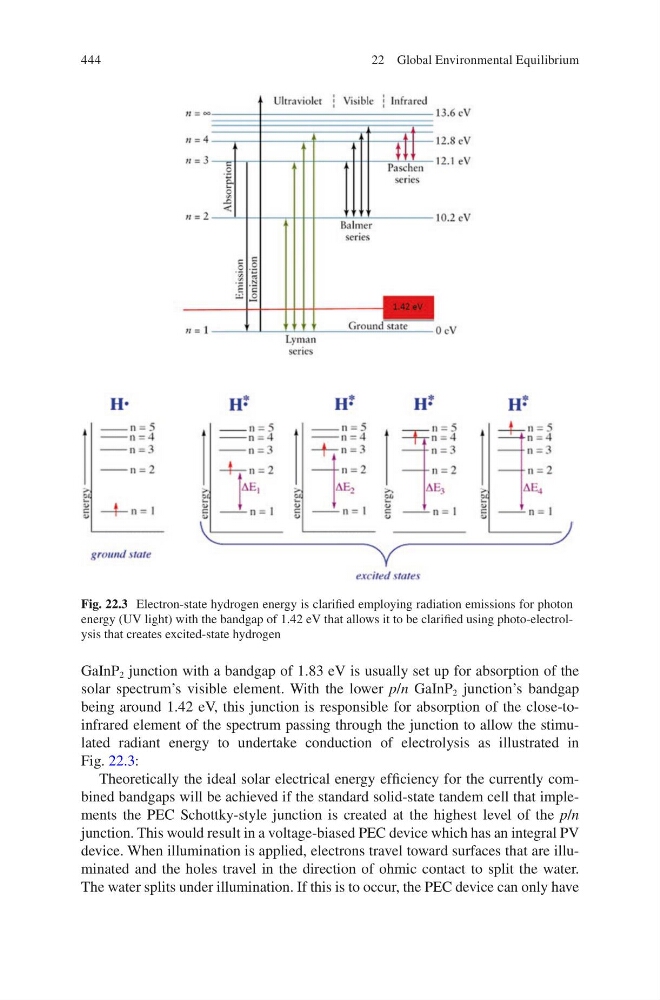
being around 1.42 eV, this junction is responsible for absorption of the close-toinfrared element of the spectrum passing through the junction to allow the stimulated radiant energy to undertake conduction of electrolysis as illustrated in
Fig. 22.3:
Theoretically the ideal solar electrical energy efficiency for the currently combined bandgaps will be achieved if the standard solid-state tandem cell that implements the PEC Schottky-style junction is created at the highest level of the p/n
junction. This would result in a voltage-biased PEC device which has an integral PV
device. When illumination is applied, electrons travel toward surfaces that are illuminated and the holes travel in the direction of ohmic contact to split the water.
The water splits under illumination. If this is to occur, the PEC device can only have
Fig. 22.3 Electron-state hydrogen energy is clarified employing radiation emissions for photon
energy (UV light) with the bandgap of 1.42 eV that allows it to be clarified using photo-electrolysis that creates excited-state hydrogen
22 Global Environmental Equilibrium
GaInP 2 junction with a bandgap of 1.83 eV is usually set up for absorption of the
solar spectrum’s visible element. With the lower p/n GaInP 2 junction’s bandgap
being around 1.42 eV, this junction is responsible for absorption of the close-toinfrared element of the spectrum passing through the junction to allow the stimulated radiant energy to undertake conduction of electrolysis as illustrated in
Fig. 22.3:
Theoretically the ideal solar electrical energy efficiency for the currently combined bandgaps will be achieved if the standard solid-state tandem cell that implements the PEC Schottky-style junction is created at the highest level of the p/n
junction. This would result in a voltage-biased PEC device which has an integral PV
device. When illumination is applied, electrons travel toward surfaces that are illuminated and the holes travel in the direction of ohmic contact to split the water.
The water splits under illumination. If this is to occur, the PEC device can only have
Fig. 22.3 Electron-state hydrogen energy is clarified employing radiation emissions for photon
energy (UV light) with the bandgap of 1.42 eV that allows it to be clarified using photo-electrolysis that creates excited-state hydrogen
22 Global Environmental Equilibrium