

442
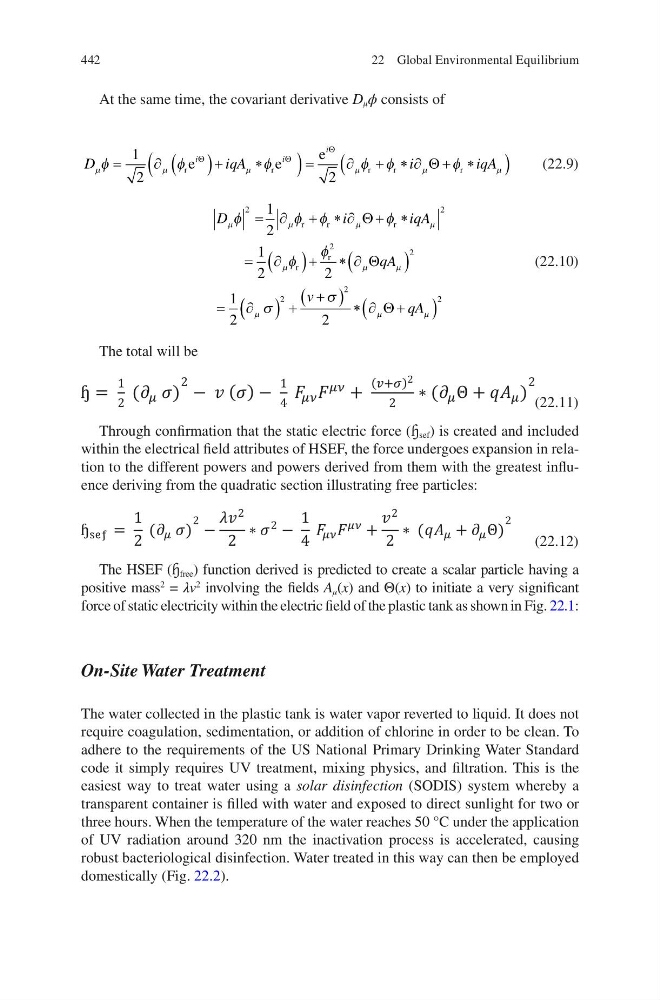
At the same time, the covariant derivative D μ ϕ consists of
D
i qA
i
i qA
i
i
i
µ
µ
µ
µ
µ
µ
φ
φ
φ
φ φ
φ
=
∂ ( ) + ∗
(
) = ∂ + ∗ ∂ + ∗
(
)
1
2
2
r
r
r
r
r
e
e
e
Θ
Θ
Θ
Θ
(22.9)
D
i
iqA
qA
µ
µ
µ
µ
µ
µ
µ
µ
φ
φ φ
φ
φ
φ
σ
2
2
2
2
1
2
1
2
2
1
2
= ∂ + ∗ ∂ + ∗
= ∂
( ) + ∗ ∂
(
)
= ∂
r
r
r
r
r
Θ
Θ
( ( ) +
+
(
) ∗ ∂ +
(
)
2
2
2
2
v
qA
σ
µ
µ
Θ
(22.10)
The total will be
(22.11)
Through confirmation that the static electric force (ɧ sef ) is created and included
within the electrical field attributes of HSEF, the force undergoes expansion in relation to the different powers and powers derived from them with the greatest influence deriving from the quadratic section illustrating free particles:
(22.12)
The HSEF (ɧ free ) function derived is predicted to create a scalar particle having a
positive mass
2
= λv
2
involving the fields A μ (x) and Θ(x) to initiate a very significant
force of static electricity within the electric field of the plastic tank as shown in Fig. 22.1:
On-Site Water Treatment
The water collected in the plastic tank is water vapor reverted to liquid. It does not
require coagulation, sedimentation, or addition of chlorine in order to be clean. To
adhere to the requirements of the US National Primary Drinking Water Standard
code it simply requires UV treatment, mixing physics, and filtration. This is the
easiest way to treat water using a solar disinfection (SODIS) system whereby a
transparent container is filled with water and exposed to direct sunlight for two or
three hours. When the temperature of the water reaches 50 °C under the application
of UV radiation around 320 nm the inactivation process is accelerated, causing
robust bacteriological disinfection. Water treated in this way can then be employed
domestically (Fig. 22.2).
22 Global Environmental Equilibrium
At the same time, the covariant derivative D μ ϕ consists of
D
i qA
i
i qA
i
i
i
µ
µ
µ
µ
µ
µ
φ
φ
φ
φ φ
φ
=
∂ ( ) + ∗
(
) = ∂ + ∗ ∂ + ∗
(
)
1
2
2
r
r
r
r
r
e
e
e
Θ
Θ
Θ
Θ
(22.9)
D
i
iqA
qA
µ
µ
µ
µ
µ
µ
µ
µ
φ
φ φ
φ
φ
φ
σ
2
2
2
2
1
2
1
2
2
1
2
= ∂ + ∗ ∂ + ∗
= ∂
( ) + ∗ ∂
(
)
= ∂
r
r
r
r
r
Θ
Θ
( ( ) +
+
(
) ∗ ∂ +
(
)
2
2
2
2
v
qA
σ
µ
µ
Θ
(22.10)
The total will be
(22.11)
Through confirmation that the static electric force (ɧ sef ) is created and included
within the electrical field attributes of HSEF, the force undergoes expansion in relation to the different powers and powers derived from them with the greatest influence deriving from the quadratic section illustrating free particles:
(22.12)
The HSEF (ɧ free ) function derived is predicted to create a scalar particle having a
positive mass
2
= λv
2
involving the fields A μ (x) and Θ(x) to initiate a very significant
force of static electricity within the electric field of the plastic tank as shown in Fig. 22.1:
On-Site Water Treatment
The water collected in the plastic tank is water vapor reverted to liquid. It does not
require coagulation, sedimentation, or addition of chlorine in order to be clean. To
adhere to the requirements of the US National Primary Drinking Water Standard
code it simply requires UV treatment, mixing physics, and filtration. This is the
easiest way to treat water using a solar disinfection (SODIS) system whereby a
transparent container is filled with water and exposed to direct sunlight for two or
three hours. When the temperature of the water reaches 50 °C under the application
of UV radiation around 320 nm the inactivation process is accelerated, causing
robust bacteriological disinfection. Water treated in this way can then be employed
domestically (Fig. 22.2).
22 Global Environmental Equilibrium