

441
D
x
x iqA x
x
µ
µ
µ
Φ
Φ
Φ
( ) = ∂ ( )+
( ) ( )
D
x
x iqA x
x
µ
µ
µ
Φ
Φ
Φ
∗
∗
∗
( ) = ∂ ( )−
( ) ( )
(22.2)
and
V
m
Φ Φ
Φ Φ
Φ Φ
∗
∗
∗
( ) = ( ) + ( )
λ
2
2
2
(22.3)
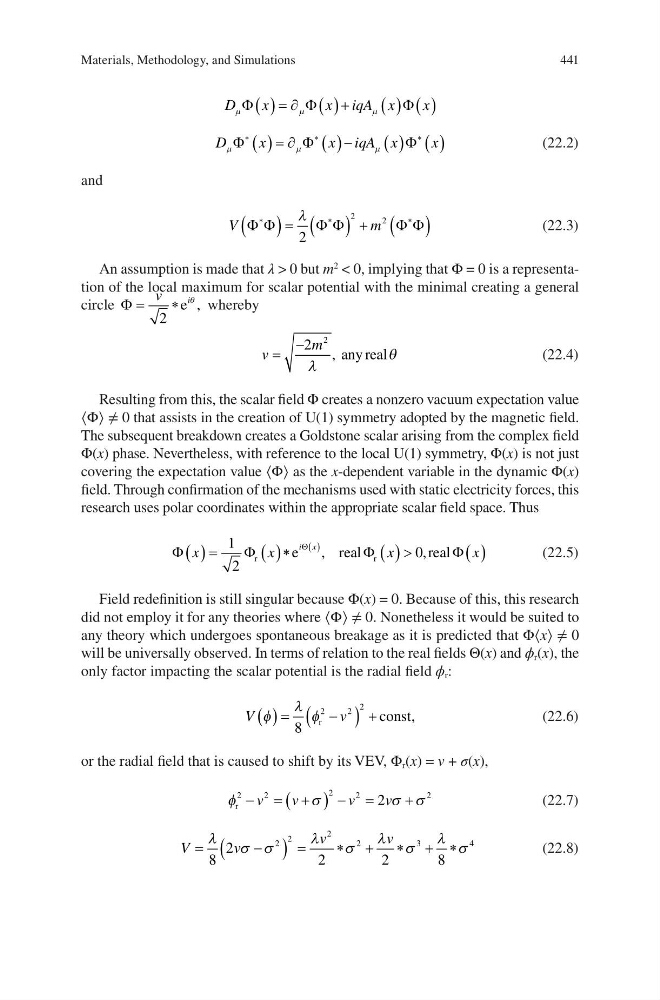
An assumption is made that λ > 0 but m
2
< 0, implying that Φ = 0 is a representation of the local maximum for scalar potential with the minimal creating a general
circle Φ =
∗
v
i
2
e
θ , whereby
v
m
=
−2
2
λ
θ
, any real
(22.4)
Resulting from this, the scalar field Φ creates a nonzero vacuum expectation value
〈Φ〉 ≠ 0 that assists in the creation of U(1) symmetry adopted by the magnetic field.
The subsequent breakdown creates a Goldstone scalar arising from the complex field
Φ(x) phase. Nevertheless, with reference to the local U(1) symmetry, Φ(x) is not just
covering the expectation value 〈Φ〉 as the x-dependent variable in the dynamic Φ(x)
field. Through confirmation of the mechanisms used with static electricity forces, this
research uses polar coordinates within the appropriate scalar field space. Thus
Φ
Φ
Φ
Φ
Θ
x
x
x
x
i x
( ) =
( )∗
( ) >
( )
( )
1
2
0
r
r
e
real
real
,
,
(22.5)
Field redefinition is still singular because Φ(x) = 0. Because of this, this research
did not employ it for any theories where 〈Φ〉 ≠ 0. Nonetheless it would be suited to
any theory which undergoes spontaneous breakage as it is predicted that Φ〈x〉 ≠ 0
will be universally observed. In terms of relation to the real fields Θ(x) and ϕ r (x), the
only factor impacting the scalar potential is the radial field ϕ r :
V
v
φ
λ φ
( ) =
−
(
) +
8
2
2
2
r
const,
(22.6)
or the radial field that is caused to shift by its VEV, Φ r (x) = v + σ(x),
φ
σ
σ σ
r
2
2
2
2
2
2
− = +
(
) − =
+
v
v
v
v
(22.7)
V
v
v
v
=
−
(
) = ∗ + ∗ + ∗
λ
σ σ
λ
σ
λ σ
λ σ
8
2
2
2
8
2
2
2
2
3
4
(22.8)
Materials, Methodology, and Simulations
D
x
x iqA x
x
µ
µ
µ
Φ
Φ
Φ
( ) = ∂ ( )+
( ) ( )
D
x
x iqA x
x
µ
µ
µ
Φ
Φ
Φ
∗
∗
∗
( ) = ∂ ( )−
( ) ( )
(22.2)
and
V
m
Φ Φ
Φ Φ
Φ Φ
∗
∗
∗
( ) = ( ) + ( )
λ
2
2
2
(22.3)
An assumption is made that λ > 0 but m
2
< 0, implying that Φ = 0 is a representation of the local maximum for scalar potential with the minimal creating a general
circle Φ =
∗
v
i
2
e
θ , whereby
v
m
=
−2
2
λ
θ
, any real
(22.4)
Resulting from this, the scalar field Φ creates a nonzero vacuum expectation value
〈Φ〉 ≠ 0 that assists in the creation of U(1) symmetry adopted by the magnetic field.
The subsequent breakdown creates a Goldstone scalar arising from the complex field
Φ(x) phase. Nevertheless, with reference to the local U(1) symmetry, Φ(x) is not just
covering the expectation value 〈Φ〉 as the x-dependent variable in the dynamic Φ(x)
field. Through confirmation of the mechanisms used with static electricity forces, this
research uses polar coordinates within the appropriate scalar field space. Thus
Φ
Φ
Φ
Φ
Θ
x
x
x
x
i x
( ) =
( )∗
( ) >
( )
( )
1
2
0
r
r
e
real
real
,
,
(22.5)
Field redefinition is still singular because Φ(x) = 0. Because of this, this research
did not employ it for any theories where 〈Φ〉 ≠ 0. Nonetheless it would be suited to
any theory which undergoes spontaneous breakage as it is predicted that Φ〈x〉 ≠ 0
will be universally observed. In terms of relation to the real fields Θ(x) and ϕ r (x), the
only factor impacting the scalar potential is the radial field ϕ r :
V
v
φ
λ φ
( ) =
−
(
) +
8
2
2
2
r
const,
(22.6)
or the radial field that is caused to shift by its VEV, Φ r (x) = v + σ(x),
φ
σ
σ σ
r
2
2
2
2
2
2
− = +
(
) − =
+
v
v
v
v
(22.7)
V
v
v
v
=
−
(
) = ∗ + ∗ + ∗
λ
σ σ
λ
σ
λ σ
λ σ
8
2
2
2
8
2
2
2
2
3
4
(22.8)
Materials, Methodology, and Simulations