

420
I
I
T
T
qEG T
T
KA
O
R s
C
ref
ref
C
=
−
3
1
1
exp
.
(21.3)
In Eq. (21.3), IR s defines the unsaturation current that relies on the dynamic function of temperature mode and photon speed, and qEG defines the photonic bandgap
energy of the electron per unit area of the cooling-state photons in the cell (Fig. 21.3).
In this cooling photon mode, the I–V relations integrate the I–V curve of all cells
in photon emission on the earth surface that are in V–R relationship that can be
expressed by
V
IR K
I I I
I
= −
+
− +
S
L
O
O
log
,
(21.4)
where K represents the constant
=
AkT
q
and I mo and V mo are the current and voltage on the earth surface. Therefore, the correlation between I mo and V mo is similar as
the I–V relationship on the earth surface plane:
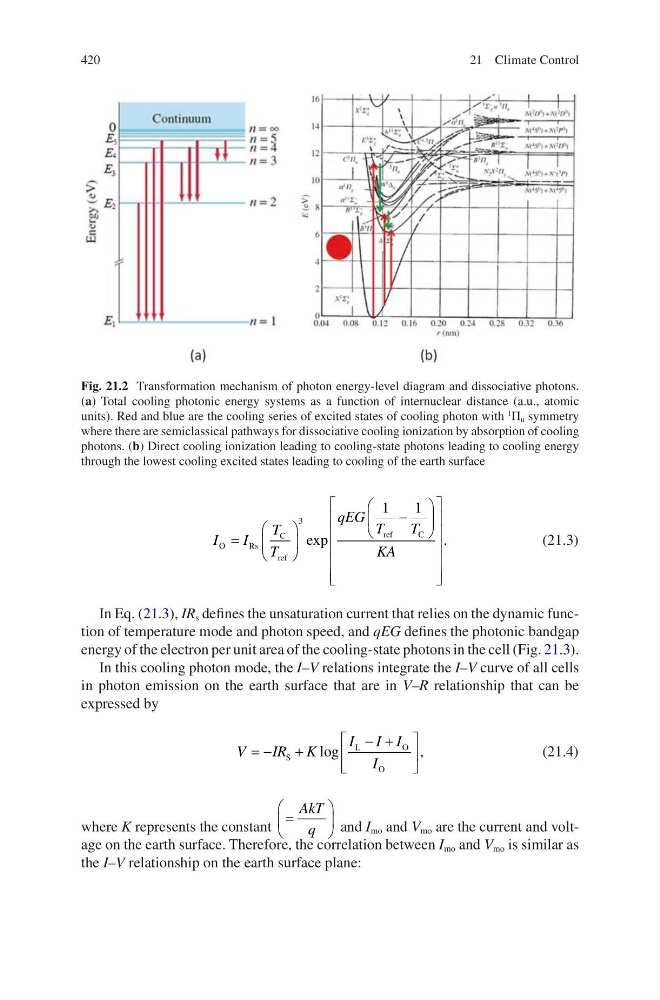
Fig. 21.2 Transformation mechanism of photon energy-level diagram and dissociative photons.
(a) Total cooling photonic energy systems as a function of internuclear distance (a.u., atomic
units). Red and blue are the cooling series of excited states of cooling photon with
1
Π u symmetry
where there are semiclassical pathways for dissociative cooling ionization by absorption of cooling
photons. (b) Direct cooling ionization leading to cooling-state photons leading to cooling energy
through the lowest cooling excited states leading to cooling of the earth surface
21 Climate Control
I
I
T
T
qEG T
T
KA
O
R s
C
ref
ref
C
=
−
3
1
1
exp
.
(21.3)
In Eq. (21.3), IR s defines the unsaturation current that relies on the dynamic function of temperature mode and photon speed, and qEG defines the photonic bandgap
energy of the electron per unit area of the cooling-state photons in the cell (Fig. 21.3).
In this cooling photon mode, the I–V relations integrate the I–V curve of all cells
in photon emission on the earth surface that are in V–R relationship that can be
expressed by
V
IR K
I I I
I
= −
+
− +
S
L
O
O
log
,
(21.4)
where K represents the constant
=
AkT
q
and I mo and V mo are the current and voltage on the earth surface. Therefore, the correlation between I mo and V mo is similar as
the I–V relationship on the earth surface plane:
Fig. 21.2 Transformation mechanism of photon energy-level diagram and dissociative photons.
(a) Total cooling photonic energy systems as a function of internuclear distance (a.u., atomic
units). Red and blue are the cooling series of excited states of cooling photon with
1
Π u symmetry
where there are semiclassical pathways for dissociative cooling ionization by absorption of cooling
photons. (b) Direct cooling ionization leading to cooling-state photons leading to cooling energy
through the lowest cooling excited states leading to cooling of the earth surface
21 Climate Control