

419
where a a
i
i
†
( ) and b b
k
k
†
( ) present the operator of the nano-point-break modules
and the photodynamic modules of the photons’ nanostructures, and the co-efficient,
V ik , presents the magnitude of the photon modules within the nano-breakpoint and
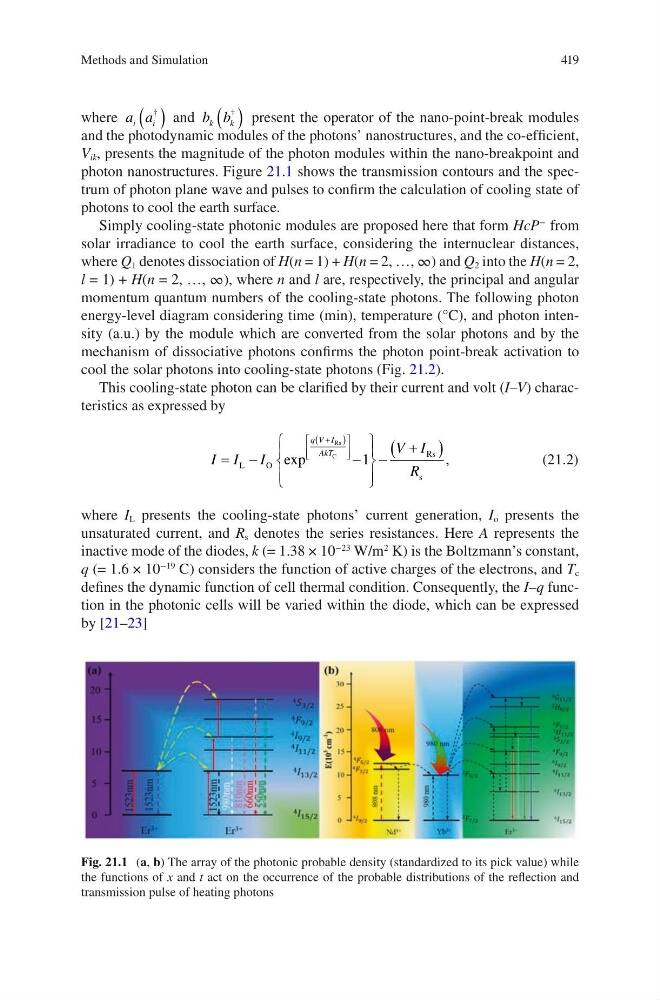
photon nanostructures. Figure 21.1 shows the transmission contours and the spectrum of photon plane wave and pulses to confirm the calculation of cooling state of
photons to cool the earth surface.
Simply cooling-state photonic modules are proposed here that form HcP
−
from
solar irradiance to cool the earth surface, considering the internuclear distances,
where Q 1 denotes dissociation of H(n = 1) + H(n = 2, …, ∞) and Q 2 into the H(n = 2,
l = 1) + H(n = 2, …, ∞), where n and l are, respectively, the principal and angular
momentum quantum numbers of the cooling-state photons. The following photon
energy-level diagram considering time (min), temperature (°C), and photon intensity (a.u.) by the module which are converted from the solar photons and by the
mechanism of dissociative photons confirms the photon point-break activation to
cool the solar photons into cooling-state photons (Fig. 21.2).
This cooling-state photon can be clarified by their current and volt (I–V) characteristics as expressed by
I I I
V I
R
q V I
AkT
= −
−
−
+
(
)
+
(
)
L
O
Rs
s
Rs
C
exp
,
1
(21.2)
where I L presents the cooling-state photons’ current generation, I o presents the
unsaturated current, and R s denotes the series resistances. Here A represents the
inactive mode of the diodes, k (= 1.38 × 10
−23
W/m
2
K) is the Boltzmann’s constant,
q (= 1.6 × 10
−19
C) considers the function of active charges of the electrons, and T c
defines the dynamic function of cell thermal condition. Consequently, the I–q function in the photonic cells will be varied within the diode, which can be expressed
by [21–23]
Fig. 21.1 (a, b) The array of the photonic probable density (standardized to its pick value) while
the functions of x and t act on the occurrence of the probable distributions of the reflection and
transmission pulse of heating photons
Methods and Simulation
where a a
i
i
†
( ) and b b
k
k
†
( ) present the operator of the nano-point-break modules
and the photodynamic modules of the photons’ nanostructures, and the co-efficient,
V ik , presents the magnitude of the photon modules within the nano-breakpoint and
photon nanostructures. Figure 21.1 shows the transmission contours and the spectrum of photon plane wave and pulses to confirm the calculation of cooling state of
photons to cool the earth surface.
Simply cooling-state photonic modules are proposed here that form HcP
−
from
solar irradiance to cool the earth surface, considering the internuclear distances,
where Q 1 denotes dissociation of H(n = 1) + H(n = 2, …, ∞) and Q 2 into the H(n = 2,
l = 1) + H(n = 2, …, ∞), where n and l are, respectively, the principal and angular
momentum quantum numbers of the cooling-state photons. The following photon
energy-level diagram considering time (min), temperature (°C), and photon intensity (a.u.) by the module which are converted from the solar photons and by the
mechanism of dissociative photons confirms the photon point-break activation to
cool the solar photons into cooling-state photons (Fig. 21.2).
This cooling-state photon can be clarified by their current and volt (I–V) characteristics as expressed by
I I I
V I
R
q V I
AkT
= −
−
−
+
(
)
+
(
)
L
O
Rs
s
Rs
C
exp
,
1
(21.2)
where I L presents the cooling-state photons’ current generation, I o presents the
unsaturated current, and R s denotes the series resistances. Here A represents the
inactive mode of the diodes, k (= 1.38 × 10
−23
W/m
2
K) is the Boltzmann’s constant,
q (= 1.6 × 10
−19
C) considers the function of active charges of the electrons, and T c
defines the dynamic function of cell thermal condition. Consequently, the I–q function in the photonic cells will be varied within the diode, which can be expressed
by [21–23]
Fig. 21.1 (a, b) The array of the photonic probable density (standardized to its pick value) while
the functions of x and t act on the occurrence of the probable distributions of the reflection and
transmission pulse of heating photons
Methods and Simulation