

383
Gt/year, have also been estimated to determine the growth rate of the atmospheric
CO 2 concentration (G ATM ; Gt/year) by using the following equation describing the
CO 2 balance among the atmosphere, ocean, and land:
E
E
G
S
S
FF
LUC
A TM
OCEAN
L AND
+
=
+
+
(18.1)
G
E
E
S
S
ATM
F F
L UC
OCEAN
L AND
=
+
−
−
(18.2)
The atmospheric G ATM is calculated in parts per million per year (ppm/year),
which can be converted into the total mass of carbon per year (GtC/year).
Assessments of environmental vulnerability have been conducted globally for the
past several decades, and numerous studies have been performed [2–4]. To date,
little research has been done on the adverse impacts of toxic levels of CO 2 in the
atmosphere on life on earth. Thus, the purpose of this report is to identify the yearly
growth rate of the CO 2 concentration in the atmosphere and its impact on the future
state of the global environmental to determine the survival period of humanity and
other living organisms.
Methods and Simulation
Global CO 2 emissions, absorption, and sequestration were analyzed by interpreting
reports from several organizations (CDIAC, IEA, UNEP, USDoE, ECE, EIA, PBL,
NEAA, NEDO, NOAA, and NASA), and the data were incorporated into MATLAB
software to develop the data set. To accurately calculate annual global carbon
estimates, I considered all data up to the year 2015 and the projected fossil energy
emissions for 2016, and from the projected total carbon estimates for 2016, the annual
growth rate of the atmospheric concentration of CO 2 was determined [5–7].
CO 2 Emissions from Fossil Fuel
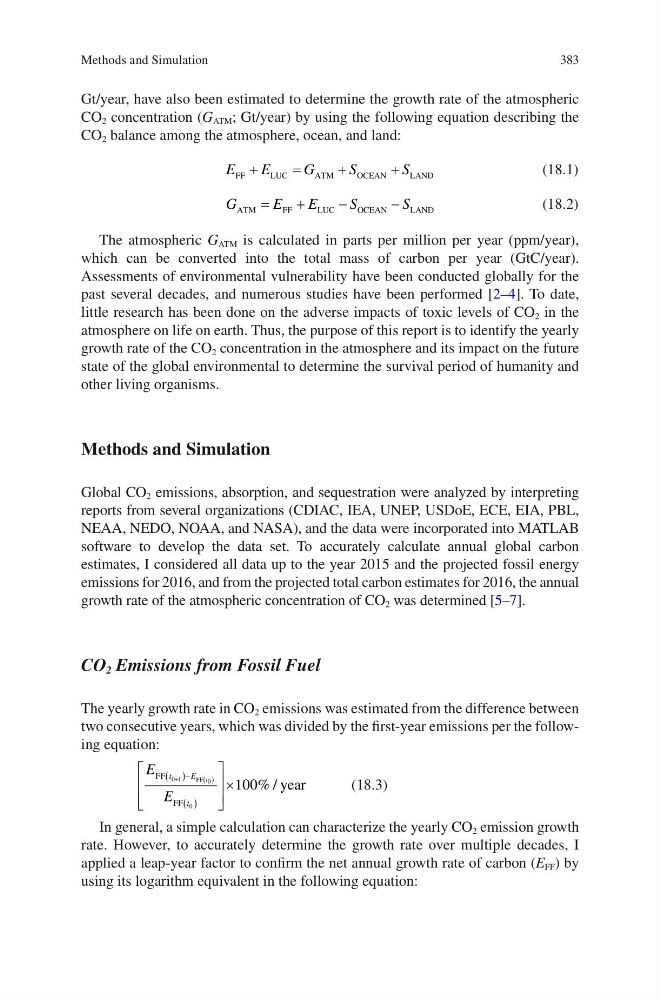
The yearly growth rate in CO 2 emissions was estimated from the difference between
two consecutive years, which was divided by the first-year emissions per the following equation:
E
E
t
E
t
t
FF
FF
FF
year
0 1
0
0
100
+
( )
( )−
( )
×
% /
(18.3)
In general, a simple calculation can characterize the yearly CO 2 emission growth
rate. However, to accurately determine the growth rate over multiple decades, I
applied a leap-year factor to confirm the net annual growth rate of carbon (E FF ) by
using its logarithm equivalent in the following equation:
Methods and Simulation
Gt/year, have also been estimated to determine the growth rate of the atmospheric
CO 2 concentration (G ATM ; Gt/year) by using the following equation describing the
CO 2 balance among the atmosphere, ocean, and land:
E
E
G
S
S
FF
LUC
A TM
OCEAN
L AND
+
=
+
+
(18.1)
G
E
E
S
S
ATM
F F
L UC
OCEAN
L AND
=
+
−
−
(18.2)
The atmospheric G ATM is calculated in parts per million per year (ppm/year),
which can be converted into the total mass of carbon per year (GtC/year).
Assessments of environmental vulnerability have been conducted globally for the
past several decades, and numerous studies have been performed [2–4]. To date,
little research has been done on the adverse impacts of toxic levels of CO 2 in the
atmosphere on life on earth. Thus, the purpose of this report is to identify the yearly
growth rate of the CO 2 concentration in the atmosphere and its impact on the future
state of the global environmental to determine the survival period of humanity and
other living organisms.
Methods and Simulation
Global CO 2 emissions, absorption, and sequestration were analyzed by interpreting
reports from several organizations (CDIAC, IEA, UNEP, USDoE, ECE, EIA, PBL,
NEAA, NEDO, NOAA, and NASA), and the data were incorporated into MATLAB
software to develop the data set. To accurately calculate annual global carbon
estimates, I considered all data up to the year 2015 and the projected fossil energy
emissions for 2016, and from the projected total carbon estimates for 2016, the annual
growth rate of the atmospheric concentration of CO 2 was determined [5–7].
CO 2 Emissions from Fossil Fuel
The yearly growth rate in CO 2 emissions was estimated from the difference between
two consecutive years, which was divided by the first-year emissions per the following equation:
E
E
t
E
t
t
FF
FF
FF
year
0 1
0
0
100
+
( )
( )−
( )
×
% /
(18.3)
In general, a simple calculation can characterize the yearly CO 2 emission growth
rate. However, to accurately determine the growth rate over multiple decades, I
applied a leap-year factor to confirm the net annual growth rate of carbon (E FF ) by
using its logarithm equivalent in the following equation:
Methods and Simulation