

26
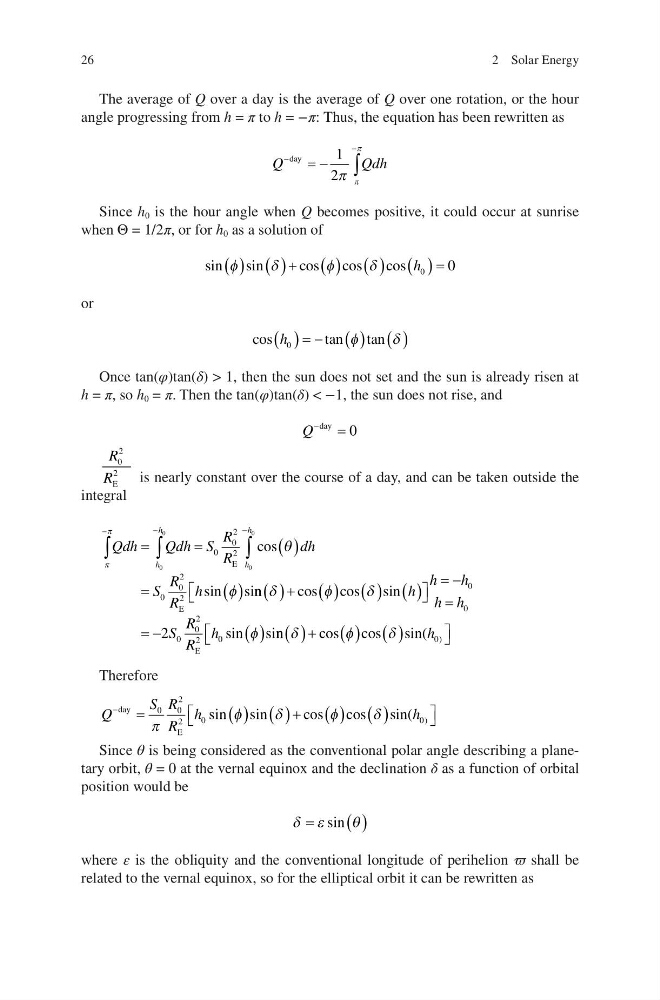
The average of Q over a day is the average of Q over one rotation, or the hour
angle progressing from h = π to h = −π: Thus, the equation has been rewritten as
Q
Q dh
³
day
1
2S S
S
Since h 0 is the hour angle when Q becomes positive, it could occur at sunrise
when Θ = 1/2π, or for h 0 as a solution of
sin
sin
cos
cos
cos
I
G
I
G
h 0
0
or
cos
t an
tan
h 0
I
G
Once tan(φ)tan(δ) > 1, then the sun does not set and the sun is already risen at
h = π, so h 0 = π. Then the tan(φ)tan(δ) < −1, the sun does not rise, and
Q
day
0
R
R
0
2
2
E
is nearly constant over the course of a day, and can be taken outside the
integral
S
S
T
I
³
³
³
Qdh
Qdh S
R
R
dh
S
R
R
h
h
h
h
h
0
0
0
0
0
0
2
2
0
0
2
2
E
E
cos
sin
sin n
cos cos
sin
sin
si
G
I
G
I
ª ¬
º ¼
h
h
h
h h
S
R
R
h
0
0
0
0
2
2
0
2
E
n n
cos cos
sin( )
G
I
G
ª ¬
º ¼
h 0
Therefore
Q
S R
R
h
h
ª ¬
º ¼
day
E
0
0
2
2
0
0
S
I
G
I
G
sin
sin
cos
cos
sin( )
Since θ is being considered as the conventional polar angle describing a planetary orbit, θ = 0 at the vernal equinox and the declination δ as a function of orbital
position would be
G H
T
sin
where ε is the obliquity and the conventional longitude of perihelion ϖ shall be
related to the vernal equinox, so for the elliptical orbit it can be rewritten as
2 Solar Energy
The average of Q over a day is the average of Q over one rotation, or the hour
angle progressing from h = π to h = −π: Thus, the equation has been rewritten as
Q
Q dh
³
day
1
2S S
S
Since h 0 is the hour angle when Q becomes positive, it could occur at sunrise
when Θ = 1/2π, or for h 0 as a solution of
sin
sin
cos
cos
cos
I
G
I
G
h 0
0
or
cos
t an
tan
h 0
I
G
Once tan(φ)tan(δ) > 1, then the sun does not set and the sun is already risen at
h = π, so h 0 = π. Then the tan(φ)tan(δ) < −1, the sun does not rise, and
Q
day
0
R
R
0
2
2
E
is nearly constant over the course of a day, and can be taken outside the
integral
S
S
T
I
³
³
³
Qdh
Qdh S
R
R
dh
S
R
R
h
h
h
h
h
0
0
0
0
0
0
2
2
0
0
2
2
E
E
cos
sin
sin n
cos cos
sin
sin
si
G
I
G
I
ª ¬
º ¼
h
h
h
h h
S
R
R
h
0
0
0
0
2
2
0
2
E
n n
cos cos
sin( )
G
I
G
ª ¬
º ¼
h 0
Therefore
Q
S R
R
h
h
ª ¬
º ¼
day
E
0
0
2
2
0
0
S
I
G
I
G
sin
sin
cos
cos
sin( )
Since θ is being considered as the conventional polar angle describing a planetary orbit, θ = 0 at the vernal equinox and the declination δ as a function of orbital
position would be
G H
T
sin
where ε is the obliquity and the conventional longitude of perihelion ϖ shall be
related to the vernal equinox, so for the elliptical orbit it can be rewritten as
2 Solar Energy