

25
the Weisskopf-Wigner approximation mechanism in order to confirm the accurate
solar energy emission on the earth surface (Fig. 2.5).
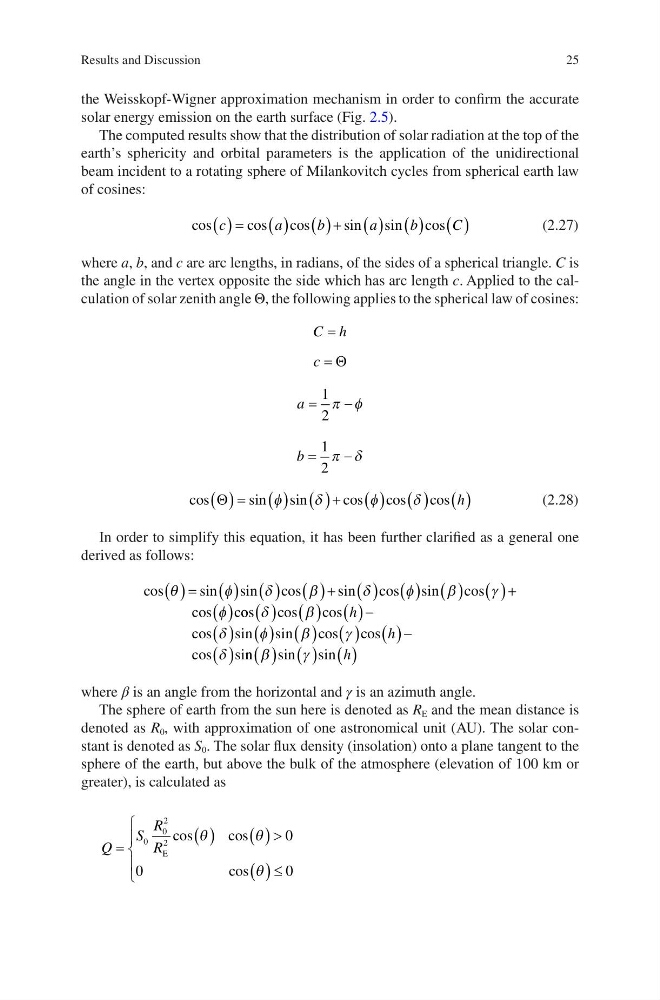
The computed results show that the distribution of solar radiation at the top of the
earth’s sphericity and orbital parameters is the application of the unidirectional
beam incident to a rotating sphere of Milankovitch cycles from spherical earth law
of cosines:
cos
cos
cos
sin
sin
cos
c
a
b
a
b
C
(2.27)
where a, b, and c are arc lengths, in radians, of the sides of a spherical triangle. C is
the angle in the vertex opposite the side which has arc length c. Applied to the calculation of solar zenith angle Θ, the following applies to the spherical law of cosines:
C h
=
c 4
a
1
2
S I
b
1
2
S G
cos
sin
sin
cos
cos
cos
4
I
G
I
G
h
(2.28)
In order to simplify this equation, it has been further clarified as a general one
derived as follows:
cos
sin
sin
cos
sin
cos sin
cos
cos c
T
I
G
E
G
I
E
J
I
o os cos cos
cos
sin
sin
cos
cos
cos
si
G
E
G
I
E
J
G
h
h
n n
sin
sin
E
J
h
where β is an angle from the horizontal and γ is an azimuth angle.
The sphere of earth from the sun here is denoted as R E and the mean distance is
denoted as R 0 , with approximation of one astronomical unit (AU). The solar constant is denoted as S 0 . The solar flux density (insolation) onto a plane tangent to the
sphere of the earth, but above the bulk of the atmosphere (elevation of 100 km or
greater), is calculated as
Q
S
R
R
!
d
®
°
¯
°
0
0
2
2
0
0
0
E
cos
cos
cos
T
T
T
Results and Discussion
the Weisskopf-Wigner approximation mechanism in order to confirm the accurate
solar energy emission on the earth surface (Fig. 2.5).
The computed results show that the distribution of solar radiation at the top of the
earth’s sphericity and orbital parameters is the application of the unidirectional
beam incident to a rotating sphere of Milankovitch cycles from spherical earth law
of cosines:
cos
cos
cos
sin
sin
cos
c
a
b
a
b
C
(2.27)
where a, b, and c are arc lengths, in radians, of the sides of a spherical triangle. C is
the angle in the vertex opposite the side which has arc length c. Applied to the calculation of solar zenith angle Θ, the following applies to the spherical law of cosines:
C h
=
c 4
a
1
2
S I
b
1
2
S G
cos
sin
sin
cos
cos
cos
4
I
G
I
G
h
(2.28)
In order to simplify this equation, it has been further clarified as a general one
derived as follows:
cos
sin
sin
cos
sin
cos sin
cos
cos c
T
I
G
E
G
I
E
J
I
o os cos cos
cos
sin
sin
cos
cos
cos
si
G
E
G
I
E
J
G
h
h
n n
sin
sin
E
J
h
where β is an angle from the horizontal and γ is an azimuth angle.
The sphere of earth from the sun here is denoted as R E and the mean distance is
denoted as R 0 , with approximation of one astronomical unit (AU). The solar constant is denoted as S 0 . The solar flux density (insolation) onto a plane tangent to the
sphere of the earth, but above the bulk of the atmosphere (elevation of 100 km or
greater), is calculated as
Q
S
R
R
!
d
®
°
¯
°
0
0
2
2
0
0
0
E
cos
cos
cos
T
T
T
Results and Discussion