

348
1.81 × 10
14
t or unit energy 3.6 × 10
7
J/m
3
is equivalent to 6500 EJ; high-quality
coal 4.90 × 10
11
t or unit energy 3.1 × 10
10
J/t is equivalent to 15,000 EJ; lowquality coal 4.3 × 10
11
t or 1.9 × 10
10
J/t unit energy is equivalent to 8200 EJ) [4–6].
The annual energy consumption worldwide was 283 EJ in 1980, 347 EJ in 1990,
400 EJ in 2000, and 511 EJ in 2010, and it will be 590 EJ in 2025. This rate is
expected to increase to 607 EJ in the year 2020, 702 EJ in 2030, 855 EJ in 2040,
and 988 EJ in 2050 [7–9]. In the year 2017 the total fossil energy consumption was
560 EJ where cities and community development sector alone consumed
224 EJ. This means if the current level of fossil fuel consumption continues, the
total fossil fuel energy source will be run out in 65 years. Since the fossil fuel
causes severe environmental disaster and is also getting to a finite level rapidly,
clean and renewable energy source is an urgent demand for the development of
sustainable cities and communities. Here, the solar radiation has been defined as a
sustainable energy to be implemented in the building and house exterior skin for
all cities and communities by the process of photo-physical reaction to act as PV
panel to produce the clean energy to satisfy the total energy demand without any
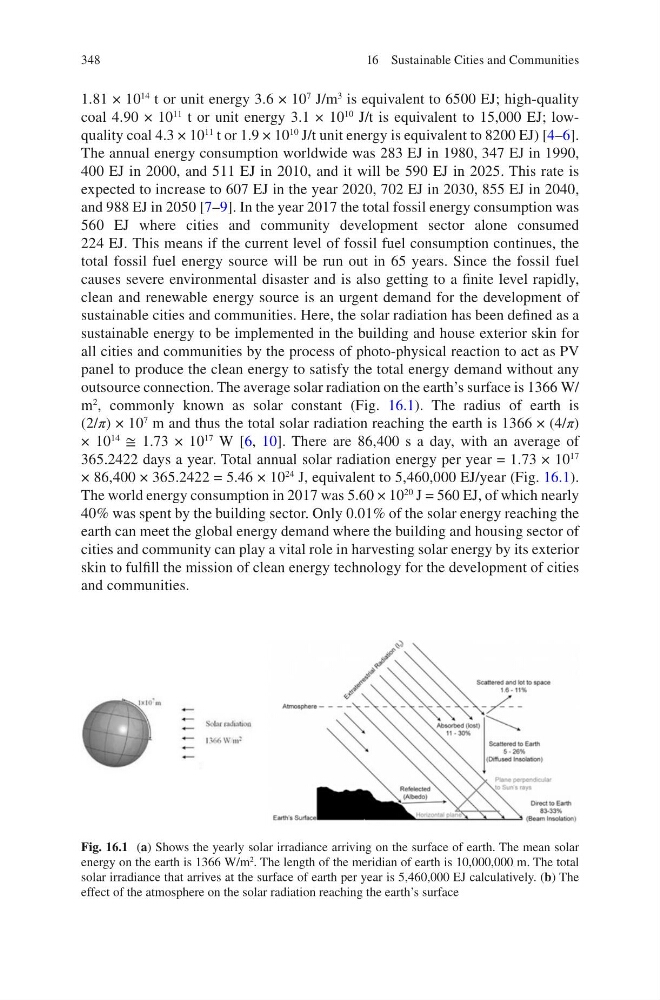
outsource connection. The average solar radiation on the earth’s surface is 1366 W/
m
2
, commonly known as solar constant (Fig. 16.1). The radius of earth is
(2/π) × 10
7
m and thus the total solar radiation reaching the earth is 1366 × (4/π)
× 10
14
≅ 1.73 × 10
17
W [6, 10]. There are 86,400 s a day, with an average of
365.2422 days a year. Total annual solar radiation energy per year = 1.73 × 10
17
× 86,400 × 365.2422 = 5.46 × 10
24
J, equivalent to 5,460,000 EJ/year (Fig. 16.1).
The world energy consumption in 2017 was 5.60 × 10
20
J = 560 EJ, of which nearly
40% was spent by the building sector. Only 0.01% of the solar energy reaching the
earth can meet the global energy demand where the building and housing sector of
cities and community can play a vital role in harvesting solar energy by its exterior
skin to fulfill the mission of clean energy technology for the development of cities
and communities.
Fig. 16.1 (a) Shows the yearly solar irradiance arriving on the surface of earth. The mean solar
energy on the earth is 1366 W/m
2 . The length of the meridian of earth is 10,000,000 m. The total
solar irradiance that arrives at the surface of earth per year is 5,460,000 EJ calculatively. (b) The
effect of the atmosphere on the solar radiation reaching the earth’s surface
16 Sustainable Cities and Communities
1.81 × 10
14
t or unit energy 3.6 × 10
7
J/m
3
is equivalent to 6500 EJ; high-quality
coal 4.90 × 10
11
t or unit energy 3.1 × 10
10
J/t is equivalent to 15,000 EJ; lowquality coal 4.3 × 10
11
t or 1.9 × 10
10
J/t unit energy is equivalent to 8200 EJ) [4–6].
The annual energy consumption worldwide was 283 EJ in 1980, 347 EJ in 1990,
400 EJ in 2000, and 511 EJ in 2010, and it will be 590 EJ in 2025. This rate is
expected to increase to 607 EJ in the year 2020, 702 EJ in 2030, 855 EJ in 2040,
and 988 EJ in 2050 [7–9]. In the year 2017 the total fossil energy consumption was
560 EJ where cities and community development sector alone consumed
224 EJ. This means if the current level of fossil fuel consumption continues, the
total fossil fuel energy source will be run out in 65 years. Since the fossil fuel
causes severe environmental disaster and is also getting to a finite level rapidly,
clean and renewable energy source is an urgent demand for the development of
sustainable cities and communities. Here, the solar radiation has been defined as a
sustainable energy to be implemented in the building and house exterior skin for
all cities and communities by the process of photo-physical reaction to act as PV
panel to produce the clean energy to satisfy the total energy demand without any
outsource connection. The average solar radiation on the earth’s surface is 1366 W/
m
2
, commonly known as solar constant (Fig. 16.1). The radius of earth is
(2/π) × 10
7
m and thus the total solar radiation reaching the earth is 1366 × (4/π)
× 10
14
≅ 1.73 × 10
17
W [6, 10]. There are 86,400 s a day, with an average of
365.2422 days a year. Total annual solar radiation energy per year = 1.73 × 10
17
× 86,400 × 365.2422 = 5.46 × 10
24
J, equivalent to 5,460,000 EJ/year (Fig. 16.1).
The world energy consumption in 2017 was 5.60 × 10
20
J = 560 EJ, of which nearly
40% was spent by the building sector. Only 0.01% of the solar energy reaching the
earth can meet the global energy demand where the building and housing sector of
cities and community can play a vital role in harvesting solar energy by its exterior
skin to fulfill the mission of clean energy technology for the development of cities
and communities.
Fig. 16.1 (a) Shows the yearly solar irradiance arriving on the surface of earth. The mean solar
energy on the earth is 1366 W/m
2 . The length of the meridian of earth is 10,000,000 m. The total
solar irradiance that arrives at the surface of earth per year is 5,460,000 EJ calculatively. (b) The
effect of the atmosphere on the solar radiation reaching the earth’s surface
16 Sustainable Cities and Communities