

297
process. As for the “tailing” region, many have regarded that it was owing to the
presence of a microbial subpopulation resistant to thermal sterilization. Najm [240]
also suggested that the “tailing” is due to the intrinsic distribution of bacterial resistance to the sterilization method, making the bacteria more resistant, adapted, and
inaccessible to heat treatment. Marugán et al. [211] reviewed that such “tailing” was
not a common phenomenon in water disinfection treatment. So far, no justifiable
explanation has been proposed to account for the occurrence of “tailing” in the
water disinfection treatment with well-mixed conditions and equally resistant
cloned bacterial population. It was suggested that the “tailing” was a result of gradual deterioration in the rate of disinfection, and total inactivation was achievable
only after a sufficient retention time. The random collisions between the catalyst
and bacteria can be expressed by the Poisson probability, as the number of collisions
supersedes prior to the number of microbial deaths [115]. If the destruction rate of
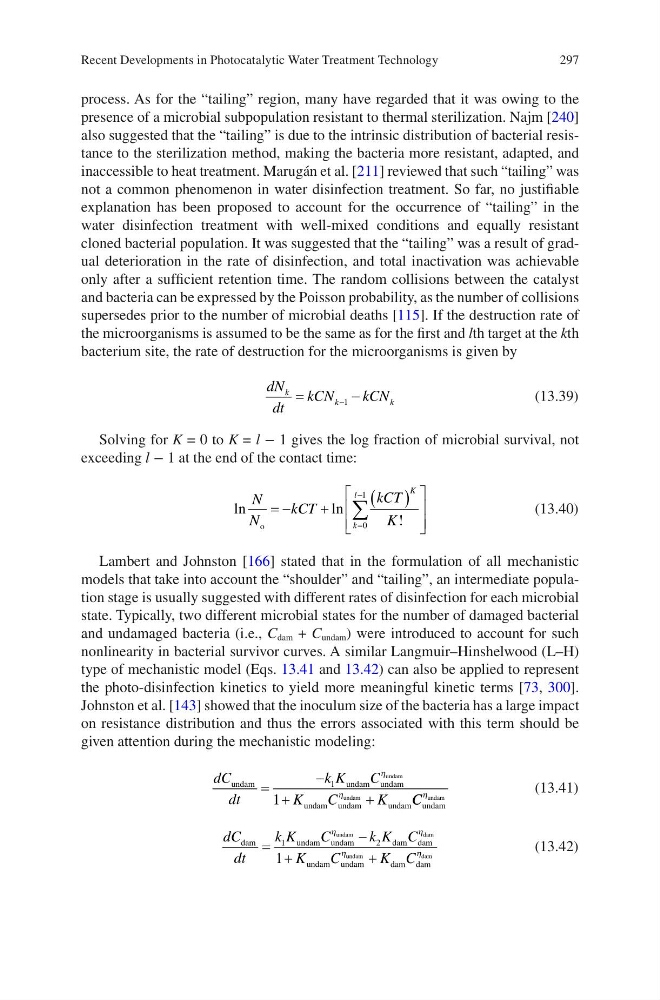
the microorganisms is assumed to be the same as for the first and lth target at the kth
bacterium site, the rate of destruction for the microorganisms is given by
dN
dt
kCN
kCN
k
k
k
=
−
−1
(13.39)
Solving for K = 0 to K = l − 1 gives the log fraction of microbial survival, not
exceeding l − 1 at the end of the contact time:
ln
ln
!
N
N
kCT
kCT
K
k
l
K
o
= −
+
( )
=
−
∑
0
1
(13.40)
Lambert and Johnston [166] stated that in the formulation of all mechanistic
models that take into account the “shoulder” and “tailing”, an intermediate population stage is usually suggested with different rates of disinfection for each microbial
state. Typically, two different microbial states for the number of damaged bacterial
and undamaged bacteria (i.e., C dam + C undam ) were introduced to account for such
nonlinearity in bacterial survivor curves. A similar Langmuir–Hinshelwood (L–H)
type of mechanistic model (Eqs. 13.41 and 13.42) can also be applied to represent
the photo-disinfection kinetics to yield more meaningful kinetic terms [73, 300].
Johnston et al. [143] showed that the inoculum size of the bacteria has a large impact
on resistance distribution and thus the errors associated with this term should be
given attention during the mechanistic modeling:
dC
dt
k K
C
K
C
K
undam
undam undam
undam undam
undam
undam
undam
=
−
+
+
1
1
η
η
C C undam
undam
η
(13.41)
dC
dt
k K
C
k K C
K
C
dam
undam undam
d am dam
undam undam
undam
d am
=
−
+
1
2
1
η
η
η u undam
d am
dam dam
+ K C
η
(13.42)
Recent Developments in Photocatalytic Water Treatment Technology
process. As for the “tailing” region, many have regarded that it was owing to the
presence of a microbial subpopulation resistant to thermal sterilization. Najm [240]
also suggested that the “tailing” is due to the intrinsic distribution of bacterial resistance to the sterilization method, making the bacteria more resistant, adapted, and
inaccessible to heat treatment. Marugán et al. [211] reviewed that such “tailing” was
not a common phenomenon in water disinfection treatment. So far, no justifiable
explanation has been proposed to account for the occurrence of “tailing” in the
water disinfection treatment with well-mixed conditions and equally resistant
cloned bacterial population. It was suggested that the “tailing” was a result of gradual deterioration in the rate of disinfection, and total inactivation was achievable
only after a sufficient retention time. The random collisions between the catalyst
and bacteria can be expressed by the Poisson probability, as the number of collisions
supersedes prior to the number of microbial deaths [115]. If the destruction rate of
the microorganisms is assumed to be the same as for the first and lth target at the kth
bacterium site, the rate of destruction for the microorganisms is given by
dN
dt
kCN
kCN
k
k
k
=
−
−1
(13.39)
Solving for K = 0 to K = l − 1 gives the log fraction of microbial survival, not
exceeding l − 1 at the end of the contact time:
ln
ln
!
N
N
kCT
kCT
K
k
l
K
o
= −
+
( )
=
−
∑
0
1
(13.40)
Lambert and Johnston [166] stated that in the formulation of all mechanistic
models that take into account the “shoulder” and “tailing”, an intermediate population stage is usually suggested with different rates of disinfection for each microbial
state. Typically, two different microbial states for the number of damaged bacterial
and undamaged bacteria (i.e., C dam + C undam ) were introduced to account for such
nonlinearity in bacterial survivor curves. A similar Langmuir–Hinshelwood (L–H)
type of mechanistic model (Eqs. 13.41 and 13.42) can also be applied to represent
the photo-disinfection kinetics to yield more meaningful kinetic terms [73, 300].
Johnston et al. [143] showed that the inoculum size of the bacteria has a large impact
on resistance distribution and thus the errors associated with this term should be
given attention during the mechanistic modeling:
dC
dt
k K
C
K
C
K
undam
undam undam
undam undam
undam
undam
undam
=
−
+
+
1
1
η
η
C C undam
undam
η
(13.41)
dC
dt
k K
C
k K C
K
C
dam
undam undam
d am dam
undam undam
undam
d am
=
−
+
1
2
1
η
η
η u undam
d am
dam dam
+ K C
η
(13.42)
Recent Developments in Photocatalytic Water Treatment Technology