

296
dS
dt
kCS
KCT
= +
1
(13.37)
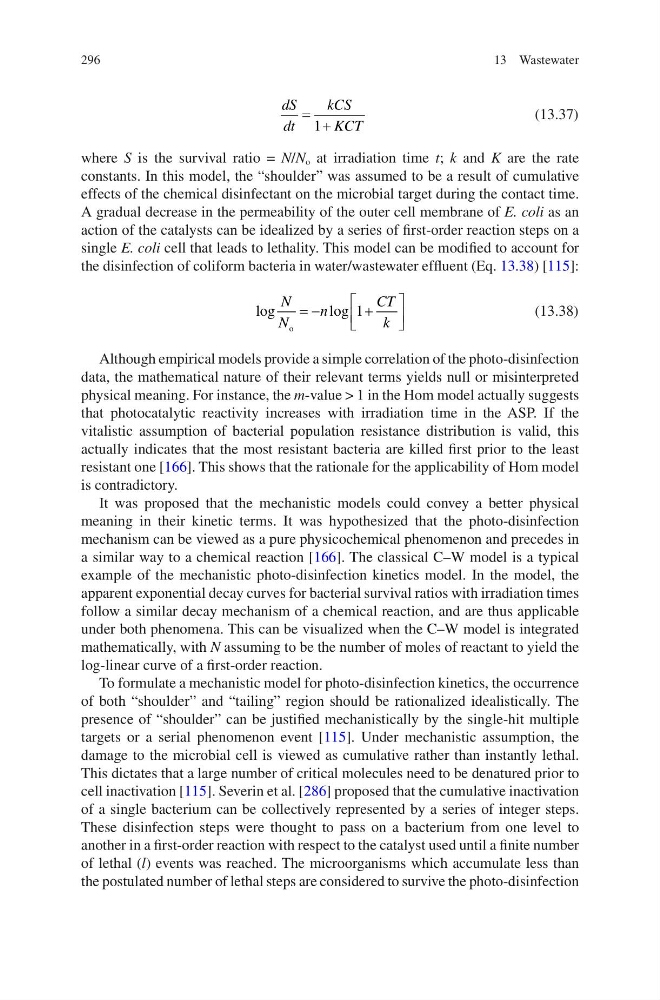
where S is the survival ratio = N/N o at irradiation time t; k and K are the rate
constants. In this model, the “shoulder” was assumed to be a result of cumulative
effects of the chemical disinfectant on the microbial target during the contact time.
A gradual decrease in the permeability of the outer cell membrane of E. coli as an
action of the catalysts can be idealized by a series of first-order reaction steps on a
single E. coli cell that leads to lethality. This model can be modified to account for
the disinfection of coliform bacteria in water/wastewater effluent (Eq. 13.38) [115]:
log
l og
N
N
n
CT
k
o
= −
+
1
(13.38)
Although empirical models provide a simple correlation of the photo- disinfection
data, the mathematical nature of their relevant terms yields null or misinterpreted
physical meaning. For instance, the m-value > 1 in the Hom model actually suggests
that photocatalytic reactivity increases with irradiation time in the ASP. If the
vitalistic assumption of bacterial population resistance distribution is valid, this
actually indicates that the most resistant bacteria are killed first prior to the least
resistant one [166]. This shows that the rationale for the applicability of Hom model
is contradictory.
It was proposed that the mechanistic models could convey a better physical
meaning in their kinetic terms. It was hypothesized that the photo-disinfection
mechanism can be viewed as a pure physicochemical phenomenon and precedes in
a similar way to a chemical reaction [166]. The classical C–W model is a typical
example of the mechanistic photo-disinfection kinetics model. In the model, the
apparent exponential decay curves for bacterial survival ratios with irradiation times
follow a similar decay mechanism of a chemical reaction, and are thus applicable
under both phenomena. This can be visualized when the C–W model is integrated
mathematically, with N assuming to be the number of moles of reactant to yield the
log-linear curve of a first-order reaction.
To formulate a mechanistic model for photo-disinfection kinetics, the occurrence
of both “shoulder” and “tailing” region should be rationalized idealistically. The
presence of “shoulder” can be justified mechanistically by the single-hit multiple
targets or a serial phenomenon event [115]. Under mechanistic assumption, the
damage to the microbial cell is viewed as cumulative rather than instantly lethal.
This dictates that a large number of critical molecules need to be denatured prior to
cell inactivation [115]. Severin et al. [286] proposed that the cumulative inactivation
of a single bacterium can be collectively represented by a series of integer steps.
These disinfection steps were thought to pass on a bacterium from one level to
another in a first-order reaction with respect to the catalyst used until a finite number
of lethal (l) events was reached. The microorganisms which accumulate less than
the postulated number of lethal steps are considered to survive the photo- disinfection
13 Wastewater
dS
dt
kCS
KCT
= +
1
(13.37)
where S is the survival ratio = N/N o at irradiation time t; k and K are the rate
constants. In this model, the “shoulder” was assumed to be a result of cumulative
effects of the chemical disinfectant on the microbial target during the contact time.
A gradual decrease in the permeability of the outer cell membrane of E. coli as an
action of the catalysts can be idealized by a series of first-order reaction steps on a
single E. coli cell that leads to lethality. This model can be modified to account for
the disinfection of coliform bacteria in water/wastewater effluent (Eq. 13.38) [115]:
log
l og
N
N
n
CT
k
o
= −
+
1
(13.38)
Although empirical models provide a simple correlation of the photo- disinfection
data, the mathematical nature of their relevant terms yields null or misinterpreted
physical meaning. For instance, the m-value > 1 in the Hom model actually suggests
that photocatalytic reactivity increases with irradiation time in the ASP. If the
vitalistic assumption of bacterial population resistance distribution is valid, this
actually indicates that the most resistant bacteria are killed first prior to the least
resistant one [166]. This shows that the rationale for the applicability of Hom model
is contradictory.
It was proposed that the mechanistic models could convey a better physical
meaning in their kinetic terms. It was hypothesized that the photo-disinfection
mechanism can be viewed as a pure physicochemical phenomenon and precedes in
a similar way to a chemical reaction [166]. The classical C–W model is a typical
example of the mechanistic photo-disinfection kinetics model. In the model, the
apparent exponential decay curves for bacterial survival ratios with irradiation times
follow a similar decay mechanism of a chemical reaction, and are thus applicable
under both phenomena. This can be visualized when the C–W model is integrated
mathematically, with N assuming to be the number of moles of reactant to yield the
log-linear curve of a first-order reaction.
To formulate a mechanistic model for photo-disinfection kinetics, the occurrence
of both “shoulder” and “tailing” region should be rationalized idealistically. The
presence of “shoulder” can be justified mechanistically by the single-hit multiple
targets or a serial phenomenon event [115]. Under mechanistic assumption, the
damage to the microbial cell is viewed as cumulative rather than instantly lethal.
This dictates that a large number of critical molecules need to be denatured prior to
cell inactivation [115]. Severin et al. [286] proposed that the cumulative inactivation
of a single bacterium can be collectively represented by a series of integer steps.
These disinfection steps were thought to pass on a bacterium from one level to
another in a first-order reaction with respect to the catalyst used until a finite number
of lethal (l) events was reached. The microorganisms which accumulate less than
the postulated number of lethal steps are considered to survive the photo- disinfection
13 Wastewater