

295
not well understood. Benabbou et al. [24] proposed that the “tailing” region was
related to the competition for photocatalysis between organic products released from
constant cell lyses and the remaining intact cells. Others have proposed that the “tailing” deviations from the log-linear reduction were due to the presence of variations
in the bacterial population resistant to the disinfectant used [166]. Nevertheless, the
use of CT concept or Hom model can lead to an overdesign for a photo-disinfection
system [92]. A further modification to the Hom model was made to account for the
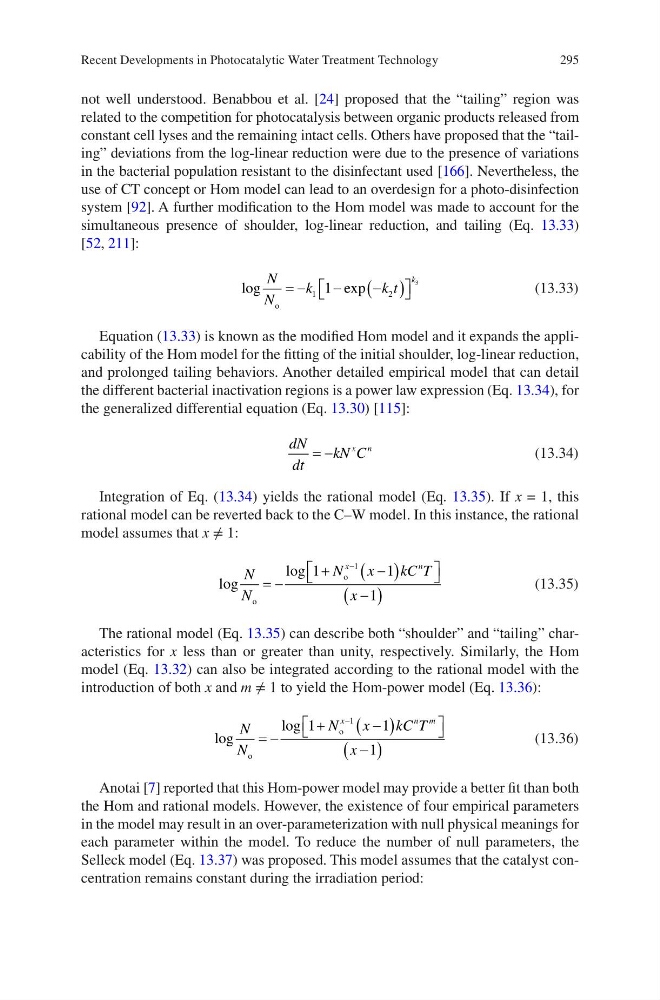
simultaneous presence of shoulder, log-linear reduction, and tailing (Eq. 13.33)
[52, 211]:
log
e xp
N
N
k
kt
k
o
= −
−
−
( )
1
2
1
3
(13.33)
Equation (13.33) is known as the modified Hom model and it expands the applicability of the Hom model for the fitting of the initial shoulder, log-linear reduction,
and prolonged tailing behaviors. Another detailed empirical model that can detail
the different bacterial inactivation regions is a power law expression (Eq. 13.34), for
the generalized differential equation (Eq. 13.30) [115]:
dN
dt
kN C
x n
= −
(13.34)
Integration of Eq. (13.34) yields the rational model (Eq. 13.35). If x = 1, this
rational model can be reverted back to the C–W model. In this instance, the rational
model assumes that x ≠ 1:
log
log
N
N
N
x
kC T
x
x
n
o
o
= −
+
−
( )
−
( )
−
1
1
1
1
(13.35)
The rational model (Eq. 13.35) can describe both “shoulder” and “tailing” characteristics for x less than or greater than unity, respectively. Similarly, the Hom
model (Eq. 13.32) can also be integrated according to the rational model with the
introduction of both x and m ≠ 1 to yield the Hom-power model (Eq. 13.36):
log
log
N
N
N
x
kC T
x
x
nm
o
o
= −
+
−
( )
−
( )
−
1
1
1
1
(13.36)
Anotai [7] reported that this Hom-power model may provide a better fit than both
the Hom and rational models. However, the existence of four empirical parameters
in the model may result in an over-parameterization with null physical meanings for
each parameter within the model. To reduce the number of null parameters, the
Selleck model (Eq. 13.37) was proposed. This model assumes that the catalyst concentration remains constant during the irradiation period:
Recent Developments in Photocatalytic Water Treatment Technology
not well understood. Benabbou et al. [24] proposed that the “tailing” region was
related to the competition for photocatalysis between organic products released from
constant cell lyses and the remaining intact cells. Others have proposed that the “tailing” deviations from the log-linear reduction were due to the presence of variations
in the bacterial population resistant to the disinfectant used [166]. Nevertheless, the
use of CT concept or Hom model can lead to an overdesign for a photo-disinfection
system [92]. A further modification to the Hom model was made to account for the
simultaneous presence of shoulder, log-linear reduction, and tailing (Eq. 13.33)
[52, 211]:
log
e xp
N
N
k
kt
k
o
= −
−
−
( )
1
2
1
3
(13.33)
Equation (13.33) is known as the modified Hom model and it expands the applicability of the Hom model for the fitting of the initial shoulder, log-linear reduction,
and prolonged tailing behaviors. Another detailed empirical model that can detail
the different bacterial inactivation regions is a power law expression (Eq. 13.34), for
the generalized differential equation (Eq. 13.30) [115]:
dN
dt
kN C
x n
= −
(13.34)
Integration of Eq. (13.34) yields the rational model (Eq. 13.35). If x = 1, this
rational model can be reverted back to the C–W model. In this instance, the rational
model assumes that x ≠ 1:
log
log
N
N
N
x
kC T
x
x
n
o
o
= −
+
−
( )
−
( )
−
1
1
1
1
(13.35)
The rational model (Eq. 13.35) can describe both “shoulder” and “tailing” characteristics for x less than or greater than unity, respectively. Similarly, the Hom
model (Eq. 13.32) can also be integrated according to the rational model with the
introduction of both x and m ≠ 1 to yield the Hom-power model (Eq. 13.36):
log
log
N
N
N
x
kC T
x
x
nm
o
o
= −
+
−
( )
−
( )
−
1
1
1
1
(13.36)
Anotai [7] reported that this Hom-power model may provide a better fit than both
the Hom and rational models. However, the existence of four empirical parameters
in the model may result in an over-parameterization with null physical meanings for
each parameter within the model. To reduce the number of null parameters, the
Selleck model (Eq. 13.37) was proposed. This model assumes that the catalyst concentration remains constant during the irradiation period:
Recent Developments in Photocatalytic Water Treatment Technology