

265
how the presence of oxygen prevents the recombination of electron/hole pair while
allowing the formation of superoxide radical ( O 2
⋅− ). This O 2
⋅− radical can be further
protonated to form the hydroperoxyl radical (HO 2
•
) and subsequently H 2 O 2 as shown
in Eqs. (13.9) and (13.10), respectively. The HO 2
•
radical formed was also reported to
have scavenging property and thus the coexistence of these radical species can doubly
prolong the recombination time of the h TR
+
in the entire photocatalysis reaction.
However it should be noted that all these occurrences in photocatalysis were attributed
to the presence of both dissolved oxygen (DO) and water molecules. Without the presence of water molecules, the highly reactive hydroxyl radicals (OH
•
) could not be
formed and impede the photodegradation of liquid-phase organics. This was evidenced from a few reports that the photocatalysis reaction did not proceed in the
absence of water molecules. Some simple organic compounds (e.g., oxalate and formic acid) can be mineralized by direct electrochemical oxidation where the e TR is
scavenged by metal ions in the system without water being present [37]. Although the
h TR
+
has been widely regarded for its ability to oxidize organic species directly, this
possibility has remained inconclusive. The h TR
+ is a powerful oxidant (+1.0 to +3.5 V
against NHE), while e TR
− is a good redundant (+0.5 to −1.5 V against NHE), depending on the type of catalysts and oxidation conditions.
Many elementary mechanistic studies on different surrogate organic compounds
(e.g., phenol, chlorophenol, oxalic acid) have been extensively investigated in the
photodegradation over TiO 2 surface. Aromatic compounds can be hydroxylated by
the reactive OH
•
radical that leads to successive oxidation/addition and eventually
ring opening. The resulting intermediates, mostly aldehydes and carboxylic acids,
will be further carboxylated to produce innocuous carbon dioxide and water. Since
the photocatalysis reaction occurs on the photon-activated surface of TiO 2 , the
understanding of the reaction steps that involve photodegradation of organics is
essential in the formulation of kinetic expression. For heterogeneous photocatalysis,
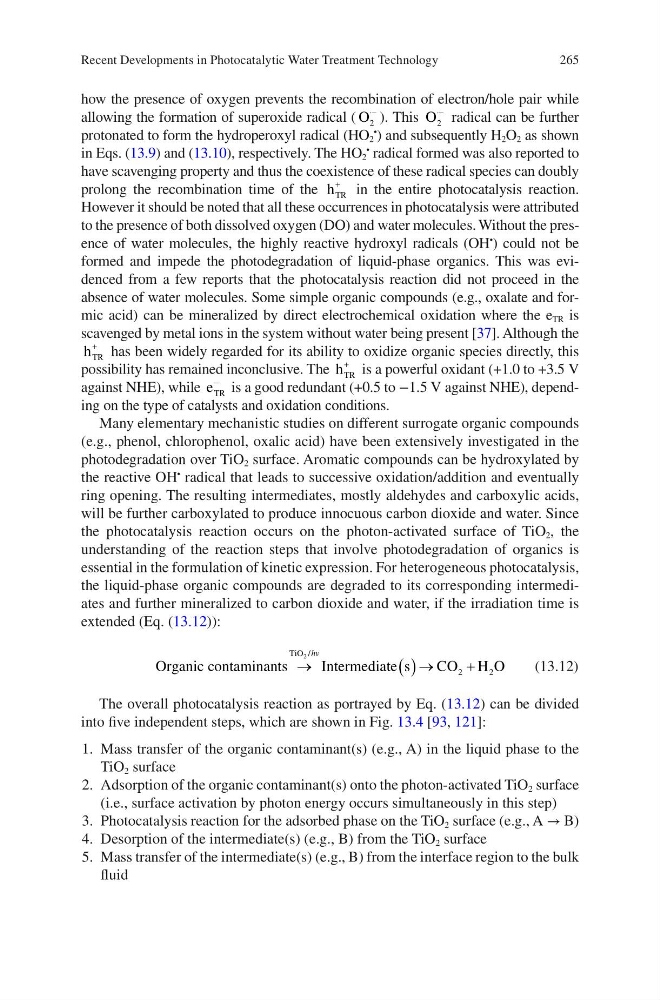
the liquid-phase organic compounds are degraded to its corresponding intermediates and further mineralized to carbon dioxide and water, if the irradiation time is
extended (Eq. (13.12)):
Organic contaminants
Intermediate s
CO H O
TiO
→
( ) →
+
2
2
2
/hv
(13.12)
The overall photocatalysis reaction as portrayed by Eq. (13.12) can be divided
into five independent steps, which are shown in Fig. 13.4 [93, 121]:
1. Mass transfer of the organic contaminant(s) (e.g., A) in the liquid phase to the
TiO 2 surface
2. Adsorption of the organic contaminant(s) onto the photon-activated TiO 2 surface
(i.e., surface activation by photon energy occurs simultaneously in this step)
3. Photocatalysis reaction for the adsorbed phase on the TiO 2 surface (e.g., A → B)
4. Desorption of the intermediate(s) (e.g., B) from the TiO 2 surface
5. Mass transfer of the intermediate(s) (e.g., B) from the interface region to the bulk
fluid
Recent Developments in Photocatalytic Water Treatment Technology
how the presence of oxygen prevents the recombination of electron/hole pair while
allowing the formation of superoxide radical ( O 2
⋅− ). This O 2
⋅− radical can be further
protonated to form the hydroperoxyl radical (HO 2
•
) and subsequently H 2 O 2 as shown
in Eqs. (13.9) and (13.10), respectively. The HO 2
•
radical formed was also reported to
have scavenging property and thus the coexistence of these radical species can doubly
prolong the recombination time of the h TR
+
in the entire photocatalysis reaction.
However it should be noted that all these occurrences in photocatalysis were attributed
to the presence of both dissolved oxygen (DO) and water molecules. Without the presence of water molecules, the highly reactive hydroxyl radicals (OH
•
) could not be
formed and impede the photodegradation of liquid-phase organics. This was evidenced from a few reports that the photocatalysis reaction did not proceed in the
absence of water molecules. Some simple organic compounds (e.g., oxalate and formic acid) can be mineralized by direct electrochemical oxidation where the e TR is
scavenged by metal ions in the system without water being present [37]. Although the
h TR
+
has been widely regarded for its ability to oxidize organic species directly, this
possibility has remained inconclusive. The h TR
+ is a powerful oxidant (+1.0 to +3.5 V
against NHE), while e TR
− is a good redundant (+0.5 to −1.5 V against NHE), depending on the type of catalysts and oxidation conditions.
Many elementary mechanistic studies on different surrogate organic compounds
(e.g., phenol, chlorophenol, oxalic acid) have been extensively investigated in the
photodegradation over TiO 2 surface. Aromatic compounds can be hydroxylated by
the reactive OH
•
radical that leads to successive oxidation/addition and eventually
ring opening. The resulting intermediates, mostly aldehydes and carboxylic acids,
will be further carboxylated to produce innocuous carbon dioxide and water. Since
the photocatalysis reaction occurs on the photon-activated surface of TiO 2 , the
understanding of the reaction steps that involve photodegradation of organics is
essential in the formulation of kinetic expression. For heterogeneous photocatalysis,
the liquid-phase organic compounds are degraded to its corresponding intermediates and further mineralized to carbon dioxide and water, if the irradiation time is
extended (Eq. (13.12)):
Organic contaminants
Intermediate s
CO H O
TiO
→
( ) →
+
2
2
2
/hv
(13.12)
The overall photocatalysis reaction as portrayed by Eq. (13.12) can be divided
into five independent steps, which are shown in Fig. 13.4 [93, 121]:
1. Mass transfer of the organic contaminant(s) (e.g., A) in the liquid phase to the
TiO 2 surface
2. Adsorption of the organic contaminant(s) onto the photon-activated TiO 2 surface
(i.e., surface activation by photon energy occurs simultaneously in this step)
3. Photocatalysis reaction for the adsorbed phase on the TiO 2 surface (e.g., A → B)
4. Desorption of the intermediate(s) (e.g., B) from the TiO 2 surface
5. Mass transfer of the intermediate(s) (e.g., B) from the interface region to the bulk
fluid
Recent Developments in Photocatalytic Water Treatment Technology