

264
Photoexcited e scavenging O
e
O
ads
−
−
⋅−
( ) + →
: 2
2
(13.5)
Oxidation of hydroxyls OH h
OH
:
−
+
⋅
+ →
(13.6)
Photodegradation by OH R H OH
R H O
⋅
⋅
′⋅
+
→ +
: −
2
(13.7)
Direct photoholes:
R h
R
Intermediate s Final degradation products
+ →
→
( )
+
+ ⋅
/
(13.8)
Protonation of superoxides O OH
HOO
: 2
⋅−
⋅
⋅
+
→
(13.9)
Co-scavenging of e HOO e
HO
−
⋅
−
−
+ →
:
2
(13.10)
Formation of H O HOO H
H O
2 2
2 2
:
−
+
+
→
(13.11)
The e TR
− and h TR
+ in Eq. (13.4) represent the surface-trapped valence-band electron
and conduction-band hole, respectively. It was reported that these trapped carriers are
usually TiO 2 surface bounded and do not recombine immediately after photon excitation [101]. In the absence of electron scavengers (Eq. 13.4), the photoexcited electron
recombines with the valence-band hole in nanoseconds with simultaneous dissipation
of heat energy. Thus, the presence of electron scavengers is vital for prolonging the
recombination and successful functioning of photocatalysis. Equation (13.5) depicts
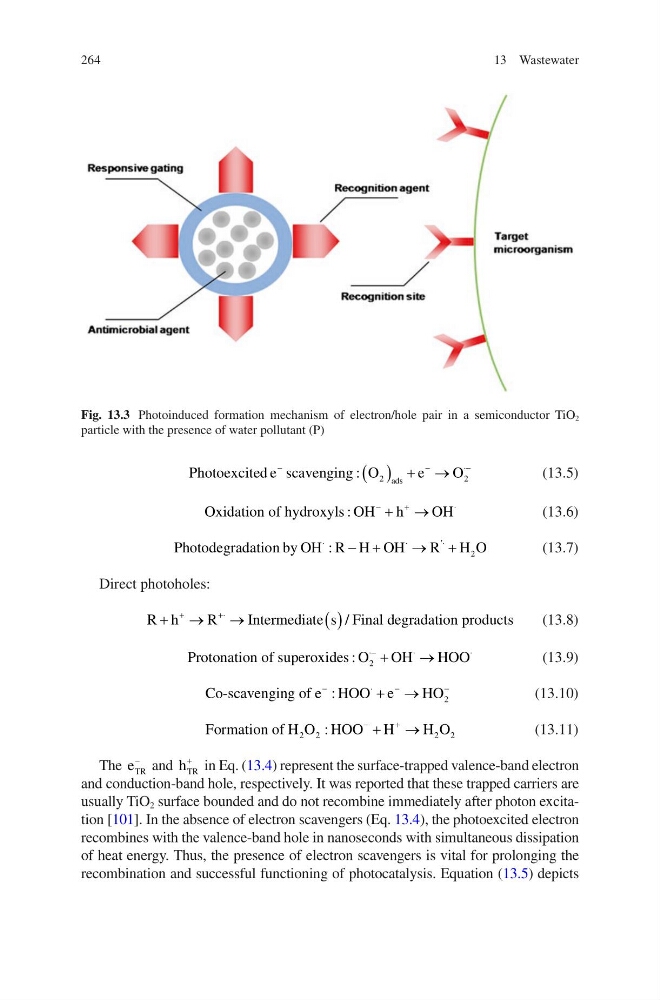
Fig. 13.3 Photoinduced formation mechanism of electron/hole pair in a semiconductor TiO 2
particle with the presence of water pollutant (P)
13 Wastewater
Photoexcited e scavenging O
e
O
ads
−
−
⋅−
( ) + →
: 2
2
(13.5)
Oxidation of hydroxyls OH h
OH
:
−
+
⋅
+ →
(13.6)
Photodegradation by OH R H OH
R H O
⋅
⋅
′⋅
+
→ +
: −
2
(13.7)
Direct photoholes:
R h
R
Intermediate s Final degradation products
+ →
→
( )
+
+ ⋅
/
(13.8)
Protonation of superoxides O OH
HOO
: 2
⋅−
⋅
⋅
+
→
(13.9)
Co-scavenging of e HOO e
HO
−
⋅
−
−
+ →
:
2
(13.10)
Formation of H O HOO H
H O
2 2
2 2
:
−
+
+
→
(13.11)
The e TR
− and h TR
+ in Eq. (13.4) represent the surface-trapped valence-band electron
and conduction-band hole, respectively. It was reported that these trapped carriers are
usually TiO 2 surface bounded and do not recombine immediately after photon excitation [101]. In the absence of electron scavengers (Eq. 13.4), the photoexcited electron
recombines with the valence-band hole in nanoseconds with simultaneous dissipation
of heat energy. Thus, the presence of electron scavengers is vital for prolonging the
recombination and successful functioning of photocatalysis. Equation (13.5) depicts
Fig. 13.3 Photoinduced formation mechanism of electron/hole pair in a semiconductor TiO 2
particle with the presence of water pollutant (P)
13 Wastewater