

228
water system, many other factors also influence the total quantity of water available
at any given time and proportions of water loss in the system and thus, in this model,
calculation of water of wetlands and artificial reservoirs, runoff characteristics of
the land in the watershed, storage capacity in lakes, timing of precipitation, permeability of the soil beneath these storage bodies, and local evaporation rates are also
clarified computationally. Additionally, the groundwater analysis has been conducted which refers to the part of surface water located in the subsurface pore space
of soil and rocks and the water flows within aquifers below the water table which is
seepage from surface water and springs, respectively [7, 10].
Results and Discussion
The results of net water resources on earth suggested that split-explicit hydrostatic
and hydrodynamic is temporal at an average barotropic mode to account for the
exact conservation and constancy preservation of natural water which can be
expressed as
∂
∂
+… = − ∇ +
∇ +
{
}
Du
t
gD
gD
x
x
ζ
ζ
(12.7)
Here, ζ refers to the earth surface, and ρ 0 refers to a constant water density, g is
the acceleration of gravity, D = h + ζ is the total depth, u is the depth-averaged
velocity, ∇ x ζ is a shorthand for ∂ζ/∂x, and F is the vertically integrated pressure
gradient:
= −
∂
∂
−
∫
1
0
ρ
ζ
h
P
x
dz
(12.8)
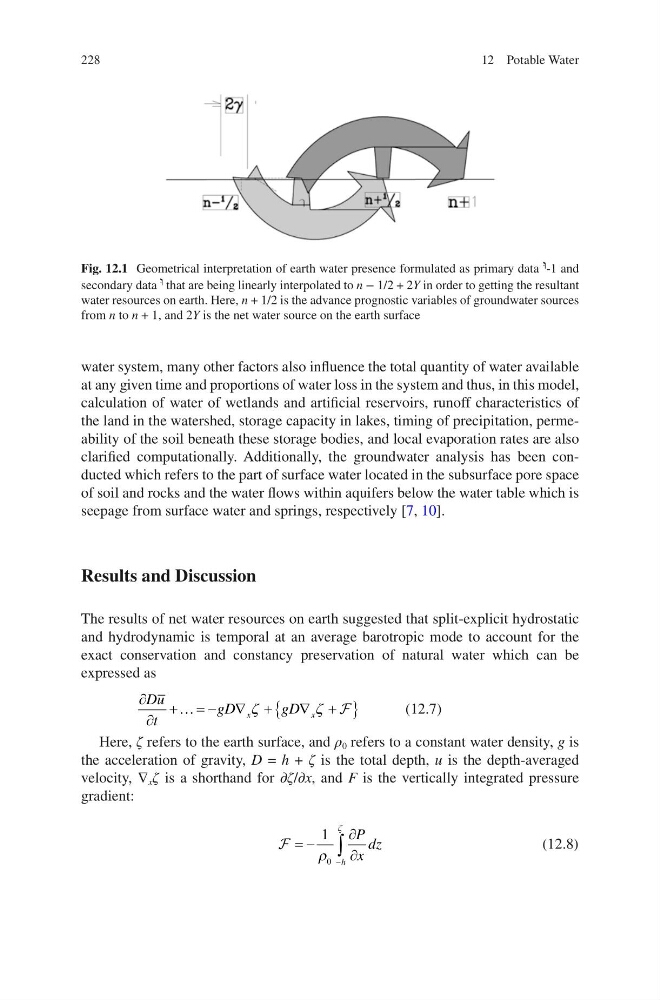
Fig. 12.1 Geometrical interpretation of earth water presence formulated as primary data וּ -1 and
secondary data וּ that are being linearly interpolated to n − 1/2 + 2Y in order to getting the resultant
water resources on earth. Here, n + 1/2 is the advance prognostic variables of groundwater sources
from n to n + 1, and 2Y is the net water source on the earth surface
12 Potable Water
water system, many other factors also influence the total quantity of water available
at any given time and proportions of water loss in the system and thus, in this model,
calculation of water of wetlands and artificial reservoirs, runoff characteristics of
the land in the watershed, storage capacity in lakes, timing of precipitation, permeability of the soil beneath these storage bodies, and local evaporation rates are also
clarified computationally. Additionally, the groundwater analysis has been conducted which refers to the part of surface water located in the subsurface pore space
of soil and rocks and the water flows within aquifers below the water table which is
seepage from surface water and springs, respectively [7, 10].
Results and Discussion
The results of net water resources on earth suggested that split-explicit hydrostatic
and hydrodynamic is temporal at an average barotropic mode to account for the
exact conservation and constancy preservation of natural water which can be
expressed as
∂
∂
+… = − ∇ +
∇ +
{
}
Du
t
gD
gD
x
x
ζ
ζ
(12.7)
Here, ζ refers to the earth surface, and ρ 0 refers to a constant water density, g is
the acceleration of gravity, D = h + ζ is the total depth, u is the depth-averaged
velocity, ∇ x ζ is a shorthand for ∂ζ/∂x, and F is the vertically integrated pressure
gradient:
= −
∂
∂
−
∫
1
0
ρ
ζ
h
P
x
dz
(12.8)
Fig. 12.1 Geometrical interpretation of earth water presence formulated as primary data וּ -1 and
secondary data וּ that are being linearly interpolated to n − 1/2 + 2Y in order to getting the resultant
water resources on earth. Here, n + 1/2 is the advance prognostic variables of groundwater sources
from n to n + 1, and 2Y is the net water source on the earth surface
12 Potable Water