

219
energy, V d is the d axis energy, ω r is the rate of change of angular position of the
rotor, λ is the amplitude of flux prompted, and p is the quantity of pairs of poles. The
equivalence that follows, which can be applicable in conjunction with a static d–q
frame of reference for dynamic modeling, is relevant with regard to a squirrel cage
induction dynamo (SCIG):
The equations that are applicable for the stator side are
The equations that are applicable for the rotor side are
The equations that apply to the air gap flux connotation are
where R s , R r , L m , L ls , L lr , ω r , i d , i q , V d , V q , λ d , and λ q are the stator winding resistance,
motor winding resistance, fascinating inductance, stator leakage inductance, rotor
leakage inductance, electrical rotor angular velocity, flow of electricity, energy,
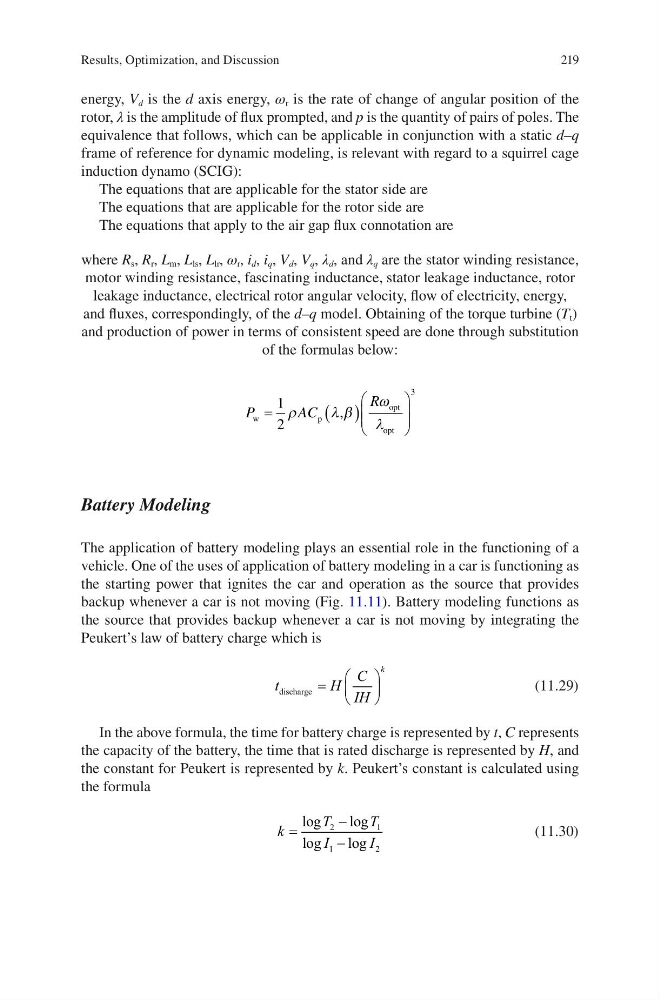
and fluxes, correspondingly, of the d–q model. Obtaining of the torque turbine (T t )
and production of power in terms of consistent speed are done through substitution
of the formulas below:
P
AC
R
w
p
opt
opt
,
=
( )
1
2
3
ρ
λβ
ω
λ
Battery Modeling
The application of battery modeling plays an essential role in the functioning of a
vehicle. One of the uses of application of battery modeling in a car is functioning as
the starting power that ignites the car and operation as the source that provides
backup whenever a car is not moving (Fig. 11.11). Battery modeling functions as
the source that provides backup whenever a car is not moving by integrating the
Peukert’s law of battery charge which is
t
H
C
IH
k
discharge =
(11.29)
In the above formula, the time for battery charge is represented by t, C represents
the capacity of the battery, the time that is rated discharge is represented by H, and
the constant for Peukert is represented by k. Peukert’s constant is calculated using
the formula
k
T
T
I
I
=
−
−
log
log
log
log
2
1
1
2
(11.30)
Results, Optimization, and Discussion
energy, V d is the d axis energy, ω r is the rate of change of angular position of the
rotor, λ is the amplitude of flux prompted, and p is the quantity of pairs of poles. The
equivalence that follows, which can be applicable in conjunction with a static d–q
frame of reference for dynamic modeling, is relevant with regard to a squirrel cage
induction dynamo (SCIG):
The equations that are applicable for the stator side are
The equations that are applicable for the rotor side are
The equations that apply to the air gap flux connotation are
where R s , R r , L m , L ls , L lr , ω r , i d , i q , V d , V q , λ d , and λ q are the stator winding resistance,
motor winding resistance, fascinating inductance, stator leakage inductance, rotor
leakage inductance, electrical rotor angular velocity, flow of electricity, energy,
and fluxes, correspondingly, of the d–q model. Obtaining of the torque turbine (T t )
and production of power in terms of consistent speed are done through substitution
of the formulas below:
P
AC
R
w
p
opt
opt
,
=
( )
1
2
3
ρ
λβ
ω
λ
Battery Modeling
The application of battery modeling plays an essential role in the functioning of a
vehicle. One of the uses of application of battery modeling in a car is functioning as
the starting power that ignites the car and operation as the source that provides
backup whenever a car is not moving (Fig. 11.11). Battery modeling functions as
the source that provides backup whenever a car is not moving by integrating the
Peukert’s law of battery charge which is
t
H
C
IH
k
discharge =
(11.29)
In the above formula, the time for battery charge is represented by t, C represents
the capacity of the battery, the time that is rated discharge is represented by H, and
the constant for Peukert is represented by k. Peukert’s constant is calculated using
the formula
k
T
T
I
I
=
−
−
log
log
log
log
2
1
1
2
(11.30)
Results, Optimization, and Discussion