

181
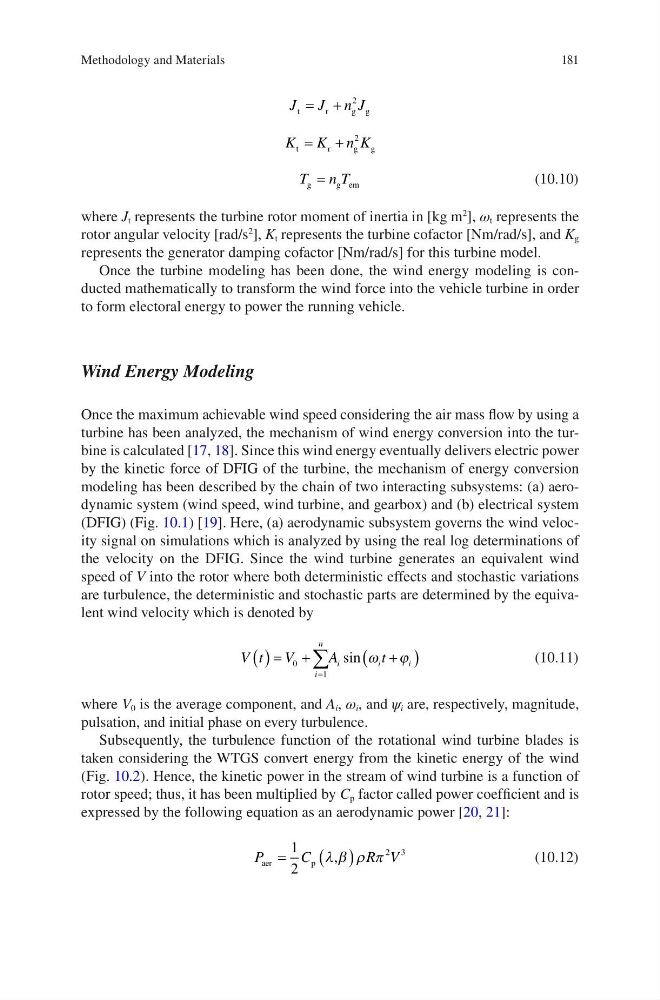
J J n J
t
r
g g
= +
2
K K n K
t
r
g g
= +
2
T n T
g
g em
=
(10.10)
where J t represents the turbine rotor moment of inertia in [kg m
2
], ω t represents the
rotor angular velocity [rad/s
2
], K t represents the turbine cofactor [Nm/rad/s], and K g
represents the generator damping cofactor [Nm/rad/s] for this turbine model.
Once the turbine modeling has been done, the wind energy modeling is conducted mathematically to transform the wind force into the vehicle turbine in order
to form electoral energy to power the running vehicle.
Wind Energy Modeling
Once the maximum achievable wind speed considering the air mass flow by using a
turbine has been analyzed, the mechanism of wind energy conversion into the turbine is calculated [17, 18]. Since this wind energy eventually delivers electric power
by the kinetic force of DFIG of the turbine, the mechanism of energy conversion
modeling has been described by the chain of two interacting subsystems: (a) aerodynamic system (wind speed, wind turbine, and gearbox) and (b) electrical system
(DFIG) (Fig. 10.1) [19]. Here, (a) aerodynamic subsystem governs the wind velocity signal on simulations which is analyzed by using the real log determinations of
the velocity on the DFIG. Since the wind turbine generates an equivalent wind
speed of V into the rotor where both deterministic effects and stochastic variations
are turbulence, the deterministic and stochastic parts are determined by the equivalent wind velocity which is denoted by
V t V
A
t
i
n
i
i
i
( ) = +
+
(
)
=
∑
0
1
sin ω ϕ
(10.11)
where V 0 is the average component, and A i , ω i , and ψ i are, respectively, magnitude,
pulsation, and initial phase on every turbulence.
Subsequently, the turbulence function of the rotational wind turbine blades is
taken considering the WTGS convert energy from the kinetic energy of the wind
(Fig. 10.2). Hence, the kinetic power in the stream of wind turbine is a function of
rotor speed; thus, it has been multiplied by C p factor called power coefficient and is
expressed by the following equation as an aerodynamic power [20, 21]:
P
C
R V
aer
p
,
=
( )
1
2
2 3
λ β ρ π
(10.12)
Methodology and Materials
J J n J
t
r
g g
= +
2
K K n K
t
r
g g
= +
2
T n T
g
g em
=
(10.10)
where J t represents the turbine rotor moment of inertia in [kg m
2
], ω t represents the
rotor angular velocity [rad/s
2
], K t represents the turbine cofactor [Nm/rad/s], and K g
represents the generator damping cofactor [Nm/rad/s] for this turbine model.
Once the turbine modeling has been done, the wind energy modeling is conducted mathematically to transform the wind force into the vehicle turbine in order
to form electoral energy to power the running vehicle.
Wind Energy Modeling
Once the maximum achievable wind speed considering the air mass flow by using a
turbine has been analyzed, the mechanism of wind energy conversion into the turbine is calculated [17, 18]. Since this wind energy eventually delivers electric power
by the kinetic force of DFIG of the turbine, the mechanism of energy conversion
modeling has been described by the chain of two interacting subsystems: (a) aerodynamic system (wind speed, wind turbine, and gearbox) and (b) electrical system
(DFIG) (Fig. 10.1) [19]. Here, (a) aerodynamic subsystem governs the wind velocity signal on simulations which is analyzed by using the real log determinations of
the velocity on the DFIG. Since the wind turbine generates an equivalent wind
speed of V into the rotor where both deterministic effects and stochastic variations
are turbulence, the deterministic and stochastic parts are determined by the equivalent wind velocity which is denoted by
V t V
A
t
i
n
i
i
i
( ) = +
+
(
)
=
∑
0
1
sin ω ϕ
(10.11)
where V 0 is the average component, and A i , ω i , and ψ i are, respectively, magnitude,
pulsation, and initial phase on every turbulence.
Subsequently, the turbulence function of the rotational wind turbine blades is
taken considering the WTGS convert energy from the kinetic energy of the wind
(Fig. 10.2). Hence, the kinetic power in the stream of wind turbine is a function of
rotor speed; thus, it has been multiplied by C p factor called power coefficient and is
expressed by the following equation as an aerodynamic power [20, 21]:
P
C
R V
aer
p
,
=
( )
1
2
2 3
λ β ρ π
(10.12)
Methodology and Materials