

179
Here ρ represents the air density (kg/m
3
), C p represents the power coefficient, A is
considered as the intercepting area of the wind rotor blades (m
2
), V represents the
average wind speed (m/s), and λ represents the tip speed ratio [11, 13]. Here, the
peak value of the energy coefficient C p is 0.593 [8, 14]. Thus, the average tip speed
ratio (TSR) of wind turbine is defined from the rate of its rotational velocity, which
is mathematically calculated as
λ
ω
=
R
V
(10.2)
where R denotes the radius of turbine (m), ω denotes the angular velocity (rad/s),
and V is the mean wind velocity (m/s). The power governed by wind turbine is thus
calculated as the following equation:
Q
P
w
Time kWh
= ×(
)[
]
(10.3)
Since various factors can interfere the wind, the wind velocity is measured by
dynamic wind speed with respect to factorial error proneness due to accountable
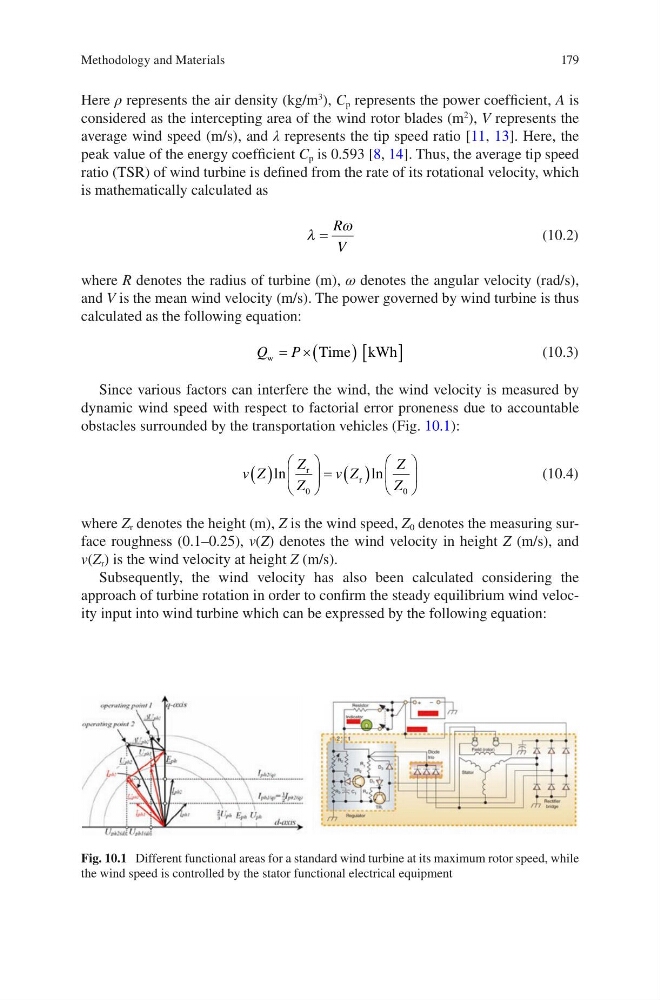
obstacles surrounded by the transportation vehicles (Fig. 10.1):
v Z
Z
Z
v Z
Z
Z
( )
= ( )
ln
ln
r
r
0
0
(10.4)
where Z r denotes the height (m), Z is the wind speed, Z 0 denotes the measuring surface roughness (0.1–0.25), v(Z) denotes the wind velocity in height Z (m/s), and
v(Z r ) is the wind velocity at height Z (m/s).
Subsequently, the wind velocity has also been calculated considering the
approach of turbine rotation in order to confirm the steady equilibrium wind velocity input into wind turbine which can be expressed by the following equation:
Fig. 10.1 Different functional areas for a standard wind turbine at its maximum rotor speed, while
the wind speed is controlled by the stator functional electrical equipment
Methodology and Materials
Here ρ represents the air density (kg/m
3
), C p represents the power coefficient, A is
considered as the intercepting area of the wind rotor blades (m
2
), V represents the
average wind speed (m/s), and λ represents the tip speed ratio [11, 13]. Here, the
peak value of the energy coefficient C p is 0.593 [8, 14]. Thus, the average tip speed
ratio (TSR) of wind turbine is defined from the rate of its rotational velocity, which
is mathematically calculated as
λ
ω
=
R
V
(10.2)
where R denotes the radius of turbine (m), ω denotes the angular velocity (rad/s),
and V is the mean wind velocity (m/s). The power governed by wind turbine is thus
calculated as the following equation:
Q
P
w
Time kWh
= ×(
)[
]
(10.3)
Since various factors can interfere the wind, the wind velocity is measured by
dynamic wind speed with respect to factorial error proneness due to accountable
obstacles surrounded by the transportation vehicles (Fig. 10.1):
v Z
Z
Z
v Z
Z
Z
( )
= ( )
ln
ln
r
r
0
0
(10.4)
where Z r denotes the height (m), Z is the wind speed, Z 0 denotes the measuring surface roughness (0.1–0.25), v(Z) denotes the wind velocity in height Z (m/s), and
v(Z r ) is the wind velocity at height Z (m/s).
Subsequently, the wind velocity has also been calculated considering the
approach of turbine rotation in order to confirm the steady equilibrium wind velocity input into wind turbine which can be expressed by the following equation:
Fig. 10.1 Different functional areas for a standard wind turbine at its maximum rotor speed, while
the wind speed is controlled by the stator functional electrical equipment
Methodology and Materials