

178
opment and implementation can be interesting to utilize wind power to reduce the
impact on energy, ecosystems, and local communities. Simply, wind power has the
tremendous potential to meet the near-term (2020) and long-term (2050) energy
mitigation goal and greenhouse gas (GHG) emission reductions once appropriate
technology has been developed. Though a series of wind power technologies are
available across the world which meet nearly 1.8% of global electricity demand, the
functional use of wind power in relevance to transportation vehicles to generate
electricity is yet limited [7]. Since the wind power interestingly has a great potential
to be converted into energy for running transportation vehicles, this research has
implemented the wind turbine placement in the running vehicle to satisfy its required
energy demand. Thus, the wind turbine modeling is conducted by MATLAB
Simulink in this research where the drivetrain model, wind energy conversion chain
analysis, kinetic energy conversion mechanism, two interacting main subsystems,
and the detailed process of energy conversion system have been calculated mathematically. Subsequently, the control structure, designing, and generator modeling
are also analyzed by a set of mathematical calculations for total process of wind
energy capture and utilization of it for the transportation vehicle. In order to prove
this mechanism for commercial utilization, this technology is introduced into a
sedan automobile as an experiment. Interesting experimental results suggested that
wind energy implementation in the running vehicle is very much functional which
indeed could be an innovative technology for the transportation sector to meet their
complete energy demand.
Methodology and Materials
Turbine Modeling for Transportation Sector
Since the differential speed of wind turbine is governed by its electronic equipment,
the wind turbine has been proposed to be installed into the vehicle to power the running vehicles through wind [8, 9]. Naturally a mathematical mechanism has been
computed in order to simulate the DFIG for producing electricity energy from wind
to run the transportation vehicle [4, 10]. Subsequently, the mechanical portion of the
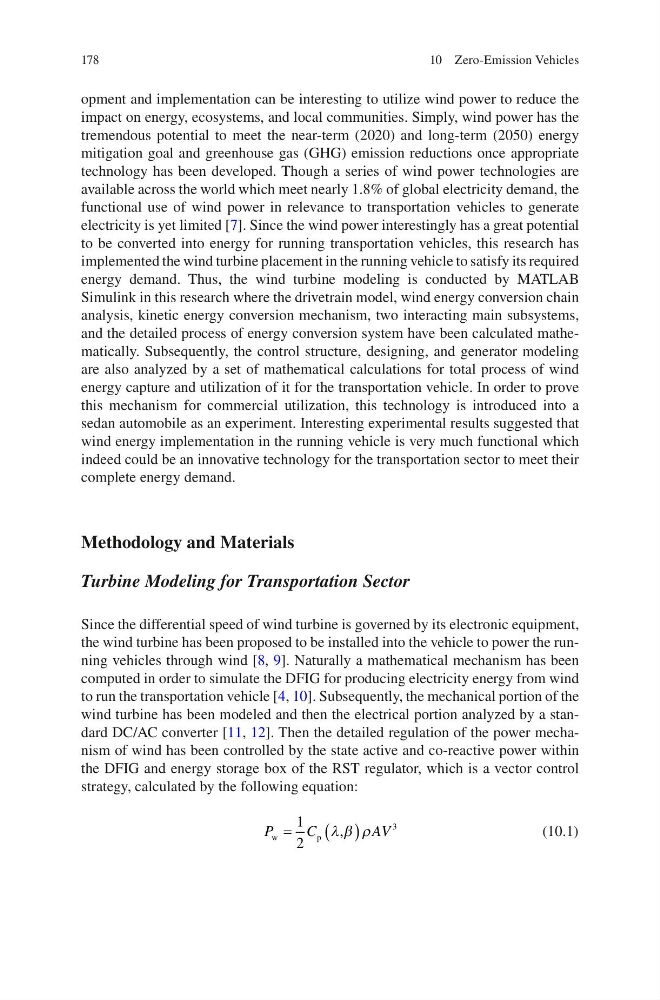
wind turbine has been modeled and then the electrical portion analyzed by a standard DC/AC converter [11, 12]. Then the detailed regulation of the power mechanism of wind has been controlled by the state active and co-reactive power within
the DFIG and energy storage box of the RST regulator, which is a vector control
strategy, calculated by the following equation:
P
C
AV
w
p
,
=
( )
1
2
3
λ β ρ
(10.1)
10 Zero-Emission Vehicles
opment and implementation can be interesting to utilize wind power to reduce the
impact on energy, ecosystems, and local communities. Simply, wind power has the
tremendous potential to meet the near-term (2020) and long-term (2050) energy
mitigation goal and greenhouse gas (GHG) emission reductions once appropriate
technology has been developed. Though a series of wind power technologies are
available across the world which meet nearly 1.8% of global electricity demand, the
functional use of wind power in relevance to transportation vehicles to generate
electricity is yet limited [7]. Since the wind power interestingly has a great potential
to be converted into energy for running transportation vehicles, this research has
implemented the wind turbine placement in the running vehicle to satisfy its required
energy demand. Thus, the wind turbine modeling is conducted by MATLAB
Simulink in this research where the drivetrain model, wind energy conversion chain
analysis, kinetic energy conversion mechanism, two interacting main subsystems,
and the detailed process of energy conversion system have been calculated mathematically. Subsequently, the control structure, designing, and generator modeling
are also analyzed by a set of mathematical calculations for total process of wind
energy capture and utilization of it for the transportation vehicle. In order to prove
this mechanism for commercial utilization, this technology is introduced into a
sedan automobile as an experiment. Interesting experimental results suggested that
wind energy implementation in the running vehicle is very much functional which
indeed could be an innovative technology for the transportation sector to meet their
complete energy demand.
Methodology and Materials
Turbine Modeling for Transportation Sector
Since the differential speed of wind turbine is governed by its electronic equipment,
the wind turbine has been proposed to be installed into the vehicle to power the running vehicles through wind [8, 9]. Naturally a mathematical mechanism has been
computed in order to simulate the DFIG for producing electricity energy from wind
to run the transportation vehicle [4, 10]. Subsequently, the mechanical portion of the
wind turbine has been modeled and then the electrical portion analyzed by a standard DC/AC converter [11, 12]. Then the detailed regulation of the power mechanism of wind has been controlled by the state active and co-reactive power within
the DFIG and energy storage box of the RST regulator, which is a vector control
strategy, calculated by the following equation:
P
C
AV
w
p
,
=
( )
1
2
3
λ β ρ
(10.1)
10 Zero-Emission Vehicles