

123
DC into AC energy that is called “efficiency ratio,” which is normally 80% [7, 16].
However, the surface of the acting solar panel is a unique semiconductor in the
energy-transforming process where the net current conversion by this curtain wall
skin is nearly 125% higher compared to the standard solar panel and thus it will
level the net energy production calculated as (27,770 × 1.25 × 0.8) = 27,770 kWh/
year or 7.6 kWh/day [3, 23, 27]. Simply electricity generation will remain equal to
the solar energy initially calculated which was emitted before into the solar panel.
An ideal residential house requires an average 12 kWh/day [7, 12, 15]. Since the
acting PV panel-generated solar energy is equivalent to 27,770 kWh/year or
7.6 kWh/day, it will need two solar panels of 1 m
2
each that meet the net energy
need for a residential building [23, 36]. The mean energy consumption per month of
a commercial office or buildings of 32 m × 31 m with 30 m height approximately is
10,000 kWh/day; thus, the total 1 m
2
PV panels will require 1195 units (945 + 250)
with the capacity of 7.6 kWh/unit energy production that can provide a total
energy × 1195 = 9082 kWh/day to meet the daily energy demand of about
10,000 kWh/day for a commercial office or building [19, 37, 38].
Electrostatic Force Analysis
The electrostatic force generation around the insulator tank on the roof of a building
has been determined in order to confirm the tug down of the cloud water; initially
the dynamic photon proliferation is calculated by integrating HSEF electric fields;
thus, the local U(1) gauge field will allow to add a mass term of the functional particle of ∅
′
→ e
iα(x)
∅. It is then further clarified by explaining the variable derivative
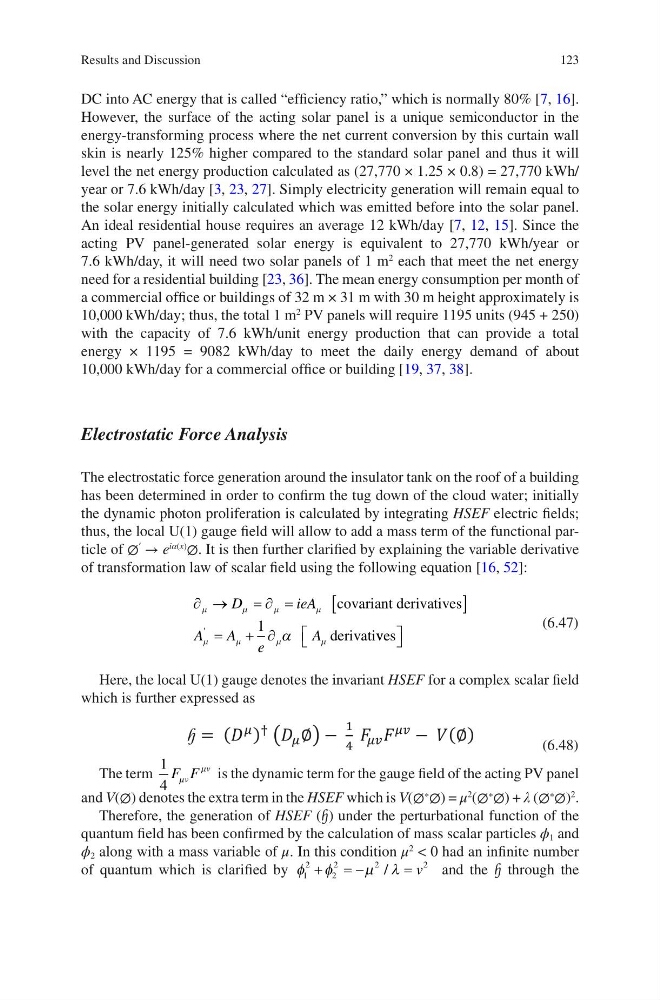
of transformation law of scalar field using the following equation [16, 52]:
w o
w
>
@
w
c
P
P
P
P
P
P
P
P
D
D
i eA
A
A e
A
covariant derivatives
derivati
1
v ves
ª ¬
º ¼
(6.47)
Here, the local U(1) gauge denotes the invariant HSEF for a complex scalar field
which is further expressed as
(6.48)
The term
1
4
F F
v
v
µ
µ is the dynamic term for the gauge field of the acting PV panel
and V(∅) denotes the extra term in the HSEF which is V(∅
∗
∅) = μ
2
(∅
∗
∅) + λ (∅
∗
∅)
2
.
Therefore, the generation of HSEF (ɧ) under the perturbational function of the
quantum field has been confirmed by the calculation of mass scalar particles ϕ 1 and
ϕ 2 along with a mass variable of μ. In this condition μ
2
< 0 had an infinite number
of quantum which is clarified by I I
P O
1
2
2
2
2
2
/
v and the ɧ through the
Results and Discussion
DC into AC energy that is called “efficiency ratio,” which is normally 80% [7, 16].
However, the surface of the acting solar panel is a unique semiconductor in the
energy-transforming process where the net current conversion by this curtain wall
skin is nearly 125% higher compared to the standard solar panel and thus it will
level the net energy production calculated as (27,770 × 1.25 × 0.8) = 27,770 kWh/
year or 7.6 kWh/day [3, 23, 27]. Simply electricity generation will remain equal to
the solar energy initially calculated which was emitted before into the solar panel.
An ideal residential house requires an average 12 kWh/day [7, 12, 15]. Since the
acting PV panel-generated solar energy is equivalent to 27,770 kWh/year or
7.6 kWh/day, it will need two solar panels of 1 m
2
each that meet the net energy
need for a residential building [23, 36]. The mean energy consumption per month of
a commercial office or buildings of 32 m × 31 m with 30 m height approximately is
10,000 kWh/day; thus, the total 1 m
2
PV panels will require 1195 units (945 + 250)
with the capacity of 7.6 kWh/unit energy production that can provide a total
energy × 1195 = 9082 kWh/day to meet the daily energy demand of about
10,000 kWh/day for a commercial office or building [19, 37, 38].
Electrostatic Force Analysis
The electrostatic force generation around the insulator tank on the roof of a building
has been determined in order to confirm the tug down of the cloud water; initially
the dynamic photon proliferation is calculated by integrating HSEF electric fields;
thus, the local U(1) gauge field will allow to add a mass term of the functional particle of ∅
′
→ e
iα(x)
∅. It is then further clarified by explaining the variable derivative
of transformation law of scalar field using the following equation [16, 52]:
w o
w
>
@
w
c
P
P
P
P
P
P
P
P
D
D
i eA
A
A e
A
covariant derivatives
derivati
1
v ves
ª ¬
º ¼
(6.47)
Here, the local U(1) gauge denotes the invariant HSEF for a complex scalar field
which is further expressed as
(6.48)
The term
1
4
F F
v
v
µ
µ is the dynamic term for the gauge field of the acting PV panel
and V(∅) denotes the extra term in the HSEF which is V(∅
∗
∅) = μ
2
(∅
∗
∅) + λ (∅
∗
∅)
2
.
Therefore, the generation of HSEF (ɧ) under the perturbational function of the
quantum field has been confirmed by the calculation of mass scalar particles ϕ 1 and
ϕ 2 along with a mass variable of μ. In this condition μ
2
< 0 had an infinite number
of quantum which is clarified by I I
P O
1
2
2
2
2
2
/
v and the ɧ through the
Results and Discussion