

124
variable derivatives using further shifted fields η and ξ defined the quantum
field as I
X K
[
0
1
2
ª ¬
º ¼
i :
(6.49)
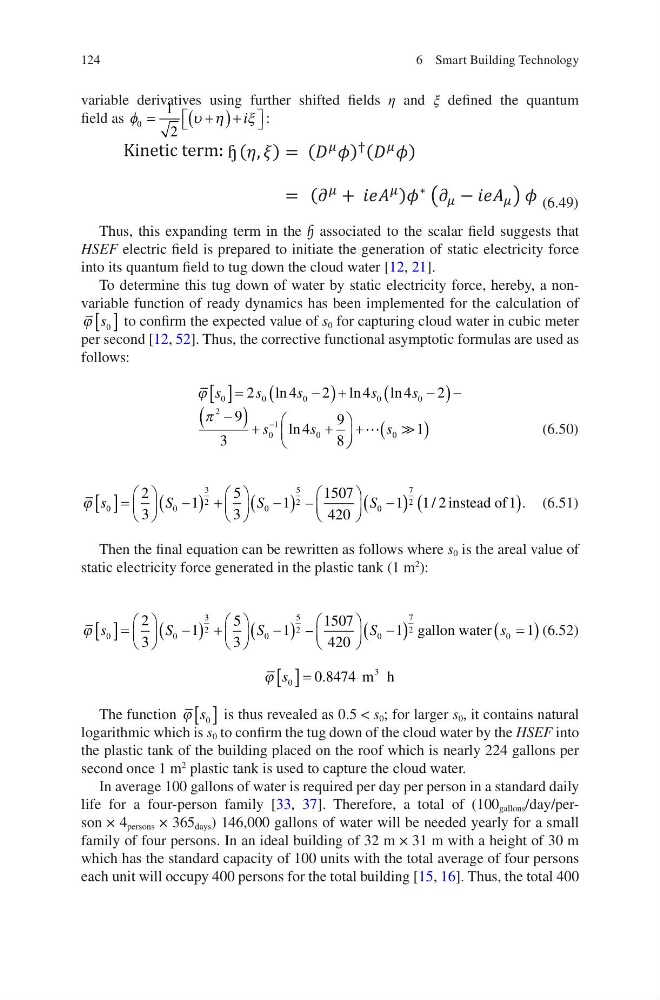
Thus, this expanding term in the ɧ associated to the scalar field suggests that
HSEF electric field is prepared to initiate the generation of static electricity force
into its quantum field to tug down the cloud water [12, 21].
To determine this tug down of water by static electricity force, hereby, a nonvariable function of ready dynamics has been implemented for the calculation of
M s 0
> @ to confirm the expected value of s 0 for capturing cloud water in cubic meter
per second [12, 52]. Thus, the corrective functional asymptotic formulas are used as
follows:
M
S
s
s
s
s
s
s
s
0
0
0
0
0
2
0
1
0
2
4
2
4
4
2
9
3
4
9
8
> @
§
©
¨
·
ln
ln
ln
ln
¹ ¹
¸
s 0 1
(6.50)
M s
S
S
S
0
0
3
2
0
5
2
0
2
3
1
5
3
1
1507
420
1
> @
§
©
¨
·
¹
¸
§
©
¨
·
¹
¸
§
©
¨
·
¹
¸
–
7
2 1 2
1
/
.
instead of
(6.51)
Then the final equation can be rewritten as follows where s 0 is the areal value of
static electricity force generated in the plastic tank (1 m
2
):
M s
S
S
S
0
0
3
2
0
5
2
0
2
3
1
5
3
1
1507
420
1
> @
§
©
¨
·
¹
¸
§
©
¨
·
¹
¸
§
©
¨
·
¹
¸
–
7
2
0
1
gallon water s
(6.52)
M s 0
3
0 8474
> @ .
m h
The function M s 0
> @ is thus revealed as 0.5 < s 0 ; for larger s 0 , it contains natural
logarithmic which is s 0 to confirm the tug down of the cloud water by the HSEF into
the plastic tank of the building placed on the roof which is nearly 224 gallons per
second once 1 m
2
plastic tank is used to capture the cloud water.
In average 100 gallons of water is required per day per person in a standard daily
life for a four-person family [33, 37]. Therefore, a total of (100 gallons /day/person × 4 persons × 365 days ) 146,000 gallons of water will be needed yearly for a small
family of four persons. In an ideal building of 32 m × 31 m with a height of 30 m
which has the standard capacity of 100 units with the total average of four persons
each unit will occupy 400 persons for the total building [15, 16]. Thus, the total 400
6 Smart Building Technology
variable derivatives using further shifted fields η and ξ defined the quantum
field as I
X K
[
0
1
2
ª ¬
º ¼
i :
(6.49)
Thus, this expanding term in the ɧ associated to the scalar field suggests that
HSEF electric field is prepared to initiate the generation of static electricity force
into its quantum field to tug down the cloud water [12, 21].
To determine this tug down of water by static electricity force, hereby, a nonvariable function of ready dynamics has been implemented for the calculation of
M s 0
> @ to confirm the expected value of s 0 for capturing cloud water in cubic meter
per second [12, 52]. Thus, the corrective functional asymptotic formulas are used as
follows:
M
S
s
s
s
s
s
s
s
0
0
0
0
0
2
0
1
0
2
4
2
4
4
2
9
3
4
9
8
> @
§
©
¨
·
ln
ln
ln
ln
¹ ¹
¸
s 0 1
(6.50)
M s
S
S
S
0
0
3
2
0
5
2
0
2
3
1
5
3
1
1507
420
1
> @
§
©
¨
·
¹
¸
§
©
¨
·
¹
¸
§
©
¨
·
¹
¸
–
7
2 1 2
1
/
.
instead of
(6.51)
Then the final equation can be rewritten as follows where s 0 is the areal value of
static electricity force generated in the plastic tank (1 m
2
):
M s
S
S
S
0
0
3
2
0
5
2
0
2
3
1
5
3
1
1507
420
1
> @
§
©
¨
·
¹
¸
§
©
¨
·
¹
¸
§
©
¨
·
¹
¸
–
7
2
0
1
gallon water s
(6.52)
M s 0
3
0 8474
> @ .
m h
The function M s 0
> @ is thus revealed as 0.5 < s 0 ; for larger s 0 , it contains natural
logarithmic which is s 0 to confirm the tug down of the cloud water by the HSEF into
the plastic tank of the building placed on the roof which is nearly 224 gallons per
second once 1 m
2
plastic tank is used to capture the cloud water.
In average 100 gallons of water is required per day per person in a standard daily
life for a four-person family [33, 37]. Therefore, a total of (100 gallons /day/person × 4 persons × 365 days ) 146,000 gallons of water will be needed yearly for a small
family of four persons. In an ideal building of 32 m × 31 m with a height of 30 m
which has the standard capacity of 100 units with the total average of four persons
each unit will occupy 400 persons for the total building [15, 16]. Thus, the total 400
6 Smart Building Technology