

120
where D t
ª ¬
º ¼ = exp {α(t)α
†
−α
*
(t)α} denotes the displacement functions with
α(t) = u(t, t 0 )α 0 and
U T
,
,
,
|
v t t
v t t
v t t
nn
n
n
n
ª ¬
º ¼
ª
¬
º
¼
ª ¬
º ¼
f
¦
0
1
1
#
(6.38)
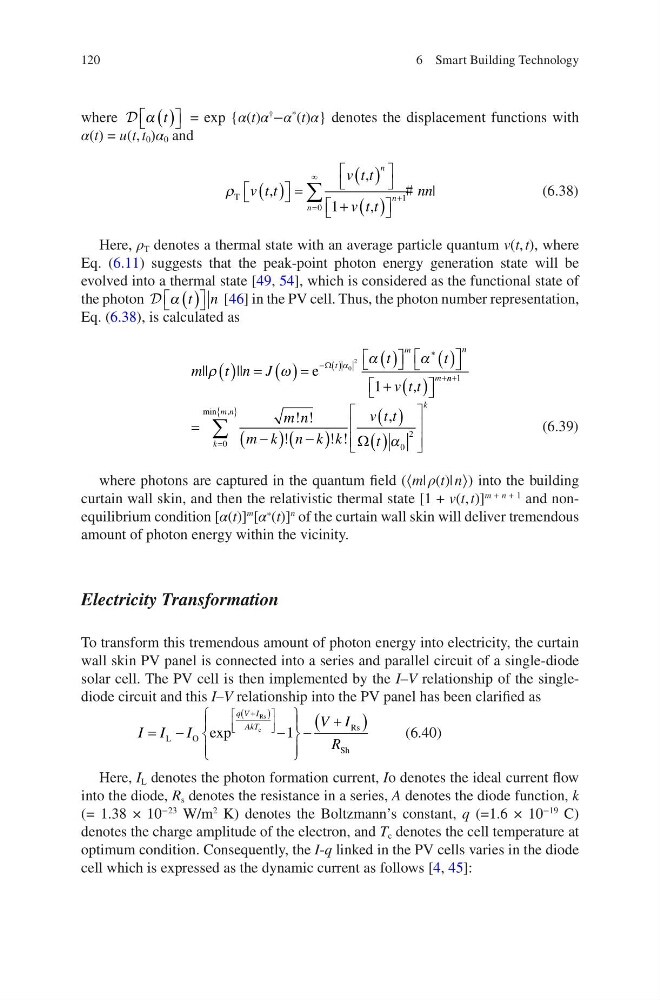
Here, ρ T denotes a thermal state with an average particle quantum v(t, t), where
Eq. (6.11) suggests that the peak-point photon energy generation state will be
evolved into a thermal state [49, 54], which is considered as the functional state of
the photon D t n
ª ¬
º ¼ [46] in the PV cell. Thus, the photon number representation,
Eq. (6.38), is calculated as
m
t n J
t
t
v t t
t
m
n
m
||
||
e
,
U
Z
D
D
D
ª ¬
º ¼
ª ¬
º ¼
ª ¬
º ¼
:
0
2
1
n n
k
m n
k
m n
m k n k k
v t t
t
^ `
ª
¬
«
«
º
¼
»
»
¦
1
0
0
2
min
! !
!
! !
,
,
: D
(6.39)
where photons are captured in the quantum field (⟨m| ρ(t)| n⟩) into the building
curtain wall skin, and then the relativistic thermal state [1 + v(t, t)]
m + n + 1
and nonequilibrium condition [α(t)]
m
[α
∗
(t)]
n
of the curtain wall skin will deliver tremendous
amount of photon energy within the vicinity.
Electricity Transformation
To transform this tremendous amount of photon energy into electricity, the curtain
wall skin PV panel is connected into a series and parallel circuit of a single-diode
solar cell. The PV cell is then implemented by the I–V relationship of the singlediode circuit and this I–V relationship into the PV panel has been clarified as
I I I
V I
R
q V I
AkT
®
°
¯ °
½
¾
°
¿ °
ª
¬
«
«
º
¼
»
»
L
O
Rs
Sh
Rs
c
exp
1
(6.40)
Here, I L denotes the photon formation current, Io denotes the ideal current flow
into the diode, R s denotes the resistance in a series, A denotes the diode function, k
(= 1.38 × 10
−23
W/m
2
K) denotes the Boltzmann’s constant, q (=1.6 × 10
−19
C)
denotes the charge amplitude of the electron, and T c denotes the cell temperature at
optimum condition. Consequently, the I-q linked in the PV cells varies in the diode
cell which is expressed as the dynamic current as follows [4, 45]:
6 Smart Building Technology
where D t
ª ¬
º ¼ = exp {α(t)α
†
−α
*
(t)α} denotes the displacement functions with
α(t) = u(t, t 0 )α 0 and
U T
,
,
,
|
v t t
v t t
v t t
nn
n
n
n
ª ¬
º ¼
ª
¬
º
¼
ª ¬
º ¼
f
¦
0
1
1
#
(6.38)
Here, ρ T denotes a thermal state with an average particle quantum v(t, t), where
Eq. (6.11) suggests that the peak-point photon energy generation state will be
evolved into a thermal state [49, 54], which is considered as the functional state of
the photon D t n
ª ¬
º ¼ [46] in the PV cell. Thus, the photon number representation,
Eq. (6.38), is calculated as
m
t n J
t
t
v t t
t
m
n
m
||
||
e
,
U
Z
D
D
D
ª ¬
º ¼
ª ¬
º ¼
ª ¬
º ¼
:
0
2
1
n n
k
m n
k
m n
m k n k k
v t t
t
^ `
ª
¬
«
«
º
¼
»
»
¦
1
0
0
2
min
! !
!
! !
,
,
: D
(6.39)
where photons are captured in the quantum field (⟨m| ρ(t)| n⟩) into the building
curtain wall skin, and then the relativistic thermal state [1 + v(t, t)]
m + n + 1
and nonequilibrium condition [α(t)]
m
[α
∗
(t)]
n
of the curtain wall skin will deliver tremendous
amount of photon energy within the vicinity.
Electricity Transformation
To transform this tremendous amount of photon energy into electricity, the curtain
wall skin PV panel is connected into a series and parallel circuit of a single-diode
solar cell. The PV cell is then implemented by the I–V relationship of the singlediode circuit and this I–V relationship into the PV panel has been clarified as
I I I
V I
R
q V I
AkT
®
°
¯ °
½
¾
°
¿ °
ª
¬
«
«
º
¼
»
»
L
O
Rs
Sh
Rs
c
exp
1
(6.40)
Here, I L denotes the photon formation current, Io denotes the ideal current flow
into the diode, R s denotes the resistance in a series, A denotes the diode function, k
(= 1.38 × 10
−23
W/m
2
K) denotes the Boltzmann’s constant, q (=1.6 × 10
−19
C)
denotes the charge amplitude of the electron, and T c denotes the cell temperature at
optimum condition. Consequently, the I-q linked in the PV cells varies in the diode
cell which is expressed as the dynamic current as follows [4, 45]:
6 Smart Building Technology