

119
v t t
d
,
e
o f
f
³
Z
Z Z
with
V
D
D
Z
Z
Z
Z
ª ¬
º ¼
n T
,
l
d
(6.33)
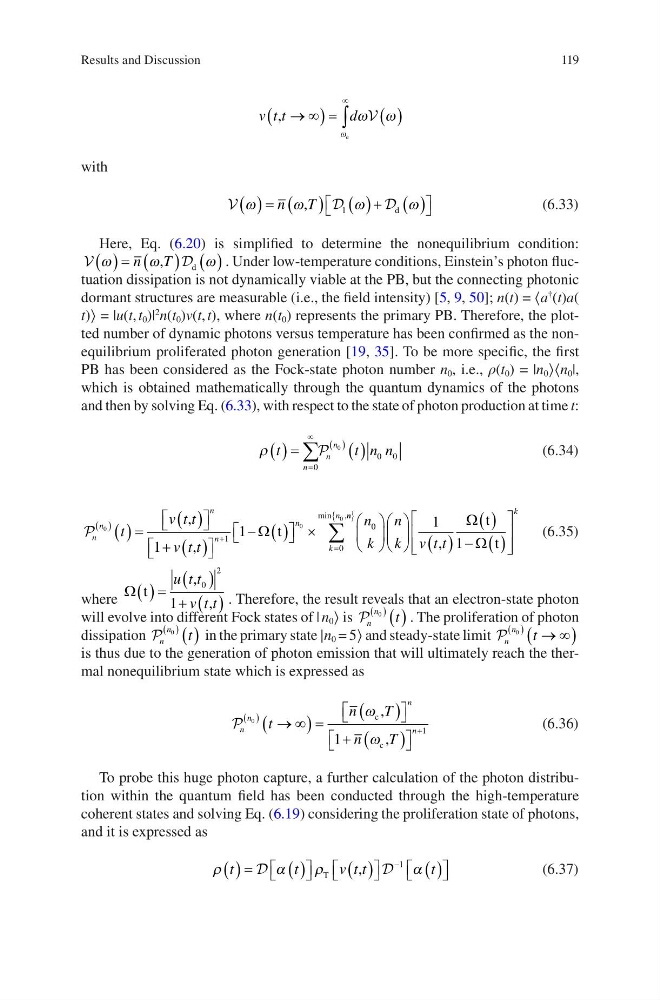
Here, Eq. (6.20) is simplified to determine the nonequilibrium condition:
V
D
Z
Z
Z
n T
,
d
. Under low-temperature conditions, Einstein’s photon fluctuation dissipation is not dynamically viable at the PB, but the connecting photonic
dormant structures are measurable (i.e., the field intensity) [5, 9, 50]; n(t) = 〈a
†
(t)a(
t)〉 = |u(t, t 0 )|
2
n(t 0 )v(t, t), where n(t 0 ) represents the primary PB. Therefore, the plotted number of dynamic photons versus temperature has been confirmed as the nonequilibrium proliferated photon generation [19, 35]. To be more specific, the first
PB has been considered as the Fock-state photon number n 0 , i.e., ρ(t 0 ) = |n 0 ⟩⟨n 0 |,
which is obtained mathematically through the quantum dynamics of the photons
and then by solving Eq. (6.33), with respect to the state of photon production at time t:
U t
t n n
n
n
n
f
¦
0
0 0
0
(6.34)
n
n
n
n
n
k
n
t
v t t
v t t
0
0
0
1
1
1
0
ª ¬
º ¼
ª ¬
º ¼
ª ¬
º ¼ u
,
,
t
,
:
min
n n
k
n
k
n
k v t t
^ `
¦
§
©
¨
·
¹
¸
§
©
¨
·
¹
¸
ª
¬
«
«
º
¼
»
»
0
1
1
,
t
t
:
:
(6.35)
where
: t
,
,
u t t
v t t
0
2
1
. Therefore, the result reveals that an electron-state photon
will evolve into different Fock states of | n 0 ⟩ is n
n
t
0
. The proliferation of photon
dissipation n
n
t
0
in the primary state ∣n 0 = 5⟩ and steady-state limit n
n
t
0
o f
is thus due to the generation of photon emission that will ultimately reach the thermal nonequilibrium state which is expressed as
n
n
n
n
t
n
T
n
T
0
1
1
o f
ª ¬
º ¼
ª ¬
º ¼
Z
Z
c
c
,
,
(6.36)
To probe this huge photon capture, a further calculation of the photon distribution within the quantum field has been conducted through the high-temperature
coherent states and solving Eq. (6.19) considering the proliferation state of photons,
and it is expressed as
U
D
U
D
t
t
v t t
t
ª ¬
º ¼
ª ¬
º ¼
ª ¬
º ¼
T
,
1
(6.37)
Results and Discussion
v t t
d
,
e
o f
f
³
Z
Z Z
with
V
D
D
Z
Z
Z
Z
ª ¬
º ¼
n T
,
l
d
(6.33)
Here, Eq. (6.20) is simplified to determine the nonequilibrium condition:
V
D
Z
Z
Z
n T
,
d
. Under low-temperature conditions, Einstein’s photon fluctuation dissipation is not dynamically viable at the PB, but the connecting photonic
dormant structures are measurable (i.e., the field intensity) [5, 9, 50]; n(t) = 〈a
†
(t)a(
t)〉 = |u(t, t 0 )|
2
n(t 0 )v(t, t), where n(t 0 ) represents the primary PB. Therefore, the plotted number of dynamic photons versus temperature has been confirmed as the nonequilibrium proliferated photon generation [19, 35]. To be more specific, the first
PB has been considered as the Fock-state photon number n 0 , i.e., ρ(t 0 ) = |n 0 ⟩⟨n 0 |,
which is obtained mathematically through the quantum dynamics of the photons
and then by solving Eq. (6.33), with respect to the state of photon production at time t:
U t
t n n
n
n
n
f
¦
0
0 0
0
(6.34)
n
n
n
n
n
k
n
t
v t t
v t t
0
0
0
1
1
1
0
ª ¬
º ¼
ª ¬
º ¼
ª ¬
º ¼ u
,
,
t
,
:
min
n n
k
n
k
n
k v t t
^ `
¦
§
©
¨
·
¹
¸
§
©
¨
·
¹
¸
ª
¬
«
«
º
¼
»
»
0
1
1
,
t
t
:
:
(6.35)
where
: t
,
,
u t t
v t t
0
2
1
. Therefore, the result reveals that an electron-state photon
will evolve into different Fock states of | n 0 ⟩ is n
n
t
0
. The proliferation of photon
dissipation n
n
t
0
in the primary state ∣n 0 = 5⟩ and steady-state limit n
n
t
0
o f
is thus due to the generation of photon emission that will ultimately reach the thermal nonequilibrium state which is expressed as
n
n
n
n
t
n
T
n
T
0
1
1
o f
ª ¬
º ¼
ª ¬
º ¼
Z
Z
c
c
,
,
(6.36)
To probe this huge photon capture, a further calculation of the photon distribution within the quantum field has been conducted through the high-temperature
coherent states and solving Eq. (6.19) considering the proliferation state of photons,
and it is expressed as
U
D
U
D
t
t
v t t
t
ª ¬
º ¼
ª ¬
º ¼
ª ¬
º ¼
T
,
1
(6.37)
Results and Discussion