

118
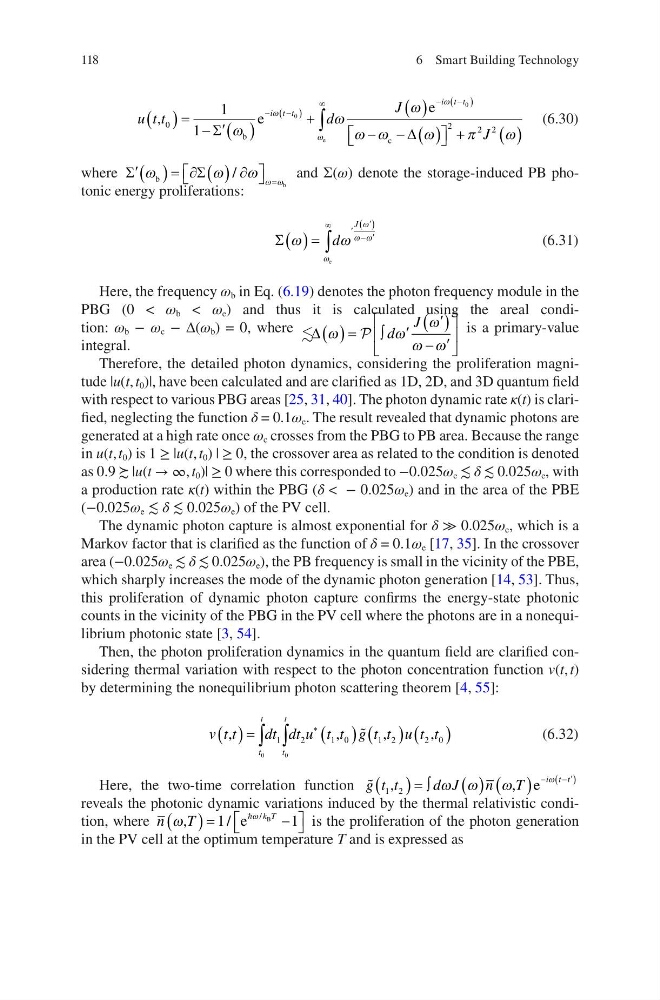
u t t
d
J
i t t
i t t
,
e
e
b
c
e
0
1
1
0
0
ª
c
f
³
6
'
Z
Z
Z
Z Z
Z
Z
Z
Z
¬ ¬
º ¼
2
2 2
S
Z
J
(6.30)
where c w w
ª ¬
º ¼
6 Z
Z
Z Z Z
b
b
6
/
and Σ(ω) denote the storage-induced PB photonic energy proliferations:
6 Z
Z
Z
Z
Z Z
f
c
c
c
³
e
d
J
(6.31)
Here, the frequency ω b in Eq. (6.19) denotes the photon frequency module in the
PBG (0 < ω b < ω e ) and thus it is calculated using the areal condition: ω b − ω c − ∆(ω b ) = 0, where ' Z
Z
Z
Z Z
³
ª
¬
«
º
¼
»
c
c
c
d
J
is a primary-value
integral.
Therefore, the detailed photon dynamics, considering the proliferation magnitude |u(t, t 0 )|, have been calculated and are clarified as 1D, 2D, and 3D quantum field
with respect to various PBG areas [25, 31, 40]. The photon dynamic rate κ(t) is clarified, neglecting the function δ = 0.1ω e . The result revealed that dynamic photons are
generated at a high rate once ω c crosses from the PBG to PB area. Because the range
in u(t, t 0 ) is 1 ≥ |u(t, t 0 ) | ≥ 0, the crossover area as related to the condition is denoted
as 0.9 ≿ |u(t → ∞, t 0 )| ≥ 0 where this corresponded to −0.025ω e ≲ δ ≲ 0.025ω e , with
a production rate κ(t) within the PBG (δ < − 0.025ω e ) and in the area of the PBE
(−0.025ω e ≲ δ ≲ 0.025ω e ) of the PV cell.
The dynamic photon capture is almost exponential for δ ≫ 0.025ω e , which is a
Markov factor that is clarified as the function of δ = 0.1ω e [17, 35]. In the crossover
area (−0.025ω e ≲ δ ≲ 0.025ω e ), the PB frequency is small in the vicinity of the PBE,
which sharply increases the mode of the dynamic photon generation [14, 53]. Thus,
this proliferation of dynamic photon capture confirms the energy-state photonic
counts in the vicinity of the PBG in the PV cell where the photons are in a nonequilibrium photonic state [3, 54].
Then, the photon proliferation dynamics in the quantum field are clarified considering thermal variation with respect to the photon concentration function v(t, t)
by determining the nonequilibrium photon scattering theorem [4, 55]:
v t t
dt dt u t t g t t u t t
t
t
t
t
,
,
,
,
³ ³
0
0
1
2
1 0
1 2
2 0
(6.32)
Here, the two-time correlation function
g t t
d J
n T
i t t
1 2
,
, e
³
c
Z Z
Z
Z
reveals the photonic dynamic variations induced by the thermal relativistic condition, where n T
k T
Z
Z
,
e
B
ª ¬
º ¼
1
1
/
/
is the proliferation of the photon generation
in the PV cell at the optimum temperature T and is expressed as
6 Smart Building Technology
u t t
d
J
i t t
i t t
,
e
e
b
c
e
0
1
1
0
0
ª
c
f
³
6
'
Z
Z
Z
Z Z
Z
Z
Z
Z
¬ ¬
º ¼
2
2 2
S
Z
J
(6.30)
where c w w
ª ¬
º ¼
6 Z
Z
Z Z Z
b
b
6
/
and Σ(ω) denote the storage-induced PB photonic energy proliferations:
6 Z
Z
Z
Z
Z Z
f
c
c
c
³
e
d
J
(6.31)
Here, the frequency ω b in Eq. (6.19) denotes the photon frequency module in the
PBG (0 < ω b < ω e ) and thus it is calculated using the areal condition: ω b − ω c − ∆(ω b ) = 0, where ' Z
Z
Z
Z Z
³
ª
¬
«
º
¼
»
c
c
c
d
J
is a primary-value
integral.
Therefore, the detailed photon dynamics, considering the proliferation magnitude |u(t, t 0 )|, have been calculated and are clarified as 1D, 2D, and 3D quantum field
with respect to various PBG areas [25, 31, 40]. The photon dynamic rate κ(t) is clarified, neglecting the function δ = 0.1ω e . The result revealed that dynamic photons are
generated at a high rate once ω c crosses from the PBG to PB area. Because the range
in u(t, t 0 ) is 1 ≥ |u(t, t 0 ) | ≥ 0, the crossover area as related to the condition is denoted
as 0.9 ≿ |u(t → ∞, t 0 )| ≥ 0 where this corresponded to −0.025ω e ≲ δ ≲ 0.025ω e , with
a production rate κ(t) within the PBG (δ < − 0.025ω e ) and in the area of the PBE
(−0.025ω e ≲ δ ≲ 0.025ω e ) of the PV cell.
The dynamic photon capture is almost exponential for δ ≫ 0.025ω e , which is a
Markov factor that is clarified as the function of δ = 0.1ω e [17, 35]. In the crossover
area (−0.025ω e ≲ δ ≲ 0.025ω e ), the PB frequency is small in the vicinity of the PBE,
which sharply increases the mode of the dynamic photon generation [14, 53]. Thus,
this proliferation of dynamic photon capture confirms the energy-state photonic
counts in the vicinity of the PBG in the PV cell where the photons are in a nonequilibrium photonic state [3, 54].
Then, the photon proliferation dynamics in the quantum field are clarified considering thermal variation with respect to the photon concentration function v(t, t)
by determining the nonequilibrium photon scattering theorem [4, 55]:
v t t
dt dt u t t g t t u t t
t
t
t
t
,
,
,
,
³ ³
0
0
1
2
1 0
1 2
2 0
(6.32)
Here, the two-time correlation function
g t t
d J
n T
i t t
1 2
,
, e
³
c
Z Z
Z
Z
reveals the photonic dynamic variations induced by the thermal relativistic condition, where n T
k T
Z
Z
,
e
B
ª ¬
º ¼
1
1
/
/
is the proliferation of the photon generation
in the PV cell at the optimum temperature T and is expressed as
6 Smart Building Technology