

117
DOS is thus expressed as
PC
e
e
Z
Z Z
Z Z
v
1
4
, where Θ(ω − ω e ) represents the Heaviside step function and ω e expresses the frequency of the photonic
energy generation [1, 11].
This DOS is thus determined to confirm a 3D isentropic function in the PV cells
to acquire an accurate qualitative state of the non-Weisskopf-Wigner mode of photons in the PV cell [11, 13, 38]. Naturally, this 3D PV cell will be the functional DOS
in the PBE area of DOS, PC
e
e
Z
Z Z
Z Z
v
1
4
, which is then integrated
into the electromagnetic field (EMF) vector of PV cell to determine the energy generation accurately [24, 52]. Considering the 2D and 1D of the PV cells, the photonic
DOS is exhibited as a pure algorithm divergence which is found close to the PBE
and expressed as ϱ PC (ω) ∝ − [ln|(ω − ω 0 )/ω 0 | − 1]Θ(ω − ω e ), where ω e denotes the
midpoint of tip algorithm. The functional area J(ω) is thus clarified as the energy
generation field of the DOS of the PV cell where the photonic magnitude of V(ω)
depends on the photonic band (PB) of the PV cell [25, 41]:
J
V
Z
Z
Z
2
(6.29)
Hence, the PB frequency ω c and proliferative photonic dynamic are considered
as the function u(t, t 0 ) for photon energy generation in the relation 〈a(t)〉 = u(t, t 0 )
〈a(t 0 )〉. It is therefore determined using the functional integral equation and is
expressed as
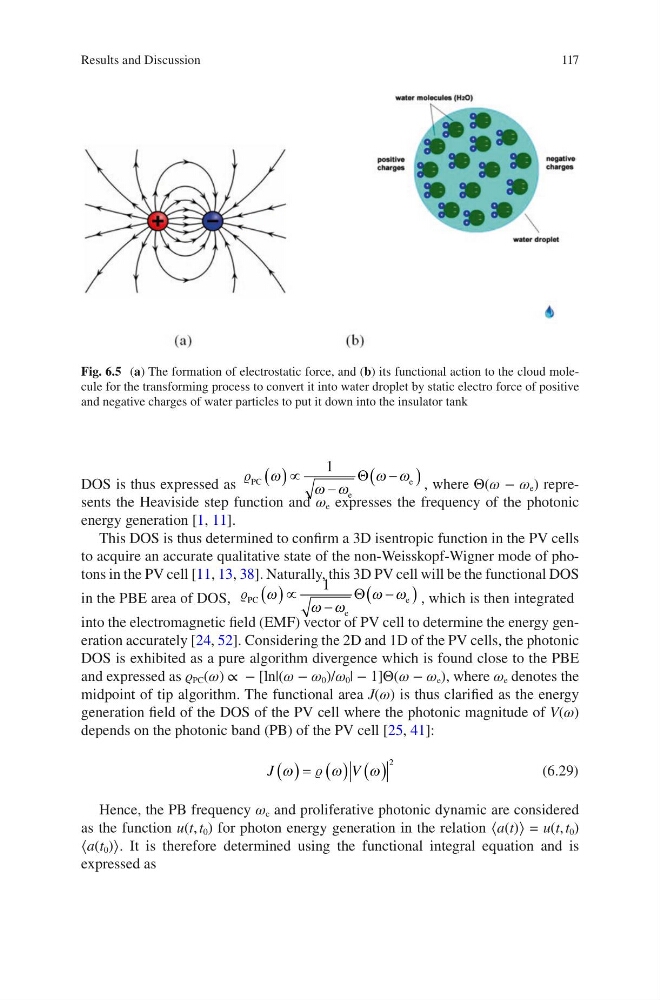
Fig. 6.5 (a) The formation of electrostatic force, and (b) its functional action to the cloud molecule for the transforming process to convert it into water droplet by static electro force of positive
and negative charges of water particles to put it down into the insulator tank
Results and Discussion
DOS is thus expressed as
PC
e
e
Z
Z Z
Z Z
v
1
4
, where Θ(ω − ω e ) represents the Heaviside step function and ω e expresses the frequency of the photonic
energy generation [1, 11].
This DOS is thus determined to confirm a 3D isentropic function in the PV cells
to acquire an accurate qualitative state of the non-Weisskopf-Wigner mode of photons in the PV cell [11, 13, 38]. Naturally, this 3D PV cell will be the functional DOS
in the PBE area of DOS, PC
e
e
Z
Z Z
Z Z
v
1
4
, which is then integrated
into the electromagnetic field (EMF) vector of PV cell to determine the energy generation accurately [24, 52]. Considering the 2D and 1D of the PV cells, the photonic
DOS is exhibited as a pure algorithm divergence which is found close to the PBE
and expressed as ϱ PC (ω) ∝ − [ln|(ω − ω 0 )/ω 0 | − 1]Θ(ω − ω e ), where ω e denotes the
midpoint of tip algorithm. The functional area J(ω) is thus clarified as the energy
generation field of the DOS of the PV cell where the photonic magnitude of V(ω)
depends on the photonic band (PB) of the PV cell [25, 41]:
J
V
Z
Z
Z
2
(6.29)
Hence, the PB frequency ω c and proliferative photonic dynamic are considered
as the function u(t, t 0 ) for photon energy generation in the relation 〈a(t)〉 = u(t, t 0 )
〈a(t 0 )〉. It is therefore determined using the functional integral equation and is
expressed as
Fig. 6.5 (a) The formation of electrostatic force, and (b) its functional action to the cloud molecule for the transforming process to convert it into water droplet by static electro force of positive
and negative charges of water particles to put it down into the insulator tank
Results and Discussion