

116
D
i
iqA
qA
P
P
P
P
P
P
P
P
I
I I
I
I
I
V
2
2
2
2
1
2
1
2
2
1
2
w w
w
w
w
r
r
r
r
r
4
4
w
2
2
2
2
v
qA
V
P
P
4
(6.26)
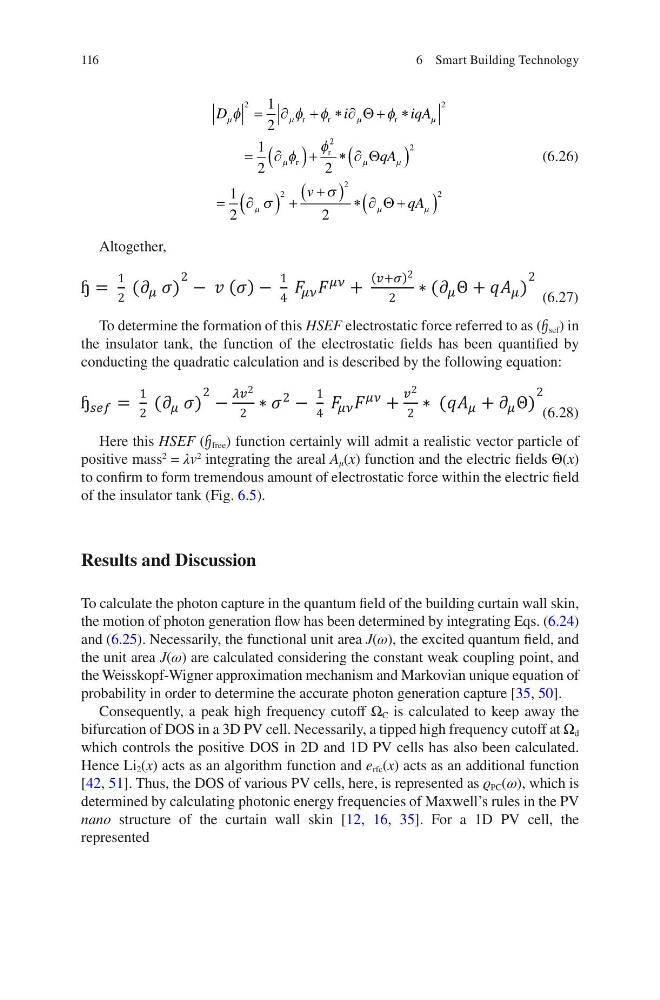
Altogether,
(6.27)
To determine the formation of this HSEF electrostatic force referred to as (ɧ sef ) in
the insulator tank, the function of the electrostatic fields has been quantified by
conducting the quadratic calculation and is described by the following equation:
(6.28)
Here this HSEF (ɧ free ) function certainly will admit a realistic vector particle of
positive mass
2
= λv
2
integrating the areal A μ (x) function and the electric fields Θ(x)
to confirm to form tremendous amount of electrostatic force within the electric field
of the insulator tank (Fig. 6.5).
Results and Discussion
To calculate the photon capture in the quantum field of the building curtain wall skin,
the motion of photon generation flow has been determined by integrating Eqs. (6.24)
and (6.25). Necessarily, the functional unit area J(ω), the excited quantum field, and
the unit area J(ω) are calculated considering the constant weak coupling point, and
the Weisskopf-Wigner approximation mechanism and Markovian unique equation of
probability in order to determine the accurate photon generation capture [35, 50].
Consequently, a peak high frequency cutoff Ω C is calculated to keep away the
bifurcation of DOS in a 3D PV cell. Necessarily, a tipped high frequency cutoff at Ω d
which controls the positive DOS in 2D and 1D PV cells has also been calculated.
Hence Li 2 (x) acts as an algorithm function and e rfc (x) acts as an additional function
[42, 51]. Thus, the DOS of various PV cells, here, is represented as ϱ PC (ω), which is
determined by calculating photonic energy frequencies of Maxwell’s rules in the PV
nano structure of the curtain wall skin [12, 16, 35]. For a 1D PV cell, the
represented
6 Smart Building Technology
D
i
iqA
qA
P
P
P
P
P
P
P
P
I
I I
I
I
I
V
2
2
2
2
1
2
1
2
2
1
2
w w
w
w
w
r
r
r
r
r
4
4
w
2
2
2
2
v
qA
V
P
P
4
(6.26)
Altogether,
(6.27)
To determine the formation of this HSEF electrostatic force referred to as (ɧ sef ) in
the insulator tank, the function of the electrostatic fields has been quantified by
conducting the quadratic calculation and is described by the following equation:
(6.28)
Here this HSEF (ɧ free ) function certainly will admit a realistic vector particle of
positive mass
2
= λv
2
integrating the areal A μ (x) function and the electric fields Θ(x)
to confirm to form tremendous amount of electrostatic force within the electric field
of the insulator tank (Fig. 6.5).
Results and Discussion
To calculate the photon capture in the quantum field of the building curtain wall skin,
the motion of photon generation flow has been determined by integrating Eqs. (6.24)
and (6.25). Necessarily, the functional unit area J(ω), the excited quantum field, and
the unit area J(ω) are calculated considering the constant weak coupling point, and
the Weisskopf-Wigner approximation mechanism and Markovian unique equation of
probability in order to determine the accurate photon generation capture [35, 50].
Consequently, a peak high frequency cutoff Ω C is calculated to keep away the
bifurcation of DOS in a 3D PV cell. Necessarily, a tipped high frequency cutoff at Ω d
which controls the positive DOS in 2D and 1D PV cells has also been calculated.
Hence Li 2 (x) acts as an algorithm function and e rfc (x) acts as an additional function
[42, 51]. Thus, the DOS of various PV cells, here, is represented as ϱ PC (ω), which is
determined by calculating photonic energy frequencies of Maxwell’s rules in the PV
nano structure of the curtain wall skin [12, 16, 35]. For a 1D PV cell, the
represented
6 Smart Building Technology