

109
The solar panel cells, here, necessarily work as a P-N junction superconductor in
order to form electricity through the acting PV panels, which are interlinked in a
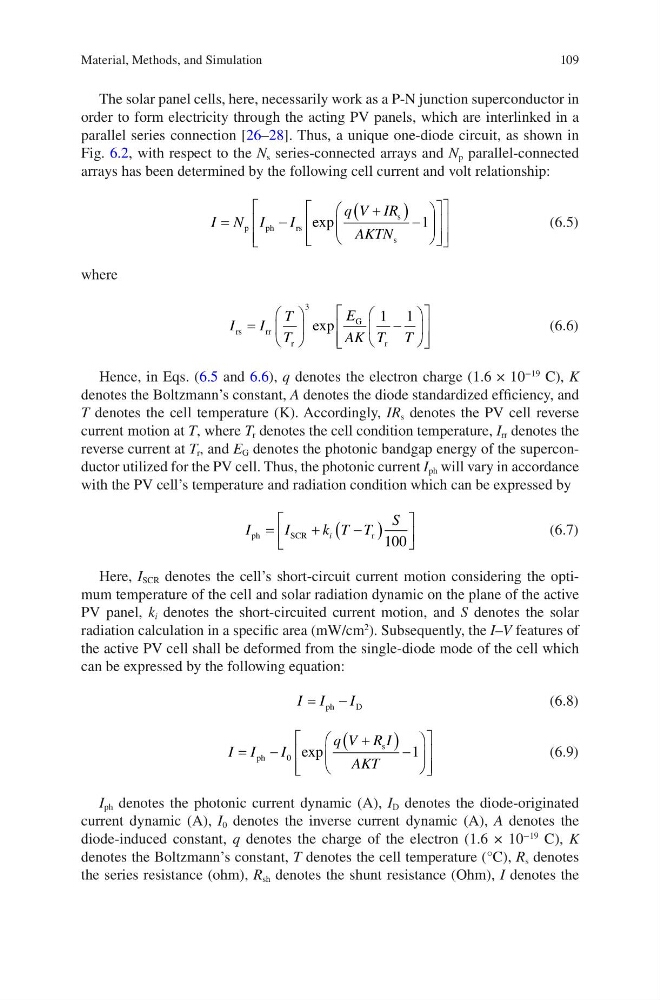
parallel series connection [26–28]. Thus, a unique one-diode circuit, as shown in
Fig. 6.2, with respect to the N s series-connected arrays and N p parallel-connected
arrays has been determined by the following cell current and volt relationship:
I N I
I
q V IR
AKTN
§
©
¨ ¨
·
¹
¸ ¸
ª
¬
«
«
º
¼
»
»
ª
¬
«
«
º
¼
»
»
p
p h
r s
s
s
exp
1
(6.5)
where
I
I
T
T
E
AK T T
rs
rr
r
G
r
§
©
¨
·
¹
¸
§
©
¨
·
¹
¸
ª
¬
«
«
º
¼
»
»
3
1 1
exp
(6.6)
Hence, in Eqs. (6.5 and 6.6), q denotes the electron charge (1.6 × 10
−19
C), K
denotes the Boltzmann’s constant, A denotes the diode standardized efficiency, and
T denotes the cell temperature (K). Accordingly, IR s denotes the PV cell reverse
current motion at T, where T r denotes the cell condition temperature, I rr denotes the
reverse current at T r , and E G denotes the photonic bandgap energy of the superconductor utilized for the PV cell. Thus, the photonic current I ph will vary in accordance
with the PV cell’s temperature and radiation condition which can be expressed by
I
I
k T T
S
i
ph
SCR
r
ª
¬
«
º
¼
»
100
(6.7)
Here, I SCR denotes the cell’s short-circuit current motion considering the optimum temperature of the cell and solar radiation dynamic on the plane of the active
PV panel, k i denotes the short-circuited current motion, and S denotes the solar
radiation calculation in a specific area (mW/cm
2
). Subsequently, the I–V features of
the active PV cell shall be deformed from the single-diode mode of the cell which
can be expressed by the following equation:
I I
I
ph
D
(6.8)
I I
I
q V R I
AKT
§
©
¨ ¨
·
¹
¸ ¸
ª
¬
«
«
º
¼
»
»
ph
s
0
1
exp
(6.9)
I ph denotes the photonic current dynamic (A), I D denotes the diode-originated
current dynamic (A), I 0 denotes the inverse current dynamic (A), A denotes the
diode-induced constant, q denotes the charge of the electron (1.6 × 10
−19
C), K
denotes the Boltzmann’s constant, T denotes the cell temperature (°C), R s denotes
the series resistance (ohm), R sh denotes the shunt resistance (Ohm), I denotes the
Material, Methods, and Simulation
The solar panel cells, here, necessarily work as a P-N junction superconductor in
order to form electricity through the acting PV panels, which are interlinked in a
parallel series connection [26–28]. Thus, a unique one-diode circuit, as shown in
Fig. 6.2, with respect to the N s series-connected arrays and N p parallel-connected
arrays has been determined by the following cell current and volt relationship:
I N I
I
q V IR
AKTN
§
©
¨ ¨
·
¹
¸ ¸
ª
¬
«
«
º
¼
»
»
ª
¬
«
«
º
¼
»
»
p
p h
r s
s
s
exp
1
(6.5)
where
I
I
T
T
E
AK T T
rs
rr
r
G
r
§
©
¨
·
¹
¸
§
©
¨
·
¹
¸
ª
¬
«
«
º
¼
»
»
3
1 1
exp
(6.6)
Hence, in Eqs. (6.5 and 6.6), q denotes the electron charge (1.6 × 10
−19
C), K
denotes the Boltzmann’s constant, A denotes the diode standardized efficiency, and
T denotes the cell temperature (K). Accordingly, IR s denotes the PV cell reverse
current motion at T, where T r denotes the cell condition temperature, I rr denotes the
reverse current at T r , and E G denotes the photonic bandgap energy of the superconductor utilized for the PV cell. Thus, the photonic current I ph will vary in accordance
with the PV cell’s temperature and radiation condition which can be expressed by
I
I
k T T
S
i
ph
SCR
r
ª
¬
«
º
¼
»
100
(6.7)
Here, I SCR denotes the cell’s short-circuit current motion considering the optimum temperature of the cell and solar radiation dynamic on the plane of the active
PV panel, k i denotes the short-circuited current motion, and S denotes the solar
radiation calculation in a specific area (mW/cm
2
). Subsequently, the I–V features of
the active PV cell shall be deformed from the single-diode mode of the cell which
can be expressed by the following equation:
I I
I
ph
D
(6.8)
I I
I
q V R I
AKT
§
©
¨ ¨
·
¹
¸ ¸
ª
¬
«
«
º
¼
»
»
ph
s
0
1
exp
(6.9)
I ph denotes the photonic current dynamic (A), I D denotes the diode-originated
current dynamic (A), I 0 denotes the inverse current dynamic (A), A denotes the
diode-induced constant, q denotes the charge of the electron (1.6 × 10
−19
C), K
denotes the Boltzmann’s constant, T denotes the cell temperature (°C), R s denotes
the series resistance (ohm), R sh denotes the shunt resistance (Ohm), I denotes the
Material, Methods, and Simulation