

107
satisfy the daily water needs for buildings and houses. Simply application of these
two technologies to design a smart building technology would indeed be an interesting idea to mitigate net energy and water crisis for the building sector globally.
Material, Methods, and Simulation
Since the photoreaction is correlated to the photon charge, the attributes of photon
electromagnetic wave and the dynamic of the photon particle are induced into the
building curtain wall skin [12, 17]. Then the photon energy density frequency into
the curtain wall surface is computed considering the quantum flow of photon radiation [18, 19]. Consequently, a computational model of photon radiation is quantified
to demonstrate the photon energy generation from sunlight considering radiation
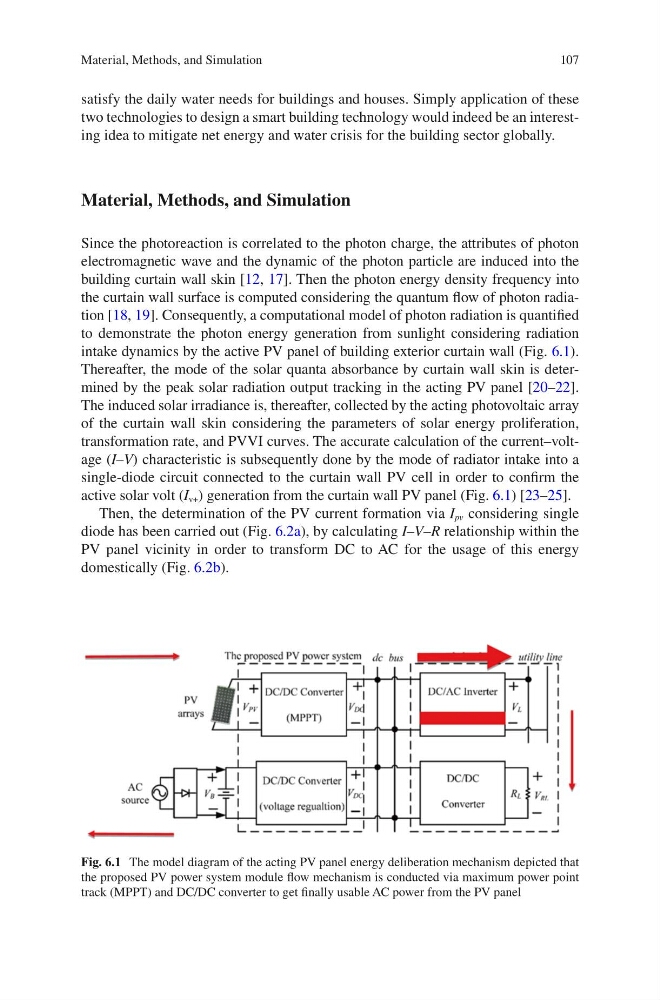
intake dynamics by the active PV panel of building exterior curtain wall (Fig. 6.1).
Thereafter, the mode of the solar quanta absorbance by curtain wall skin is determined by the peak solar radiation output tracking in the acting PV panel [20–22].
The induced solar irradiance is, thereafter, collected by the acting photovoltaic array
of the curtain wall skin considering the parameters of solar energy proliferation,
transformation rate, and PVVI curves. The accurate calculation of the current–voltage (I–V) characteristic is subsequently done by the mode of radiator intake into a
single-diode circuit connected to the curtain wall PV cell in order to confirm the
active solar volt (I v+ ) generation from the curtain wall PV panel (Fig. 6.1) [23–25].
Then, the determination of the PV current formation via I pv considering single
diode has been carried out (Fig. 6.2a), by calculating I–V–R relationship within the
PV panel vicinity in order to transform DC to AC for the usage of this energy
domestically (Fig. 6.2b).
Fig. 6.1 The model diagram of the acting PV panel energy deliberation mechanism depicted that
the proposed PV power system module flow mechanism is conducted via maximum power point
track (MPPT) and DC/DC converter to get finally usable AC power from the PV panel
Material, Methods, and Simulation
satisfy the daily water needs for buildings and houses. Simply application of these
two technologies to design a smart building technology would indeed be an interesting idea to mitigate net energy and water crisis for the building sector globally.
Material, Methods, and Simulation
Since the photoreaction is correlated to the photon charge, the attributes of photon
electromagnetic wave and the dynamic of the photon particle are induced into the
building curtain wall skin [12, 17]. Then the photon energy density frequency into
the curtain wall surface is computed considering the quantum flow of photon radiation [18, 19]. Consequently, a computational model of photon radiation is quantified
to demonstrate the photon energy generation from sunlight considering radiation
intake dynamics by the active PV panel of building exterior curtain wall (Fig. 6.1).
Thereafter, the mode of the solar quanta absorbance by curtain wall skin is determined by the peak solar radiation output tracking in the acting PV panel [20–22].
The induced solar irradiance is, thereafter, collected by the acting photovoltaic array
of the curtain wall skin considering the parameters of solar energy proliferation,
transformation rate, and PVVI curves. The accurate calculation of the current–voltage (I–V) characteristic is subsequently done by the mode of radiator intake into a
single-diode circuit connected to the curtain wall PV cell in order to confirm the
active solar volt (I v+ ) generation from the curtain wall PV panel (Fig. 6.1) [23–25].
Then, the determination of the PV current formation via I pv considering single
diode has been carried out (Fig. 6.2a), by calculating I–V–R relationship within the
PV panel vicinity in order to transform DC to AC for the usage of this energy
domestically (Fig. 6.2b).
Fig. 6.1 The model diagram of the acting PV panel energy deliberation mechanism depicted that
the proposed PV power system module flow mechanism is conducted via maximum power point
track (MPPT) and DC/DC converter to get finally usable AC power from the PV panel
Material, Methods, and Simulation