

98
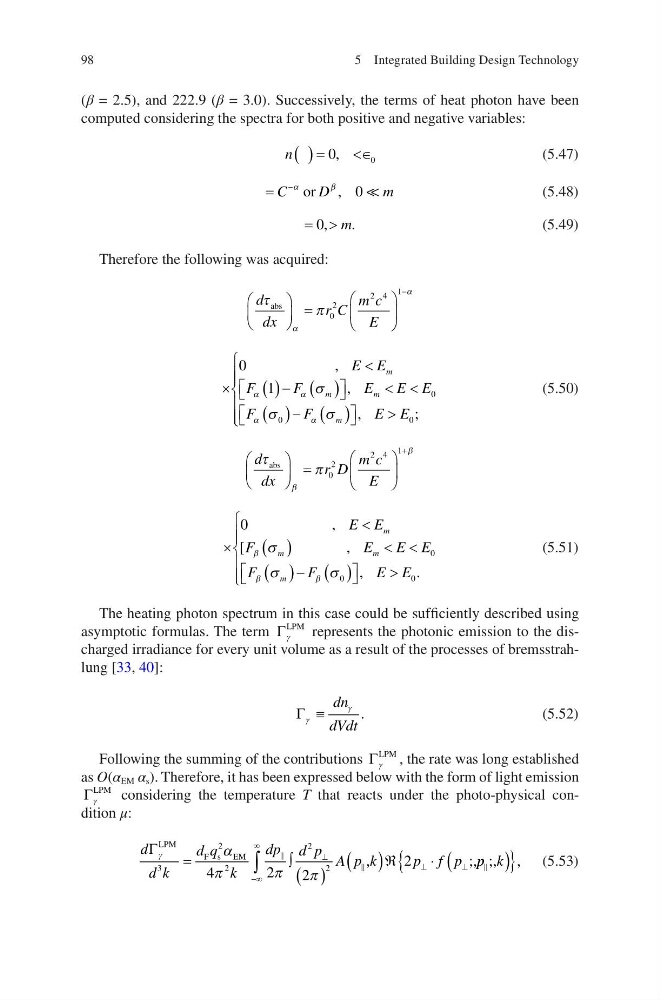
(β = 2.5), and 222.9 (β = 3.0). Successively, the terms of heat photon have been
computed considering the spectra for both positive and negative variables:
n ( ) = <∈
0
0
,
(5.47)
=
−
C
D
m
α
β
or , 0
(5.48)
= >
0,
.
m
(5.49)
Therefore the following was acquired:
d
dx
r C
m c
E
τ
π
α
α
abs
=
−
0
2
2 4 1
×
<
( )− ( )
< <
( )− ( )
>
0
1
0
0
0
,
,
,
;
E E
F
F
E
E E
F
F
E E
m
m
m
m
α
α
α
α
σ
σ
σ
(5.50)
d
dx
r D
m c
E
τ
π
β
β
abs
=
+
0
2
2 4 1
×
<
( )
< <
( )− ( )
>
0
0
0
0
,
[
,
,
.
E E
F
E
E E
F
F
E E
m
m
m
m
β
β
β
σ
σ
σ
(5.51)
The heating photon spectrum in this case could be sufficiently described using
asymptotic formulas. The term Γ γ
LPM represents the photonic emission to the discharged irradiance for every unit volume as a result of the processes of bremsstrahlung [33, 40]:
Γ γ
γ
≡
dn
dVdt
.
(5.52)
Following the summing of the contributions Γ γ
LPM , the rate was long established
as O(α EM α s ). Therefore, it has been expressed below with the form of light emission
Γ γ
LPM considering the temperature T that reacts under the photo-physical condition μ:
d
d k
d q
k
dp d p A p k
p f p
Γ γ
α
π
π
π
LPM
F s EM
,
; ,
3
2
2
2
2
4
2
2
2
=
∫ ( )
( ) ℜ ⋅
−∞
∞
⊥
⊥
⊥
∫
p p k
;,
(
)
{
} , (5.53)
5 Integrated Building Design Technology
(β = 2.5), and 222.9 (β = 3.0). Successively, the terms of heat photon have been
computed considering the spectra for both positive and negative variables:
n ( ) = <∈
0
0
,
(5.47)
=
−
C
D
m
α
β
or , 0
(5.48)
= >
0,
.
m
(5.49)
Therefore the following was acquired:
d
dx
r C
m c
E
τ
π
α
α
abs
=
−
0
2
2 4 1
×
<
( )− ( )
< <
( )− ( )
>
0
1
0
0
0
,
,
,
;
E E
F
F
E
E E
F
F
E E
m
m
m
m
α
α
α
α
σ
σ
σ
(5.50)
d
dx
r D
m c
E
τ
π
β
β
abs
=
+
0
2
2 4 1
×
<
( )
< <
( )− ( )
>
0
0
0
0
,
[
,
,
.
E E
F
E
E E
F
F
E E
m
m
m
m
β
β
β
σ
σ
σ
(5.51)
The heating photon spectrum in this case could be sufficiently described using
asymptotic formulas. The term Γ γ
LPM represents the photonic emission to the discharged irradiance for every unit volume as a result of the processes of bremsstrahlung [33, 40]:
Γ γ
γ
≡
dn
dVdt
.
(5.52)
Following the summing of the contributions Γ γ
LPM , the rate was long established
as O(α EM α s ). Therefore, it has been expressed below with the form of light emission
Γ γ
LPM considering the temperature T that reacts under the photo-physical condition μ:
d
d k
d q
k
dp d p A p k
p f p
Γ γ
α
π
π
π
LPM
F s EM
,
; ,
3
2
2
2
2
4
2
2
2
=
∫ ( )
( ) ℜ ⋅
−∞
∞
⊥
⊥
⊥
∫
p p k
;,
(
)
{
} , (5.53)
5 Integrated Building Design Technology