

99
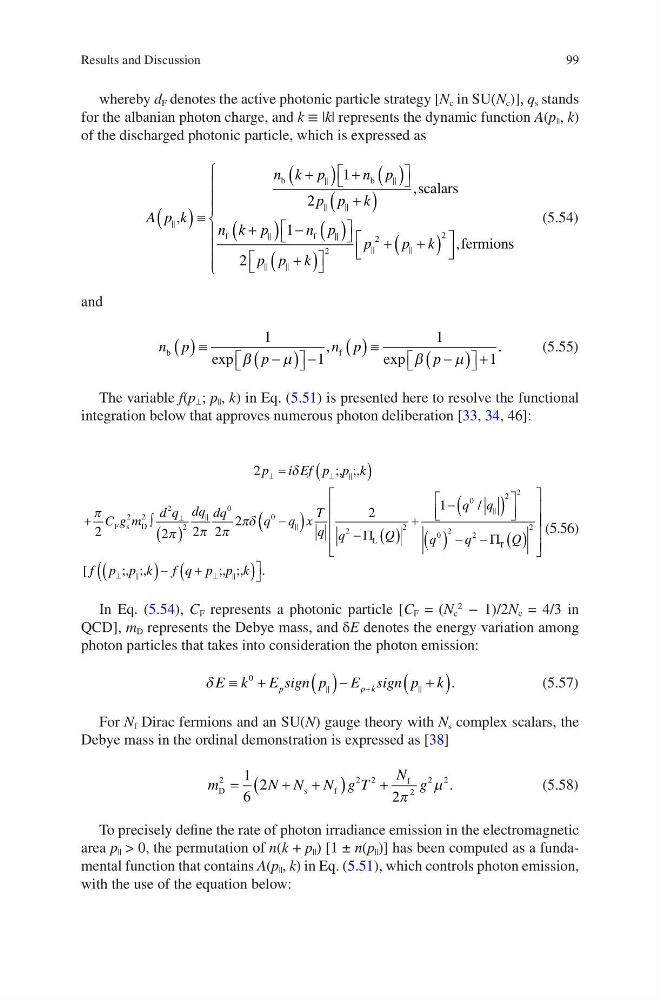
whereby d F denotes the active photonic particle strategy [N c in SU(N c )], q s stands
for the albanian photon charge, and k ≡ |k| represents the dynamic function A(p || , k)
of the discharged photonic particle, which is expressed as
A p k
n k p
n p
p p k
n k p
n p
,
scalars
b
b
f
f
( ) ≡
+
(
) + ( )
+
(
)
+
(
) −
1
2
1
,
( )
+
(
)
+
+
(
)
2
2
2
2
p p k
p
p k ,fermions
(5.54)
and
n p
p
n p
p
b
f
( ) ≡
−
(
)
−
( ) ≡
−
(
)
+
1
1
1
1
exp
,
exp
.
β
µ
β
µ
(5.55)
The variable f(p ⊥ ; p || , k) in Eq. (5.51) is presented here to resolve the functional
integration below that approves numerous photon deliberation [33, 34, 46]:
2
2
2
2 2
2
2 2
2
2
0
0
p i Ef p p k
C g m
d q dq dq
q q
⊥
⊥
⊥
=
(
)
+
∫ ( )
−
δ
π
π
π π
πδ
;, ;,
F s
D
( (
)
− ( )
+
− (
)
( ) − − ( )
x
T
q q
Q
q q
q
q
Q
2
1
2
2
0
2
2
0
2
2
2
Π
Π
L
T
/
(
) − +
(
)
(
⊥
⊥
[
.
f p p k f q p p k
;, ;,
;, ;,
(5.56)
In Eq. (5.54), C F represents a photonic particle [C F = (N c
2
− 1)/2N c = 4/3 in
QCD], m D represents the Debye mass, and δE denotes the energy variation among
photon particles that takes into consideration the photon emission:
δ E k E sign p
E sign p k
p
p k
≡ +
( ) −
+
(
)
+
0
.
(5.57)
For N f Dirac fermions and an SU(N) gauge theory with N s complex scalars, the
Debye mass in the ordinal demonstration is expressed as [38]
m
N N N g T
N g
D
s
f
f
2
2 2
2
2 2
1
6
2
2
=
+ +
(
)
+ π
µ .
(5.58)
To precisely define the rate of photon irradiance emission in the electromagnetic
area p || > 0, the permutation of n(k + p || ) [1 ± n(p || )] has been computed as a fundamental function that contains A(p || , k) in Eq. (5.51), which controls photon emission,
with the use of the equation below:
Results and Discussion
whereby d F denotes the active photonic particle strategy [N c in SU(N c )], q s stands
for the albanian photon charge, and k ≡ |k| represents the dynamic function A(p || , k)
of the discharged photonic particle, which is expressed as
A p k
n k p
n p
p p k
n k p
n p
,
scalars
b
b
f
f
( ) ≡
+
(
) + ( )
+
(
)
+
(
) −
1
2
1
,
( )
+
(
)
+
+
(
)
2
2
2
2
p p k
p
p k ,fermions
(5.54)
and
n p
p
n p
p
b
f
( ) ≡
−
(
)
−
( ) ≡
−
(
)
+
1
1
1
1
exp
,
exp
.
β
µ
β
µ
(5.55)
The variable f(p ⊥ ; p || , k) in Eq. (5.51) is presented here to resolve the functional
integration below that approves numerous photon deliberation [33, 34, 46]:
2
2
2
2 2
2
2 2
2
2
0
0
p i Ef p p k
C g m
d q dq dq
q q
⊥
⊥
⊥
=
(
)
+
∫ ( )
−
δ
π
π
π π
πδ
;, ;,
F s
D
( (
)
− ( )
+
− (
)
( ) − − ( )
x
T
q q
Q
q q
q
q
Q
2
1
2
2
0
2
2
0
2
2
2
Π
Π
L
T
/
(
) − +
(
)
(
⊥
⊥
[
.
f p p k f q p p k
;, ;,
;, ;,
(5.56)
In Eq. (5.54), C F represents a photonic particle [C F = (N c
2
− 1)/2N c = 4/3 in
QCD], m D represents the Debye mass, and δE denotes the energy variation among
photon particles that takes into consideration the photon emission:
δ E k E sign p
E sign p k
p
p k
≡ +
( ) −
+
(
)
+
0
.
(5.57)
For N f Dirac fermions and an SU(N) gauge theory with N s complex scalars, the
Debye mass in the ordinal demonstration is expressed as [38]
m
N N N g T
N g
D
s
f
f
2
2 2
2
2 2
1
6
2
2
=
+ +
(
)
+ π
µ .
(5.58)
To precisely define the rate of photon irradiance emission in the electromagnetic
area p || > 0, the permutation of n(k + p || ) [1 ± n(p || )] has been computed as a fundamental function that contains A(p || , k) in Eq. (5.51), which controls photon emission,
with the use of the equation below:
Results and Discussion