

26
1 Surface Thermodynamics of Solid Electrode
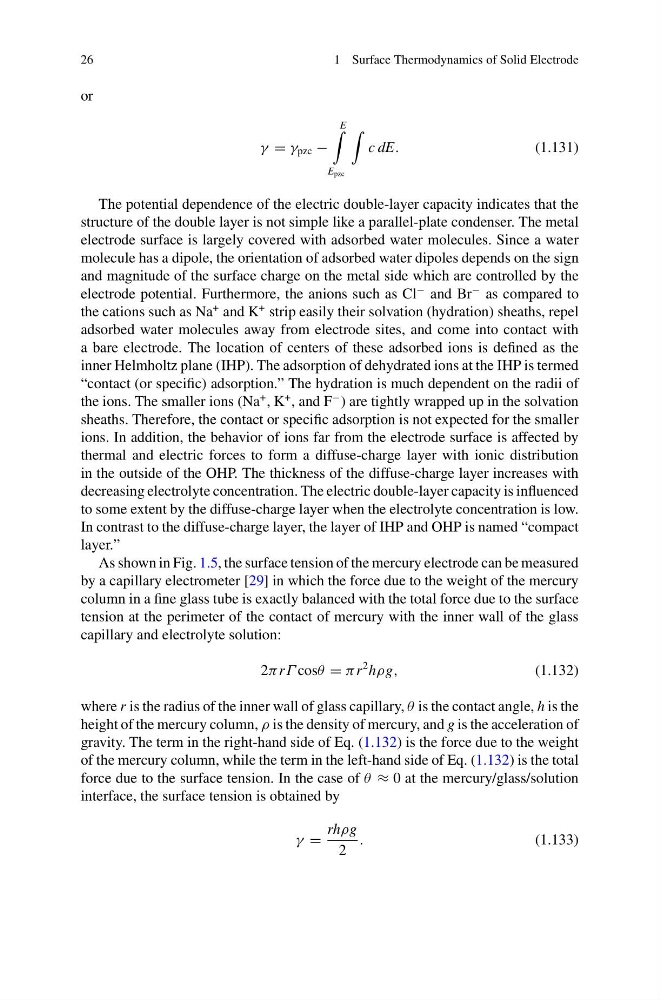
or
γ = γ pzc −
E
E pzc
c dE.
(1.131)
The potential dependence of the electric double-layer capacity indicates that the
structure of the double layer is not simple like a parallel-plate condenser. The metal
electrode surface is largely covered with adsorbed water molecules. Since a water
molecule has a dipole, the orientation of adsorbed water dipoles depends on the sign
and magnitude of the surface charge on the metal side which are controlled by the
electrode potential. Furthermore, the anions such as Cl
− and Br
− as compared to
the cations such as Na
+ and K
+ strip easily their solvation (hydration) sheaths, repel
adsorbed water molecules away from electrode sites, and come into contact with
a bare electrode. The location of centers of these adsorbed ions is defined as the
inner Helmholtz plane (IHP). The adsorption of dehydrated ions at the IHP is termed
“contact (or specific) adsorption.” The hydration is much dependent on the radii of
the ions. The smaller ions (Na
+ , K
+ , and F
− ) are tightly wrapped up in the solvation
sheaths. Therefore, the contact or specific adsorption is not expected for the smaller
ions. In addition, the behavior of ions far from the electrode surface is affected by
thermal and electric forces to form a diffuse-charge layer with ionic distribution
in the outside of the OHP. The thickness of the diffuse-charge layer increases with
decreasing electrolyte concentration. The electric double-layer capacity is influenced
to some extent by the diffuse-charge layer when the electrolyte concentration is low.
In contrast to the diffuse-charge layer, the layer of IHP and OHP is named “compact
layer.”
As shown in Fig. 1.5, the surface tension of the mercury electrode can be measured
by a capillary electrometer [29] in which the force due to the weight of the mercury
column in a fine glass tube is exactly balanced with the total force due to the surface
tension at the perimeter of the contact of mercury with the inner wall of the glass
capillary and electrolyte solution:
2π rΓ cosθ = π r
2 hρg,
(1.132)
where r is the radius of the inner wall of glass capillary, θ is the contact angle, h is the
height of the mercury column, ρ is the density of mercury, and g is the acceleration of
gravity. The term in the right-hand side of Eq. (1.132) is the force due to the weight
of the mercury column, while the term in the left-hand side of Eq. (1.132) is the total
force due to the surface tension. In the case of θ ≈ 0 at the mercury/glass/solution
interface, the surface tension is obtained by
γ =
rhρg
2
.
(1.133)
1 Surface Thermodynamics of Solid Electrode
or
γ = γ pzc −
E
E pzc
c dE.
(1.131)
The potential dependence of the electric double-layer capacity indicates that the
structure of the double layer is not simple like a parallel-plate condenser. The metal
electrode surface is largely covered with adsorbed water molecules. Since a water
molecule has a dipole, the orientation of adsorbed water dipoles depends on the sign
and magnitude of the surface charge on the metal side which are controlled by the
electrode potential. Furthermore, the anions such as Cl
− and Br
− as compared to
the cations such as Na
+ and K
+ strip easily their solvation (hydration) sheaths, repel
adsorbed water molecules away from electrode sites, and come into contact with
a bare electrode. The location of centers of these adsorbed ions is defined as the
inner Helmholtz plane (IHP). The adsorption of dehydrated ions at the IHP is termed
“contact (or specific) adsorption.” The hydration is much dependent on the radii of
the ions. The smaller ions (Na
+ , K
+ , and F
− ) are tightly wrapped up in the solvation
sheaths. Therefore, the contact or specific adsorption is not expected for the smaller
ions. In addition, the behavior of ions far from the electrode surface is affected by
thermal and electric forces to form a diffuse-charge layer with ionic distribution
in the outside of the OHP. The thickness of the diffuse-charge layer increases with
decreasing electrolyte concentration. The electric double-layer capacity is influenced
to some extent by the diffuse-charge layer when the electrolyte concentration is low.
In contrast to the diffuse-charge layer, the layer of IHP and OHP is named “compact
layer.”
As shown in Fig. 1.5, the surface tension of the mercury electrode can be measured
by a capillary electrometer [29] in which the force due to the weight of the mercury
column in a fine glass tube is exactly balanced with the total force due to the surface
tension at the perimeter of the contact of mercury with the inner wall of the glass
capillary and electrolyte solution:
2π rΓ cosθ = π r
2 hρg,
(1.132)
where r is the radius of the inner wall of glass capillary, θ is the contact angle, h is the
height of the mercury column, ρ is the density of mercury, and g is the acceleration of
gravity. The term in the right-hand side of Eq. (1.132) is the force due to the weight
of the mercury column, while the term in the left-hand side of Eq. (1.132) is the total
force due to the surface tension. In the case of θ ≈ 0 at the mercury/glass/solution
interface, the surface tension is obtained by
γ =
rhρg
2
.
(1.133)