

1.5 Major Parameters of Surface Thermodynamics
11
dG
σ
= γ dA + Ad γ +
i
μ i dn
σ
i +
i
n
σ
i d μ i .
(1.41)
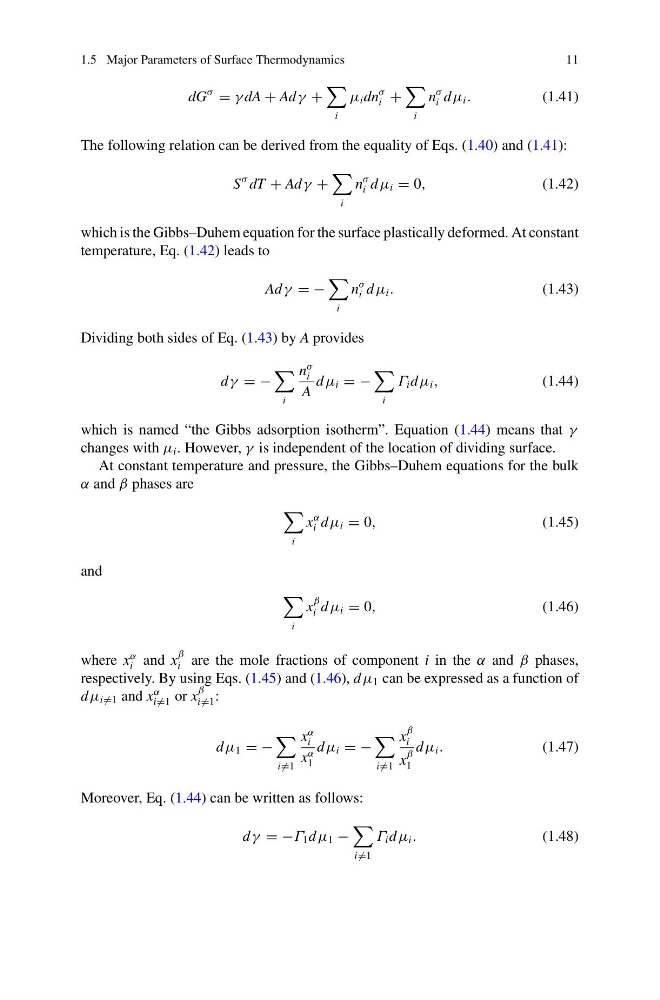
The following relation can be derived from the equality of Eqs. (1.40) and (1.41):
S
σ dT + Ad γ +
i
n
σ
i d μ i = 0,
(1.42)
which is the Gibbs–Duhem equation for the surface plastically deformed. At constant
temperature, Eq. (1.42) leads to
Ad γ = −
i
n
σ
i d μ i .
(1.43)
Dividing both sides of Eq. (1.43) by A provides
d γ = −
i
n
σ
i
A
d μ i = −
i
Γ i d μ i ,
(1.44)
which is named “the Gibbs adsorption isotherm”. Equation (1.44) means that γ
changes with μ i . However, γ is independent of the location of dividing surface.
At constant temperature and pressure, the Gibbs–Duhem equations for the bulk
α and β phases are
i
x
α
i d μ i = 0,
(1.45)
and
i
x
β
i d μ i = 0,
(1.46)
where x
α
i and x
β
i are the mole fractions of component i in the α and β phases,
respectively. By using Eqs. (1.45) and (1.46), d μ 1 can be expressed as a function of
d μ i =1 and x
α
i =1 or x
β
i =1 :
d μ 1 = −
i =1
x
α
i
x
α
1
d μ i = −
i =1
x
β
i
x
β
1
d μ i .
(1.47)
Moreover, Eq. (1.44) can be written as follows:
d γ = −Γ 1 d μ 1 −
i =1
Γ i d μ i .
(1.48)
11
dG
σ
= γ dA + Ad γ +
i
μ i dn
σ
i +
i
n
σ
i d μ i .
(1.41)
The following relation can be derived from the equality of Eqs. (1.40) and (1.41):
S
σ dT + Ad γ +
i
n
σ
i d μ i = 0,
(1.42)
which is the Gibbs–Duhem equation for the surface plastically deformed. At constant
temperature, Eq. (1.42) leads to
Ad γ = −
i
n
σ
i d μ i .
(1.43)
Dividing both sides of Eq. (1.43) by A provides
d γ = −
i
n
σ
i
A
d μ i = −
i
Γ i d μ i ,
(1.44)
which is named “the Gibbs adsorption isotherm”. Equation (1.44) means that γ
changes with μ i . However, γ is independent of the location of dividing surface.
At constant temperature and pressure, the Gibbs–Duhem equations for the bulk
α and β phases are
i
x
α
i d μ i = 0,
(1.45)
and
i
x
β
i d μ i = 0,
(1.46)
where x
α
i and x
β
i are the mole fractions of component i in the α and β phases,
respectively. By using Eqs. (1.45) and (1.46), d μ 1 can be expressed as a function of
d μ i =1 and x
α
i =1 or x
β
i =1 :
d μ 1 = −
i =1
x
α
i
x
α
1
d μ i = −
i =1
x
β
i
x
β
1
d μ i .
(1.47)
Moreover, Eq. (1.44) can be written as follows:
d γ = −Γ 1 d μ 1 −
i =1
Γ i d μ i .
(1.48)