

12
1 Surface Thermodynamics of Solid Electrode
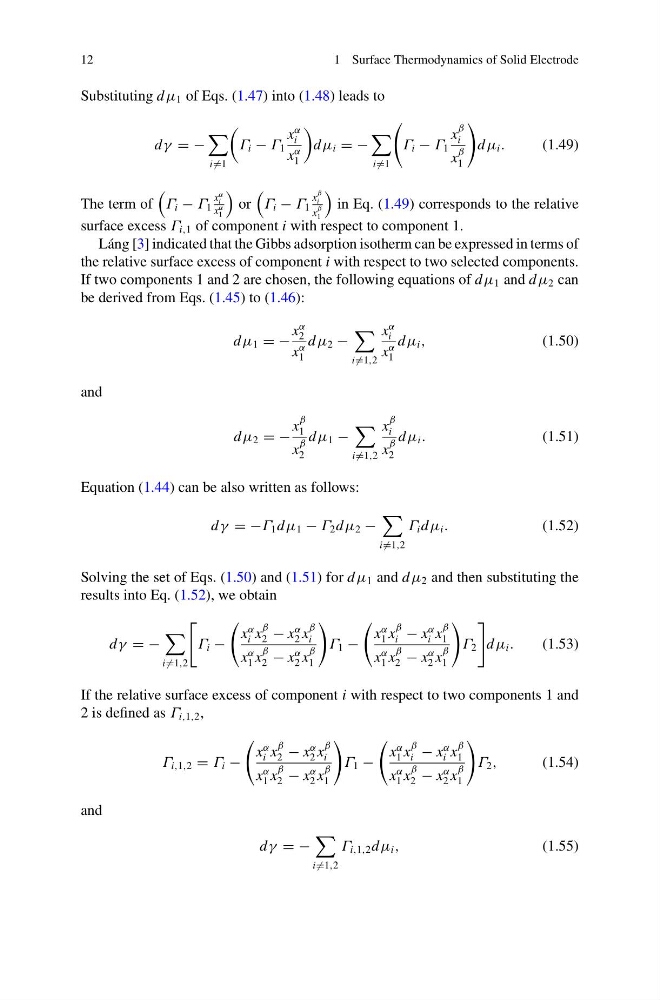
Substituting d μ 1 of Eqs. (1.47) into (1.48) leads to
d γ = −
i =1
Γ i − Γ 1
x
α
i
x
α
1
d μ i = −
i =1
Γ i − Γ 1
x
β
i
x
β
1
d μ i .
(1.49)
The term of
Γ i − Γ 1
x
α
i
x
α
1
or
Γ i − Γ 1
x
β
i
x
β
1
in Eq. (1.49) corresponds to the relative
surface excess Γ i,1 of component i with respect to component 1.
Láng [3] indicated that the Gibbs adsorption isotherm can be expressed in terms of
the relative surface excess of component i with respect to two selected components.
If two components 1 and 2 are chosen, the following equations of d μ 1 and d μ 2 can
be derived from Eqs. (1.45) to (1.46):
d μ 1 = −
x
α
2
x
α
1
d μ 2 −
i =1,2
x
α
i
x
α
1
d μ i ,
(1.50)
and
d μ 2 = −
x
β
1
x
β
2
d μ 1 −
i =1,2
x
β
i
x
β
2
d μ i .
(1.51)
Equation (1.44) can be also written as follows:
d γ = −Γ 1 d μ 1 − Γ 2 d μ 2 −
i =1,2
Γ i d μ i .
(1.52)
Solving the set of Eqs. (1.50) and (1.51) for d μ 1 and d μ 2 and then substituting the
results into Eq. (1.52), we obtain
d γ = −
i =1,2
Γ i −
x
α
i x
β
2 − x
α
2 x
β
i
x
α
1 x
β
2 − x
α
2 x
β
1
Γ 1 −
x
α
1 x
β
i − x
α
i x
β
1
x
α
1 x
β
2 − x
α
2 x
β
1
Γ 2
d μ i .
(1.53)
If the relative surface excess of component i with respect to two components 1 and
2 is defined as Γ i,1,2 ,
Γ i,1,2 = Γ i −
x
α
i x
β
2 − x
α
2 x
β
i
x
α
1 x
β
2 − x
α
2 x
β
1
Γ 1 −
x
α
1 x
β
i − x
α
i x
β
1
x
α
1 x
β
2 − x
α
2 x
β
1
Γ 2 ,
(1.54)
and
d γ = −
i =1,2
Γ i,1,2 d μ i ,
(1.55)
1 Surface Thermodynamics of Solid Electrode
Substituting d μ 1 of Eqs. (1.47) into (1.48) leads to
d γ = −
i =1
Γ i − Γ 1
x
α
i
x
α
1
d μ i = −
i =1
Γ i − Γ 1
x
β
i
x
β
1
d μ i .
(1.49)
The term of
Γ i − Γ 1
x
α
i
x
α
1
or
Γ i − Γ 1
x
β
i
x
β
1
in Eq. (1.49) corresponds to the relative
surface excess Γ i,1 of component i with respect to component 1.
Láng [3] indicated that the Gibbs adsorption isotherm can be expressed in terms of
the relative surface excess of component i with respect to two selected components.
If two components 1 and 2 are chosen, the following equations of d μ 1 and d μ 2 can
be derived from Eqs. (1.45) to (1.46):
d μ 1 = −
x
α
2
x
α
1
d μ 2 −
i =1,2
x
α
i
x
α
1
d μ i ,
(1.50)
and
d μ 2 = −
x
β
1
x
β
2
d μ 1 −
i =1,2
x
β
i
x
β
2
d μ i .
(1.51)
Equation (1.44) can be also written as follows:
d γ = −Γ 1 d μ 1 − Γ 2 d μ 2 −
i =1,2
Γ i d μ i .
(1.52)
Solving the set of Eqs. (1.50) and (1.51) for d μ 1 and d μ 2 and then substituting the
results into Eq. (1.52), we obtain
d γ = −
i =1,2
Γ i −
x
α
i x
β
2 − x
α
2 x
β
i
x
α
1 x
β
2 − x
α
2 x
β
1
Γ 1 −
x
α
1 x
β
i − x
α
i x
β
1
x
α
1 x
β
2 − x
α
2 x
β
1
Γ 2
d μ i .
(1.53)
If the relative surface excess of component i with respect to two components 1 and
2 is defined as Γ i,1,2 ,
Γ i,1,2 = Γ i −
x
α
i x
β
2 − x
α
2 x
β
i
x
α
1 x
β
2 − x
α
2 x
β
1
Γ 1 −
x
α
1 x
β
i − x
α
i x
β
1
x
α
1 x
β
2 − x
α
2 x
β
1
Γ 2 ,
(1.54)
and
d γ = −
i =1,2
Γ i,1,2 d μ i ,
(1.55)