

10
1 Surface Thermodynamics of Solid Electrode
G
β
= H
β
− TS
β
=
i
μ i n
β
i ,
(1.34)
and
G
σ
= H
σ
− TS
σ
= γ A +
i
μ i n
σ
i .
(1.35)
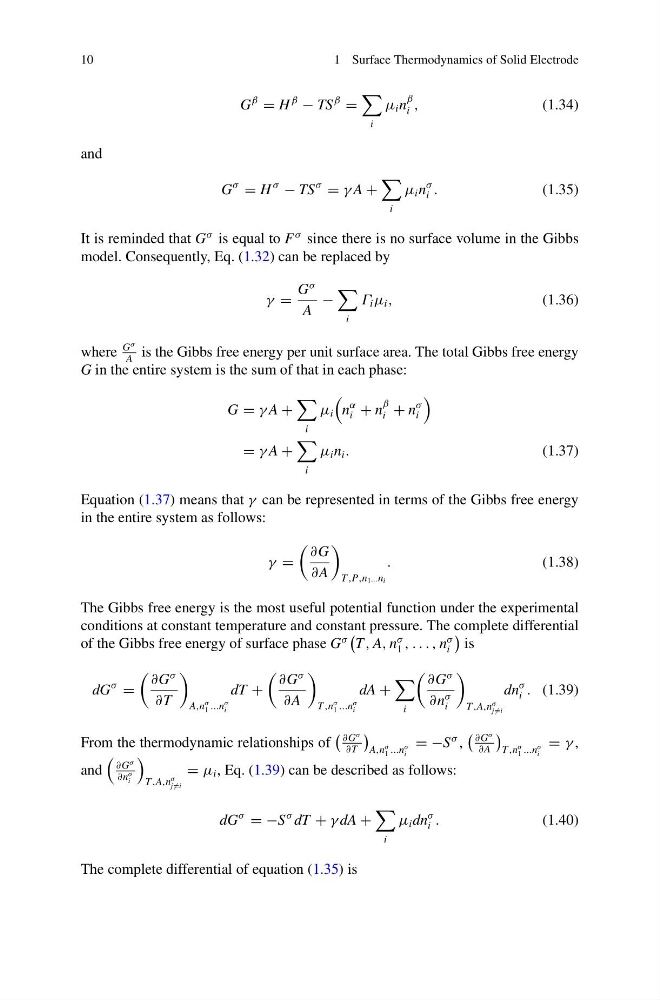
It is reminded that G
σ is equal to F
σ since there is no surface volume in the Gibbs
model. Consequently, Eq. (1.32) can be replaced by
γ =
G
σ
A
−
i
Γ i μ i ,
(1.36)
where
G
σ
A
is the Gibbs free energy per unit surface area. The total Gibbs free energy
G in the entire system is the sum of that in each phase:
G = γ A +
i
μ i
n
α
i + n
β
i + n
σ
i
= γ A +
i
μ i n i .
(1.37)
Equation (1.37) means that γ can be represented in terms of the Gibbs free energy
in the entire system as follows:
γ =
∂G
∂A
T ,P,n 1··· n i
.
(1.38)
The Gibbs free energy is the most useful potential function under the experimental
conditions at constant temperature and constant pressure. The complete differential
of the Gibbs free energy of surface phase G
σ
T , A, n
σ
1 , . . . , n
σ
i
is
dG
σ
=
∂G
σ
∂T
A,n
σ
1 ...n
σ
i
dT +
∂G
σ
∂A
T ,n
σ
1 ...n
σ
i
dA +
i
∂G
σ
∂n
σ
i
T ,A,n
σ
j =i
dn
σ
i . (1.39)
From the thermodynamic relationships of
∂G
σ
∂T
A,n
σ
1 ...n
σ
i
= −S
σ ,
∂G
σ
∂A
T ,n
σ
1 ...n
σ
i
= γ ,
and
∂G
σ
∂n
σ
i
T ,A,n
σ
j =i
= μ i , Eq. (1.39) can be described as follows:
dG
σ
= −S
σ dT + γ dA +
i
μ i dn
σ
i .
(1.40)
The complete differential of equation (1.35) is
1 Surface Thermodynamics of Solid Electrode
G
β
= H
β
− TS
β
=
i
μ i n
β
i ,
(1.34)
and
G
σ
= H
σ
− TS
σ
= γ A +
i
μ i n
σ
i .
(1.35)
It is reminded that G
σ is equal to F
σ since there is no surface volume in the Gibbs
model. Consequently, Eq. (1.32) can be replaced by
γ =
G
σ
A
−
i
Γ i μ i ,
(1.36)
where
G
σ
A
is the Gibbs free energy per unit surface area. The total Gibbs free energy
G in the entire system is the sum of that in each phase:
G = γ A +
i
μ i
n
α
i + n
β
i + n
σ
i
= γ A +
i
μ i n i .
(1.37)
Equation (1.37) means that γ can be represented in terms of the Gibbs free energy
in the entire system as follows:
γ =
∂G
∂A
T ,P,n 1··· n i
.
(1.38)
The Gibbs free energy is the most useful potential function under the experimental
conditions at constant temperature and constant pressure. The complete differential
of the Gibbs free energy of surface phase G
σ
T , A, n
σ
1 , . . . , n
σ
i
is
dG
σ
=
∂G
σ
∂T
A,n
σ
1 ...n
σ
i
dT +
∂G
σ
∂A
T ,n
σ
1 ...n
σ
i
dA +
i
∂G
σ
∂n
σ
i
T ,A,n
σ
j =i
dn
σ
i . (1.39)
From the thermodynamic relationships of
∂G
σ
∂T
A,n
σ
1 ...n
σ
i
= −S
σ ,
∂G
σ
∂A
T ,n
σ
1 ...n
σ
i
= γ ,
and
∂G
σ
∂n
σ
i
T ,A,n
σ
j =i
= μ i , Eq. (1.39) can be described as follows:
dG
σ
= −S
σ dT + γ dA +
i
μ i dn
σ
i .
(1.40)
The complete differential of equation (1.35) is