

142
5 Controversy of Thermodynamics Associated with Surface …
where g is surface stress and dε =
dA
A
is the change in elastic strain. Equation (5.10)
is the form derived for an isotropic solid electrode in place of an anisotropic solid
electrode (see Eq. (1.110) in Sect. 1.8 of Chap. 1).
Láng and Heusler [1, 2] argued that Eq. (5.10) is attributed to inserting g into
Eq. (5.7) in place of γ , while keeping γ in Eq. (5.6), and they concluded that the use
of two different parameters γ and g as the same variable (for the intensive parameter
conjugate to A) in the U
σ function cannot be valid and the U
σ function used for
derivation of Eq. (5.10) is not a homogeneous function of the first order. In addition,
they claimed that Eq. (5.10) is inconsistent with classical thermodynamics since
Eq. (5.10) contains the differential of extensive parameter dε =
dA
A
despite the Gibbs–
Duhem equation representing the relationship between the intensive parameters in
the different forms [7]. Gutman [8–10] also claimed that Eq. (5.10) is inconsistent
with classical thermodynamics and concluded that Eqs. (5.8) or (5.9) is valid as the
Gibbs–Duhem equation for a solid electrode as well as a liquid electrode (such as
Hg). However, a distinction between γ and g cannot be made from Eqs. (5.8) or (5.9)
which is a homogeneous function independent of whether the surface deformation
is plastic or elastic.
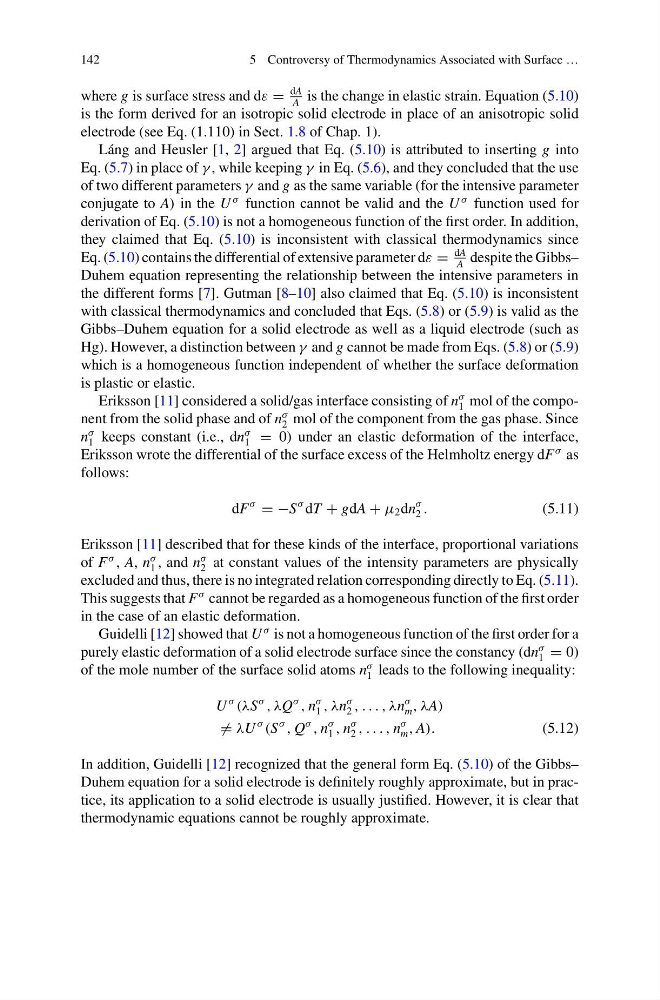
Eriksson [11] considered a solid/gas interface consisting of n
σ
1 mol of the component from the solid phase and of n
σ
2 mol of the component from the gas phase. Since
n
σ
1 keeps constant (i.e., dn
σ
1 = 0) under an elastic deformation of the interface,
Eriksson wrote the differential of the surface excess of the Helmholtz energy dF
σ as
follows:
dF
σ
= −S
σ dT + gdA + μ 2 dn
σ
2 .
(5.11)
Eriksson [11] described that for these kinds of the interface, proportional variations
of F
σ , A, n
σ
1 , and n
σ
2 at constant values of the intensity parameters are physically
excluded and thus, there is no integrated relation corresponding directly to Eq. (5.11).
This suggests that F
σ cannot be regarded as a homogeneous function of the first order
in the case of an elastic deformation.
Guidelli [12] showed that U
σ is not a homogeneous function of the first order for a
purely elastic deformation of a solid electrode surface since the constancy (dn
σ
1 = 0)
of the mole number of the surface solid atoms n
σ
1 leads to the following inequality:
U
σ
(λS
σ
, λQ
σ
, n
σ
1 , λn
σ
2 , . . . , λn
σ
m , λA)
= λU
σ
(S
σ
, Q
σ
, n
σ
1 , n
σ
2 , . . . , n
σ
m , A).
(5.12)
In addition, Guidelli [12] recognized that the general form Eq. (5.10) of the Gibbs–
Duhem equation for a solid electrode is definitely roughly approximate, but in practice, its application to a solid electrode is usually justified. However, it is clear that
thermodynamic equations cannot be roughly approximate.
5 Controversy of Thermodynamics Associated with Surface …
where g is surface stress and dε =
dA
A
is the change in elastic strain. Equation (5.10)
is the form derived for an isotropic solid electrode in place of an anisotropic solid
electrode (see Eq. (1.110) in Sect. 1.8 of Chap. 1).
Láng and Heusler [1, 2] argued that Eq. (5.10) is attributed to inserting g into
Eq. (5.7) in place of γ , while keeping γ in Eq. (5.6), and they concluded that the use
of two different parameters γ and g as the same variable (for the intensive parameter
conjugate to A) in the U
σ function cannot be valid and the U
σ function used for
derivation of Eq. (5.10) is not a homogeneous function of the first order. In addition,
they claimed that Eq. (5.10) is inconsistent with classical thermodynamics since
Eq. (5.10) contains the differential of extensive parameter dε =
dA
A
despite the Gibbs–
Duhem equation representing the relationship between the intensive parameters in
the different forms [7]. Gutman [8–10] also claimed that Eq. (5.10) is inconsistent
with classical thermodynamics and concluded that Eqs. (5.8) or (5.9) is valid as the
Gibbs–Duhem equation for a solid electrode as well as a liquid electrode (such as
Hg). However, a distinction between γ and g cannot be made from Eqs. (5.8) or (5.9)
which is a homogeneous function independent of whether the surface deformation
is plastic or elastic.
Eriksson [11] considered a solid/gas interface consisting of n
σ
1 mol of the component from the solid phase and of n
σ
2 mol of the component from the gas phase. Since
n
σ
1 keeps constant (i.e., dn
σ
1 = 0) under an elastic deformation of the interface,
Eriksson wrote the differential of the surface excess of the Helmholtz energy dF
σ as
follows:
dF
σ
= −S
σ dT + gdA + μ 2 dn
σ
2 .
(5.11)
Eriksson [11] described that for these kinds of the interface, proportional variations
of F
σ , A, n
σ
1 , and n
σ
2 at constant values of the intensity parameters are physically
excluded and thus, there is no integrated relation corresponding directly to Eq. (5.11).
This suggests that F
σ cannot be regarded as a homogeneous function of the first order
in the case of an elastic deformation.
Guidelli [12] showed that U
σ is not a homogeneous function of the first order for a
purely elastic deformation of a solid electrode surface since the constancy (dn
σ
1 = 0)
of the mole number of the surface solid atoms n
σ
1 leads to the following inequality:
U
σ
(λS
σ
, λQ
σ
, n
σ
1 , λn
σ
2 , . . . , λn
σ
m , λA)
= λU
σ
(S
σ
, Q
σ
, n
σ
1 , n
σ
2 , . . . , n
σ
m , A).
(5.12)
In addition, Guidelli [12] recognized that the general form Eq. (5.10) of the Gibbs–
Duhem equation for a solid electrode is definitely roughly approximate, but in practice, its application to a solid electrode is usually justified. However, it is clear that
thermodynamic equations cannot be roughly approximate.