

5.2 On Homogeneous Nature of the Thermodynamic Functions of Solid Electrode
141
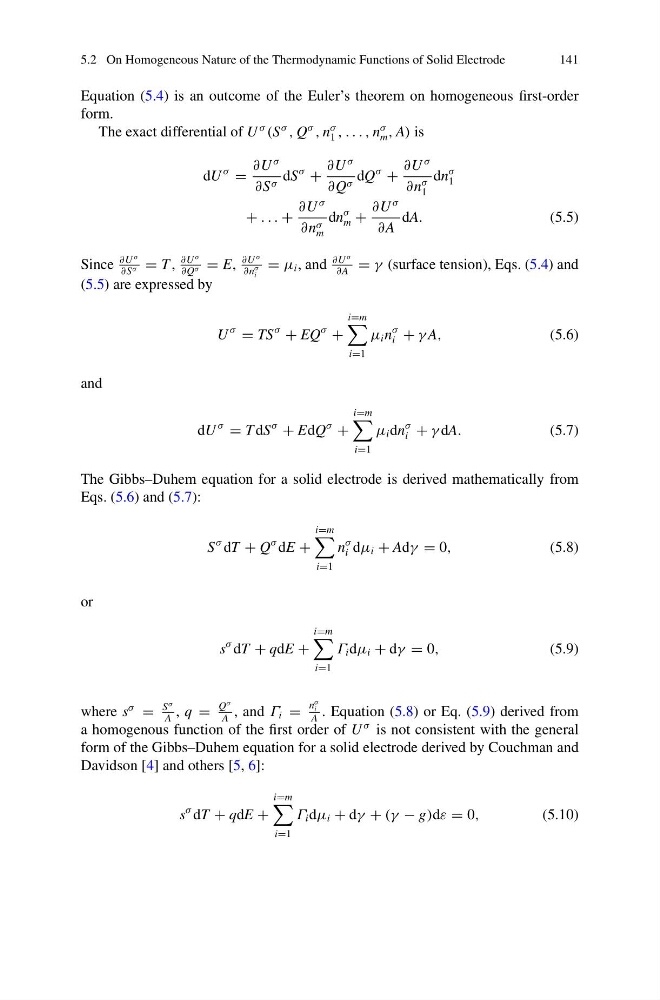
Equation (5.4) is an outcome of the Euler’s theorem on homogeneous first-order
form.
The exact differential of U
σ
(S
σ
, Q
σ
, n
σ
1 , . . . , n
σ
m , A) is
dU
σ
=
∂U
σ
∂S σ dS
σ
+
∂U
σ
∂Q σ dQ
σ
+
∂U
σ
∂n
σ
1
dn
σ
1
+ . . . +
∂U
σ
∂n σ
m
dn
σ
m +
∂U
σ
∂A
dA.
(5.5)
Since
∂U
σ
∂S σ = T ,
∂U
σ
∂Q σ = E,
∂U
σ
∂n
σ
i
= μ i , and
∂U
σ
∂A
= γ (surface tension), Eqs. (5.4) and
(5.5) are expressed by
U
σ
= TS
σ
+ EQ
σ
+
i=m
i=1
μ i n
σ
i + γ A,
(5.6)
and
dU
σ
= T dS
σ
+ EdQ
σ
+
i=m
i=1
μ i dn
σ
i + γ dA.
(5.7)
The Gibbs–Duhem equation for a solid electrode is derived mathematically from
Eqs. (5.6) and (5.7):
S
σ dT + Q
σ dE +
i=m
i=1
n
σ
i dμ i + Adγ = 0,
(5.8)
or
s
σ dT + qdE +
i=m
i=1
Γ i dμ i + dγ = 0,
(5.9)
where s
σ
=
S
σ
A
, q =
Q
σ
A
, and Γ i =
n
σ
i
A
. Equation (5.8) or Eq. (5.9) derived from
a homogenous function of the first order of U
σ is not consistent with the general
form of the Gibbs–Duhem equation for a solid electrode derived by Couchman and
Davidson [4] and others [5, 6]:
s
σ dT + qdE +
i=m
i=1
Γ i dμ i + dγ + (γ − g)dε = 0,
(5.10)
141
Equation (5.4) is an outcome of the Euler’s theorem on homogeneous first-order
form.
The exact differential of U
σ
(S
σ
, Q
σ
, n
σ
1 , . . . , n
σ
m , A) is
dU
σ
=
∂U
σ
∂S σ dS
σ
+
∂U
σ
∂Q σ dQ
σ
+
∂U
σ
∂n
σ
1
dn
σ
1
+ . . . +
∂U
σ
∂n σ
m
dn
σ
m +
∂U
σ
∂A
dA.
(5.5)
Since
∂U
σ
∂S σ = T ,
∂U
σ
∂Q σ = E,
∂U
σ
∂n
σ
i
= μ i , and
∂U
σ
∂A
= γ (surface tension), Eqs. (5.4) and
(5.5) are expressed by
U
σ
= TS
σ
+ EQ
σ
+
i=m
i=1
μ i n
σ
i + γ A,
(5.6)
and
dU
σ
= T dS
σ
+ EdQ
σ
+
i=m
i=1
μ i dn
σ
i + γ dA.
(5.7)
The Gibbs–Duhem equation for a solid electrode is derived mathematically from
Eqs. (5.6) and (5.7):
S
σ dT + Q
σ dE +
i=m
i=1
n
σ
i dμ i + Adγ = 0,
(5.8)
or
s
σ dT + qdE +
i=m
i=1
Γ i dμ i + dγ = 0,
(5.9)
where s
σ
=
S
σ
A
, q =
Q
σ
A
, and Γ i =
n
σ
i
A
. Equation (5.8) or Eq. (5.9) derived from
a homogenous function of the first order of U
σ is not consistent with the general
form of the Gibbs–Duhem equation for a solid electrode derived by Couchman and
Davidson [4] and others [5, 6]:
s
σ dT + qdE +
i=m
i=1
Γ i dμ i + dγ + (γ − g)dε = 0,
(5.10)