

5.2 On Homogeneous Nature of the Thermodynamic Functions of Solid Electrode
143
Although surface area A in Eq. (5.7) is defined as the only state variable describing
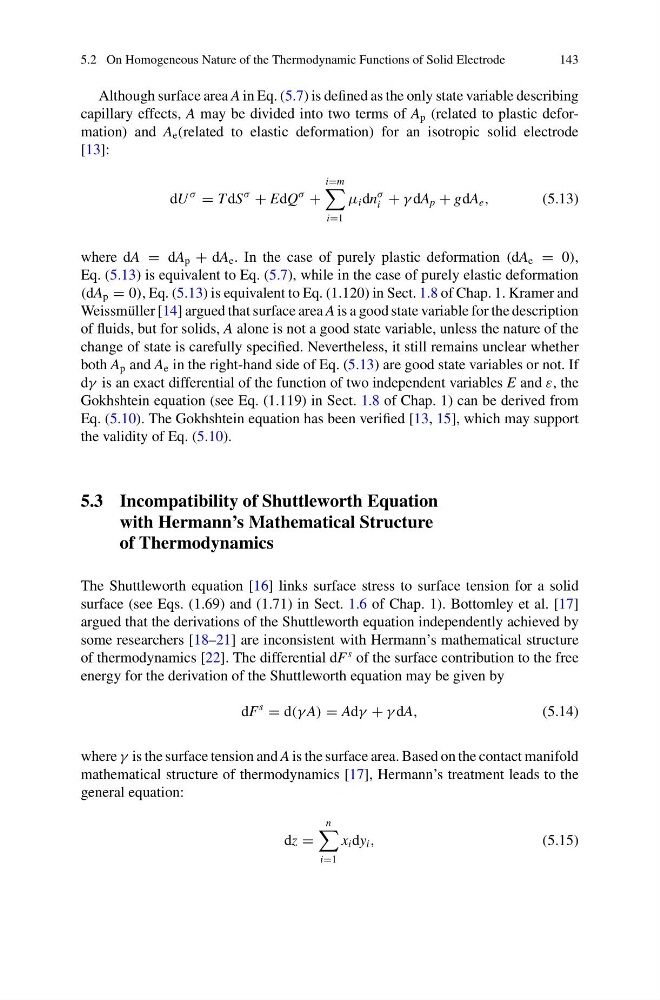
capillary effects, A may be divided into two terms of A p (related to plastic deformation) and A e (related to elastic deformation) for an isotropic solid electrode
[13]:
dU
σ
= T dS
σ
+ EdQ
σ
+
i=m
i=1
μ i dn
σ
i + γ dA p + gdA e ,
(5.13)
where dA = dA p + dA e . In the case of purely plastic deformation (dA e = 0),
Eq. (5.13) is equivalent to Eq. (5.7), while in the case of purely elastic deformation
(dA p = 0), Eq. (5.13) is equivalent to Eq. (1.120) in Sect. 1.8 of Chap. 1. Kramer and
Weissmüller [14] argued that surface area A is a good state variable for the description
of fluids, but for solids, A alone is not a good state variable, unless the nature of the
change of state is carefully specified. Nevertheless, it still remains unclear whether
both A p and A e in the right-hand side of Eq. (5.13) are good state variables or not. If
dγ is an exact differential of the function of two independent variables E and ε, the
Gokhshtein equation (see Eq. (1.119) in Sect. 1.8 of Chap. 1) can be derived from
Eq. (5.10). The Gokhshtein equation has been verified [13, 15], which may support
the validity of Eq. (5.10).
5.3 Incompatibility of Shuttleworth Equation
with Hermann’s Mathematical Structure
of Thermodynamics
The Shuttleworth equation [16] links surface stress to surface tension for a solid
surface (see Eqs. (1.69) and (1.71) in Sect. 1.6 of Chap. 1). Bottomley et al. [17]
argued that the derivations of the Shuttleworth equation independently achieved by
some researchers [18–21] are inconsistent with Hermann’s mathematical structure
of thermodynamics [22]. The differential dF
s of the surface contribution to the free
energy for the derivation of the Shuttleworth equation may be given by
dF
s
= d(γ A) = Adγ + γ dA,
(5.14)
where γ is the surface tension and A is the surface area. Based on the contact manifold
mathematical structure of thermodynamics [17], Hermann’s treatment leads to the
general equation:
dz =
n
i=1
x i dy i ,
(5.15)
143
Although surface area A in Eq. (5.7) is defined as the only state variable describing
capillary effects, A may be divided into two terms of A p (related to plastic deformation) and A e (related to elastic deformation) for an isotropic solid electrode
[13]:
dU
σ
= T dS
σ
+ EdQ
σ
+
i=m
i=1
μ i dn
σ
i + γ dA p + gdA e ,
(5.13)
where dA = dA p + dA e . In the case of purely plastic deformation (dA e = 0),
Eq. (5.13) is equivalent to Eq. (5.7), while in the case of purely elastic deformation
(dA p = 0), Eq. (5.13) is equivalent to Eq. (1.120) in Sect. 1.8 of Chap. 1. Kramer and
Weissmüller [14] argued that surface area A is a good state variable for the description
of fluids, but for solids, A alone is not a good state variable, unless the nature of the
change of state is carefully specified. Nevertheless, it still remains unclear whether
both A p and A e in the right-hand side of Eq. (5.13) are good state variables or not. If
dγ is an exact differential of the function of two independent variables E and ε, the
Gokhshtein equation (see Eq. (1.119) in Sect. 1.8 of Chap. 1) can be derived from
Eq. (5.10). The Gokhshtein equation has been verified [13, 15], which may support
the validity of Eq. (5.10).
5.3 Incompatibility of Shuttleworth Equation
with Hermann’s Mathematical Structure
of Thermodynamics
The Shuttleworth equation [16] links surface stress to surface tension for a solid
surface (see Eqs. (1.69) and (1.71) in Sect. 1.6 of Chap. 1). Bottomley et al. [17]
argued that the derivations of the Shuttleworth equation independently achieved by
some researchers [18–21] are inconsistent with Hermann’s mathematical structure
of thermodynamics [22]. The differential dF
s of the surface contribution to the free
energy for the derivation of the Shuttleworth equation may be given by
dF
s
= d(γ A) = Adγ + γ dA,
(5.14)
where γ is the surface tension and A is the surface area. Based on the contact manifold
mathematical structure of thermodynamics [17], Hermann’s treatment leads to the
general equation:
dz =
n
i=1
x i dy i ,
(5.15)