

108
4 Changes in Surface Stress Associated with Underpotential …
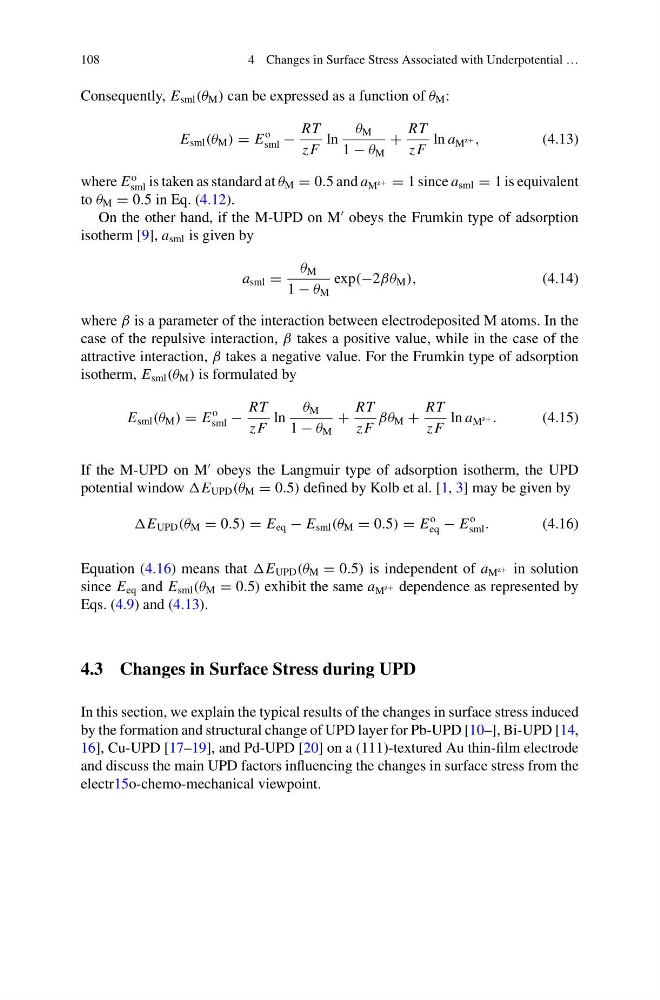
Consequently, E sml (θ M ) can be expressed as a function of θ M :
E sml (θ M ) = E
o
sml −
RT
z F
ln
θ M
1 − θ M
+
RT
z F
ln a M
z+ ,
(4.13)
where E
o
sml is taken as standard at θ M = 0.5 and a M
z+ = 1 since a sml = 1 is equivalent
to θ M = 0.5 in Eq. (4.12).
On the other hand, if the M-UPD on M
obeys the Frumkin type of adsorption
isotherm [9], a sml is given by
a sml =
θ M
1 − θ M
exp(−2βθ M ),
(4.14)
where β is a parameter of the interaction between electrodeposited M atoms. In the
case of the repulsive interaction, β takes a positive value, while in the case of the
attractive interaction, β takes a negative value. For the Frumkin type of adsorption
isotherm, E sml (θ M ) is formulated by
E sml (θ M ) = E
o
sml −
RT
z F
ln
θ M
1 − θ M
+
RT
z F
βθ M +
RT
z F
ln a M
z+ .
(4.15)
If the M-UPD on M
obeys the Langmuir type of adsorption isotherm, the UPD
potential window E UPD (θ M = 0.5) defined by Kolb et al. [1, 3] may be given by
E UPD (θ M = 0.5) = E eq − E sml (θ M = 0.5) = E
o
eq − E
o
sml .
(4.16)
Equation (4.16) means that E UPD (θ M = 0.5) is independent of a M
z+ in solution
since E eq and E sml (θ M = 0.5) exhibit the same a M
z+ dependence as represented by
Eqs. (4.9) and (4.13).
4.3 Changes in Surface Stress during UPD
In this section, we explain the typical results of the changes in surface stress induced
by the formation and structural change of UPD layer for Pb-UPD [10–], Bi-UPD [14,
16], Cu-UPD [17–19], and Pd-UPD [20] on a (111)-textured Au thin-film electrode
and discuss the main UPD factors influencing the changes in surface stress from the
electr15o-chemo-mechanical viewpoint.
4 Changes in Surface Stress Associated with Underpotential …
Consequently, E sml (θ M ) can be expressed as a function of θ M :
E sml (θ M ) = E
o
sml −
RT
z F
ln
θ M
1 − θ M
+
RT
z F
ln a M
z+ ,
(4.13)
where E
o
sml is taken as standard at θ M = 0.5 and a M
z+ = 1 since a sml = 1 is equivalent
to θ M = 0.5 in Eq. (4.12).
On the other hand, if the M-UPD on M
obeys the Frumkin type of adsorption
isotherm [9], a sml is given by
a sml =
θ M
1 − θ M
exp(−2βθ M ),
(4.14)
where β is a parameter of the interaction between electrodeposited M atoms. In the
case of the repulsive interaction, β takes a positive value, while in the case of the
attractive interaction, β takes a negative value. For the Frumkin type of adsorption
isotherm, E sml (θ M ) is formulated by
E sml (θ M ) = E
o
sml −
RT
z F
ln
θ M
1 − θ M
+
RT
z F
βθ M +
RT
z F
ln a M
z+ .
(4.15)
If the M-UPD on M
obeys the Langmuir type of adsorption isotherm, the UPD
potential window E UPD (θ M = 0.5) defined by Kolb et al. [1, 3] may be given by
E UPD (θ M = 0.5) = E eq − E sml (θ M = 0.5) = E
o
eq − E
o
sml .
(4.16)
Equation (4.16) means that E UPD (θ M = 0.5) is independent of a M
z+ in solution
since E eq and E sml (θ M = 0.5) exhibit the same a M
z+ dependence as represented by
Eqs. (4.9) and (4.13).
4.3 Changes in Surface Stress during UPD
In this section, we explain the typical results of the changes in surface stress induced
by the formation and structural change of UPD layer for Pb-UPD [10–], Bi-UPD [14,
16], Cu-UPD [17–19], and Pd-UPD [20] on a (111)-textured Au thin-film electrode
and discuss the main UPD factors influencing the changes in surface stress from the
electr15o-chemo-mechanical viewpoint.