

4.2 Underpotential Deposition (UPD)
107
ionic and metallic as suggested by Trasatti [5]. However, further study on the changes
in nature of surface M-M
bond as a function of θ is needed for better understanding
of UPD phenomena.
4.2.2 Equilibrium Potential of UPD and Adsorption Isotherm
At equilibrium, M-UPD on M
may be described by the following complete
discharging reaction:
M
z+
+ ze
−
M
= M ad
M
.
(4.7)
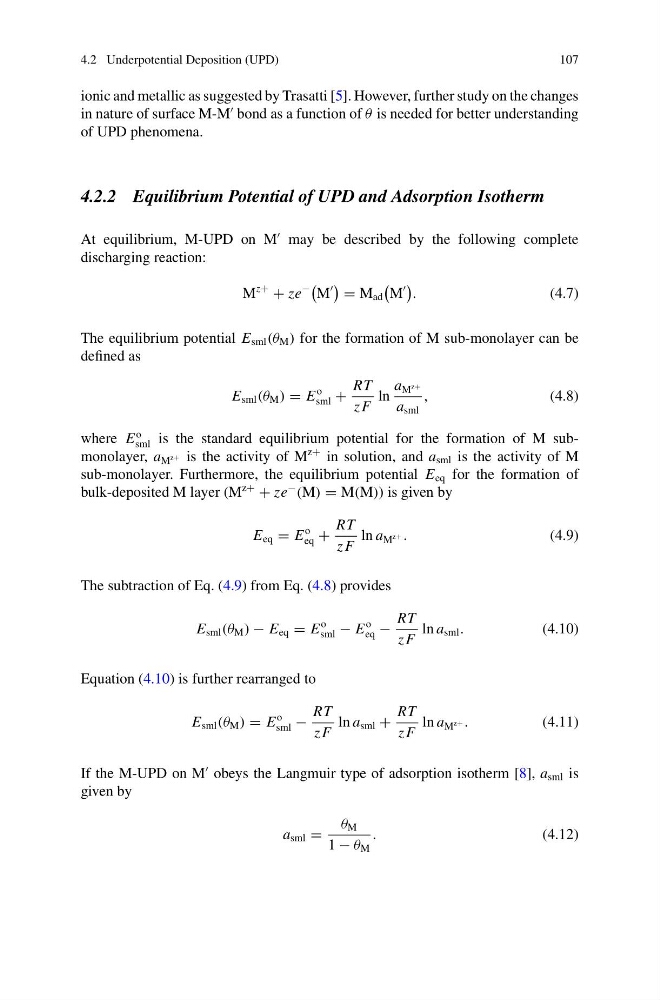
The equilibrium potential E sml (θ M ) for the formation of M sub-monolayer can be
defined as
E sml (θ M ) = E
o
sml +
RT
z F
ln
a M
z+
a sml
,
(4.8)
where E
o
sml is the standard equilibrium potential for the formation of M submonolayer, a M
z+ is the activity of M
z+ in solution, and a sml is the activity of M
sub-monolayer. Furthermore, the equilibrium potential E eq for the formation of
bulk-deposited M layer (M
z+
+ ze
−
(M) = M(M)) is given by
E eq = E
o
eq +
RT
z F
ln a M
z+ .
(4.9)
The subtraction of Eq. (4.9) from Eq. (4.8) provides
E sml (θ M ) − E eq = E
o
sml − E
o
eq −
RT
z F
ln a sml .
(4.10)
Equation (4.10) is further rearranged to
E sml (θ M ) = E
o
sml −
RT
z F
ln a sml +
RT
z F
ln a M
z+ .
(4.11)
If the M-UPD on M
obeys the Langmuir type of adsorption isotherm [8], a sml is
given by
a sml =
θ M
1 − θ M
.
(4.12)
107
ionic and metallic as suggested by Trasatti [5]. However, further study on the changes
in nature of surface M-M
bond as a function of θ is needed for better understanding
of UPD phenomena.
4.2.2 Equilibrium Potential of UPD and Adsorption Isotherm
At equilibrium, M-UPD on M
may be described by the following complete
discharging reaction:
M
z+
+ ze
−
M
= M ad
M
.
(4.7)
The equilibrium potential E sml (θ M ) for the formation of M sub-monolayer can be
defined as
E sml (θ M ) = E
o
sml +
RT
z F
ln
a M
z+
a sml
,
(4.8)
where E
o
sml is the standard equilibrium potential for the formation of M submonolayer, a M
z+ is the activity of M
z+ in solution, and a sml is the activity of M
sub-monolayer. Furthermore, the equilibrium potential E eq for the formation of
bulk-deposited M layer (M
z+
+ ze
−
(M) = M(M)) is given by
E eq = E
o
eq +
RT
z F
ln a M
z+ .
(4.9)
The subtraction of Eq. (4.9) from Eq. (4.8) provides
E sml (θ M ) − E eq = E
o
sml − E
o
eq −
RT
z F
ln a sml .
(4.10)
Equation (4.10) is further rearranged to
E sml (θ M ) = E
o
sml −
RT
z F
ln a sml +
RT
z F
ln a M
z+ .
(4.11)
If the M-UPD on M
obeys the Langmuir type of adsorption isotherm [8], a sml is
given by
a sml =
θ M
1 − θ M
.
(4.12)