

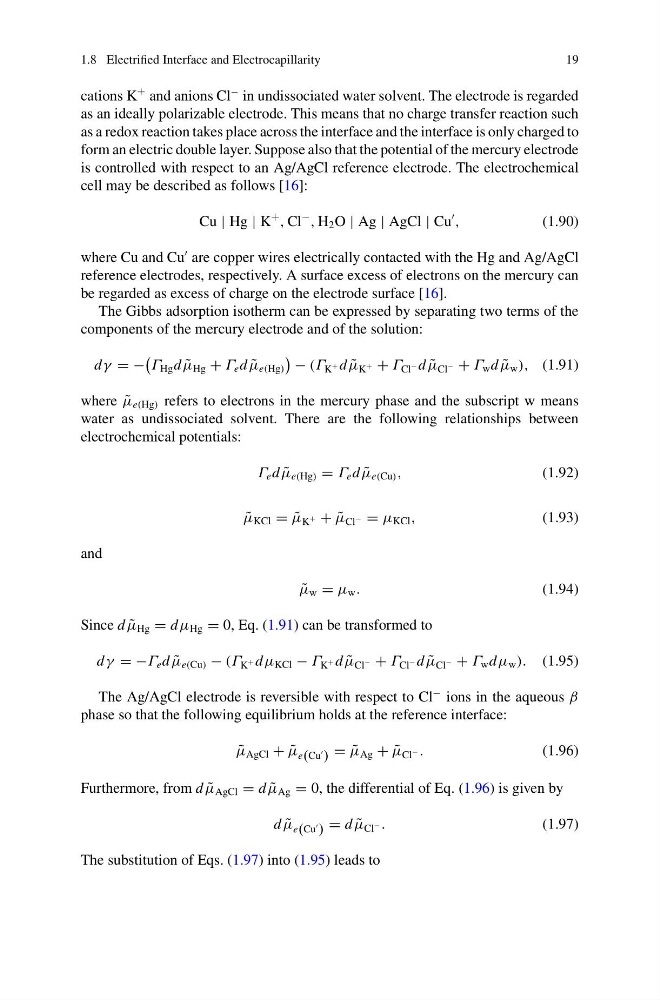
1.8 Electrified Interface and Electrocapillarity
19
cations K
+ and anions Cl
− in undissociated water solvent. The electrode is regarded
as an ideally polarizable electrode. This means that no charge transfer reaction such
as a redox reaction takes place across the interface and the interface is only charged to
form an electric double layer. Suppose also that the potential of the mercury electrode
is controlled with respect to an Ag/AgCl reference electrode. The electrochemical
cell may be described as follows [16]:
Cu | Hg | K
+
, Cl
−
, H 2 O | Ag | AgCl | Cu
,
(1.90)
where Cu and Cu
are copper wires electrically contacted with the Hg and Ag/AgCl
reference electrodes, respectively. A surface excess of electrons on the mercury can
be regarded as excess of charge on the electrode surface [16].
The Gibbs adsorption isotherm can be expressed by separating two terms of the
components of the mercury electrode and of the solution:
d γ = −
Γ Hg d ˜
μ Hg + Γ e d ˜
μ e(Hg)
− (Γ K
+ d ˜
μ K
+ + Γ Cl
− d ˜
μ Cl
− + Γ w d ˜
μ w ), (1.91)
where ˜
μ e(Hg) refers to electrons in the mercury phase and the subscript w means
water as undissociated solvent. There are the following relationships between
electrochemical potentials:
Γ e d ˜
μ e(Hg) = Γ e d ˜
μ e(Cu) ,
(1.92)
˜
μ KCl = ˜
μ K
+ + ˜
μ Cl
− = μ KCl ,
(1.93)
and
˜
μ w = μ w .
(1.94)
Since d ˜
μ Hg = d μ Hg = 0, Eq. (1.91) can be transformed to
d γ = −Γ e d ˜
μ e(Cu) − (Γ K
+ d μ KCl − Γ K
+ d ˜
μ Cl
− + Γ Cl
− d ˜
μ Cl
− + Γ w d μ w ). (1.95)
The Ag/AgCl electrode is reversible with respect to Cl
− ions in the aqueous β
phase so that the following equilibrium holds at the reference interface:
˜
μ AgCl + ˜
μ e(Cu
) = ˜
μ Ag + ˜
μ Cl
− .
(1.96)
Furthermore, from d ˜
μ AgCl = d ˜
μ Ag = 0, the differential of Eq. (1.96) is given by
d ˜
μ e(Cu
) = d ˜
μ Cl
− .
(1.97)
The substitution of Eqs. (1.97) into (1.95) leads to
19
cations K
+ and anions Cl
− in undissociated water solvent. The electrode is regarded
as an ideally polarizable electrode. This means that no charge transfer reaction such
as a redox reaction takes place across the interface and the interface is only charged to
form an electric double layer. Suppose also that the potential of the mercury electrode
is controlled with respect to an Ag/AgCl reference electrode. The electrochemical
cell may be described as follows [16]:
Cu | Hg | K
+
, Cl
−
, H 2 O | Ag | AgCl | Cu
,
(1.90)
where Cu and Cu
are copper wires electrically contacted with the Hg and Ag/AgCl
reference electrodes, respectively. A surface excess of electrons on the mercury can
be regarded as excess of charge on the electrode surface [16].
The Gibbs adsorption isotherm can be expressed by separating two terms of the
components of the mercury electrode and of the solution:
d γ = −
Γ Hg d ˜
μ Hg + Γ e d ˜
μ e(Hg)
− (Γ K
+ d ˜
μ K
+ + Γ Cl
− d ˜
μ Cl
− + Γ w d ˜
μ w ), (1.91)
where ˜
μ e(Hg) refers to electrons in the mercury phase and the subscript w means
water as undissociated solvent. There are the following relationships between
electrochemical potentials:
Γ e d ˜
μ e(Hg) = Γ e d ˜
μ e(Cu) ,
(1.92)
˜
μ KCl = ˜
μ K
+ + ˜
μ Cl
− = μ KCl ,
(1.93)
and
˜
μ w = μ w .
(1.94)
Since d ˜
μ Hg = d μ Hg = 0, Eq. (1.91) can be transformed to
d γ = −Γ e d ˜
μ e(Cu) − (Γ K
+ d μ KCl − Γ K
+ d ˜
μ Cl
− + Γ Cl
− d ˜
μ Cl
− + Γ w d μ w ). (1.95)
The Ag/AgCl electrode is reversible with respect to Cl
− ions in the aqueous β
phase so that the following equilibrium holds at the reference interface:
˜
μ AgCl + ˜
μ e(Cu
) = ˜
μ Ag + ˜
μ Cl
− .
(1.96)
Furthermore, from d ˜
μ AgCl = d ˜
μ Ag = 0, the differential of Eq. (1.96) is given by
d ˜
μ e(Cu
) = d ˜
μ Cl
− .
(1.97)
The substitution of Eqs. (1.97) into (1.95) leads to