

20
1 Surface Thermodynamics of Solid Electrode
d γ = −Γ e d ˜
μ e(Cu) + (Γ K
+ − Γ Cl
− )d ˜
μ e(Cu
) − (Γ K
+ d μ KCl + Γ w d μ w ). (1.98)
The surface charge density q on the metal side of the interface is
q = −FΓ e .
(1.99)
From the condition of electroneutrality for the interface, the charge density on the
solution side is equal to −q, that is,
−q = F(Γ K
+ − Γ Cl
− ).
(1.100)
Moreover,
d ˜
μ e(Cu) − d ˜
μ e(Cu
) = −Fd
Φ
Cu
− Φ
Cu
= −FdE − ,
(1.101)
where Φ
Cu and Φ
Cu
are the inner potentials of Cu and Cu
, respectively, and E − is
the potential of the mercury electrode with respect to the reference electrode. From
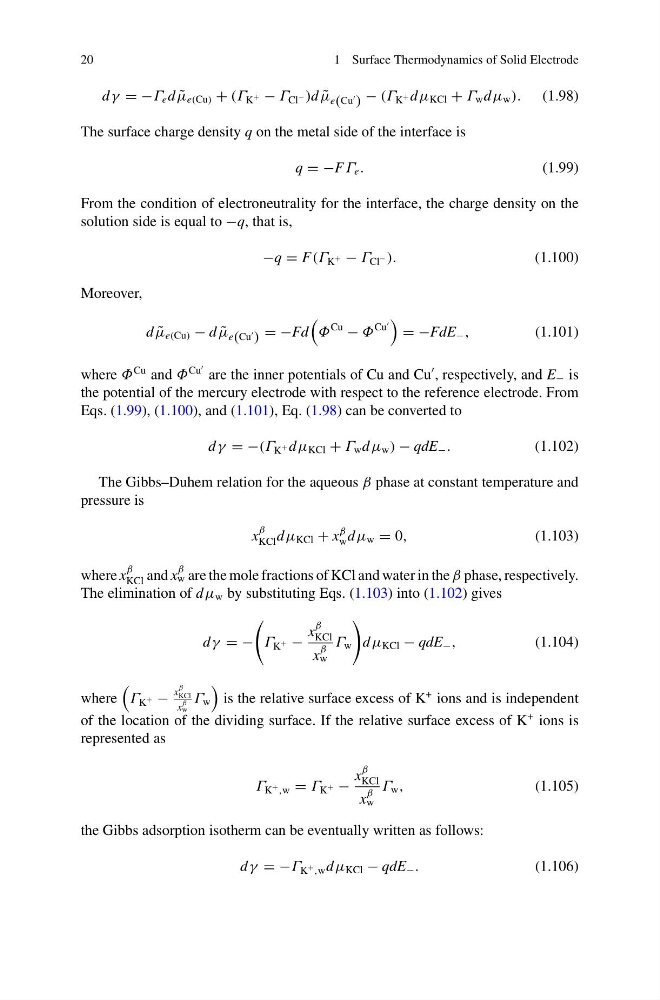
Eqs. (1.99), (1.100), and (1.101), Eq. (1.98) can be converted to
d γ = −(Γ K
+ d μ KCl + Γ w d μ w ) − qdE − .
(1.102)
The Gibbs–Duhem relation for the aqueous β phase at constant temperature and
pressure is
x
β
KCl d μ KCl + x
β
w d μ w = 0,
(1.103)
where x
β
KCl and x
β
w are the mole fractions of KCl and water in the β phase, respectively.
The elimination of d μ w by substituting Eqs. (1.103) into (1.102) gives
d γ = −
Γ K
+ −
x
β
KCl
x
β
w
Γ w
d μ KCl − qdE − ,
(1.104)
where
Γ K
+ −
x
β
KCl
x
β
w
Γ w
is the relative surface excess of K
+ ions and is independent
of the location of the dividing surface. If the relative surface excess of K
+ ions is
represented as
Γ K
+ ,w = Γ K
+ −
x
β
KCl
x
β
w
Γ w ,
(1.105)
the Gibbs adsorption isotherm can be eventually written as follows:
d γ = −Γ K
+ ,w d μ KCl − qdE − .
(1.106)
1 Surface Thermodynamics of Solid Electrode
d γ = −Γ e d ˜
μ e(Cu) + (Γ K
+ − Γ Cl
− )d ˜
μ e(Cu
) − (Γ K
+ d μ KCl + Γ w d μ w ). (1.98)
The surface charge density q on the metal side of the interface is
q = −FΓ e .
(1.99)
From the condition of electroneutrality for the interface, the charge density on the
solution side is equal to −q, that is,
−q = F(Γ K
+ − Γ Cl
− ).
(1.100)
Moreover,
d ˜
μ e(Cu) − d ˜
μ e(Cu
) = −Fd
Φ
Cu
− Φ
Cu
= −FdE − ,
(1.101)
where Φ
Cu and Φ
Cu
are the inner potentials of Cu and Cu
, respectively, and E − is
the potential of the mercury electrode with respect to the reference electrode. From
Eqs. (1.99), (1.100), and (1.101), Eq. (1.98) can be converted to
d γ = −(Γ K
+ d μ KCl + Γ w d μ w ) − qdE − .
(1.102)
The Gibbs–Duhem relation for the aqueous β phase at constant temperature and
pressure is
x
β
KCl d μ KCl + x
β
w d μ w = 0,
(1.103)
where x
β
KCl and x
β
w are the mole fractions of KCl and water in the β phase, respectively.
The elimination of d μ w by substituting Eqs. (1.103) into (1.102) gives
d γ = −
Γ K
+ −
x
β
KCl
x
β
w
Γ w
d μ KCl − qdE − ,
(1.104)
where
Γ K
+ −
x
β
KCl
x
β
w
Γ w
is the relative surface excess of K
+ ions and is independent
of the location of the dividing surface. If the relative surface excess of K
+ ions is
represented as
Γ K
+ ,w = Γ K
+ −
x
β
KCl
x
β
w
Γ w ,
(1.105)
the Gibbs adsorption isotherm can be eventually written as follows:
d γ = −Γ K
+ ,w d μ KCl − qdE − .
(1.106)